Well, Labor Day has come and gone, but considering God’s plan and purpose for us regarding labor is always appropriate. Work was imbedded into the purposes of God for mankind from day one. His first words to Adam and Eve included a mandate to work: “Be fruitful and multiply, and replenish the earth, and subdue it.” (Gen. 1:28) Further, in the expanded account of creation, recorded in Genesis 2, we read that “the Lord planted a garden eastward in Eden, and there he put the man whom he had formed…And the Lord God took the man, and put him into the garden of Eden to dress it and keep it.” (Gen. 2:8,15)
Work by the “sweat of thy face” was part of the curse placed upon mankind because of Adam’s disobedience to God. (Gen. 3:17-19) So, work is righteous, for it is the will of God for those of us who are His created beings. Through work, we shall eat bread, but God announces that “in sorrow shalt thou eat of it all the days of thy life.” It is righteous, for it is God’s will; and it is honorable, for it is the designed destiny of man, and it yields life-sustaining nutrients vital to our physical well-being.
Fast forward from the Garden to 2023, or even to 50 A.D. When Paul wrote his epistles, there were those, even then, who looked upon work with disdain. Paul quoted a Cretian poet when writing to Titus of the challenges he would face as a pastor on that island, where men were commonly known as “slow bellies.” That graphic term describes men who were indolent, slothful hogs. They enjoyed filling their bellies with food, but they refused to work for their fare. The Apostle acknowledged, when writing to the church at Thessalonica, that there were people there who were known as “working not at all.” (2 Thess. 3:10-12) Of these people Paul flatly stated that if they were not willing to work, they should not be afforded the privilege of eating.
There have always been men and women who refuse to live by wise King Solomon’s counsel, as written in Ecclesiastes 9:10, which was and is: “Whatsoever thy had findeth to do, do it with all thy might; for there is no work, nor device, nor knowledge, nor wisdom, in the grave whither thou goest.” (Prov. 9:10)
The wise king affirms that labor is good—labor done with a good attitude and a right spirit. Some years back, U.S. News and World Report reported that employees, on average, spent 34% of their paid time not working. This aversion to diligent labor is expressed in the following poem: “I wish I was a rock, sitting on a hill; doing nothing all day long, just a sittin’ still. I wouldn’t eat, I wouldn’t sleep, I wouldn’t ever wash, I’d just sit still a thousand years and rest myself by gosh!”
Well, the world has changed a good bit! In the days of Thomas Jefferson, someone in Philadelphia said that the work week should be 60 hours, or six 10-hour days, rather than the 72-hour work week they were accustomed to. Even the thought of trimming the standard work week down 12 hours caused quite a stir, as the longer work week had been common since the days of the Revolutionary War.
John Wesley, the 18th-century English preacher who founded the first Methodist church in the U.S. in 1784, knew nothing of a 72-hour work week. It is said that he preached three sermons a day for 54 years, traveling by horseback and carriage more than 200,000 miles. All the while, he authored a four-volume commentary on the whole Bible; a dictionary of the English language; a five-volume work on natural philosophy; a four-volume work on church history; histories of England and Rome; grammars on the Hebrew, Latin, Greek, French, and English languages; three works on medicine; six volumes of church music; and seven volumes of sermons and papers. He also edited a library of 50 volumes, known as the Christian Library—all of this while devoting himself to his pastoral ministry. Rising at 4 a.m., he would work solidly until 10 p.m. At age 83, he was chagrined that he could write no more than 15 hours a day without hurting his eyes. At age 86, he had to cut back from preaching three times a day to preaching just twice. In his 86th year, he preached in almost every town in England and Wales, often riding 30 to 50 miles a day! (Selected)
Harlow Curtis, who led General Motors in those golden years of 1953-58, was selected as Man of the Year in 1955 by Time. Here is how he spoke of a good work ethic: “Do it the hard way! Think ahead of your job, then nothing in the world can stop you. Do it better than it need be done; next time, doing it well will be child’s play. Let no one stand between you and the difficult task; let nothing deny you this rich chance to gain strength by adversity, confidence by mastery, success by deserving. Do it better than anyone else can do it. I know that sounds old-fashioned. It is, but it has built the world.”
Jesus said, “I must work the works of Him that sent me, while it is day: the night cometh, when no man can work.” (John 9:4) Those who name His name as our Lord ought to cultivate His attitude toward work. We must work the works of our Heavenly Father with the urgency that He had, because the time will come when we can work no more. We dare not be “slow bellies.” We must not allow others to work for our food when we are able-bodied and can work ourselves. We should work with a thankful attitude for work to do, and for the privilege of “keeping” our plot in the garden of His world. “Work for the night is coming, work through the morning hours; work while the dew is sparkling, work ‘mid springing flowers. Work when the day grows brighter, work in the glowing sun; work for the night is coming, when man’s work is done.” (Anna Coghill, Lowell Mason)
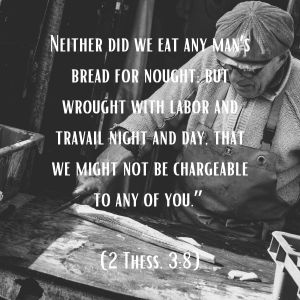
“Neither did we eat any man’s bread for nought; but wrought with labor and travail night and day, that we might not be chargeable to any of you.” (2 Thess. 3:8)
 YOU and GOD