Paul mentions in writing to the church at Corinth “the ordinances” that he had delivered to the church. (I Cor. 11:2) The context that follows his praise for the church in keeping the ordinances clearly indicates that one of them is what he calls “the Lord’s supper.” (I Cor. 11: 20) It is sometimes called “the Last supper,” or more often “Communion” or “the Lord’s Table.” The other “ordinance” that Christ commanded is what He instructed His disciples to do after they had made “disciples,” and that was “baptizing them in the name of the Father, and of the Son, and of the Holy Ghost.” (Matt. 28:19,20). So, in most evangelical churches, those two commands of Christ are regularly kept—baptism and the Lord’s supper—as the “ordinances.”
That the Lord’s supper was commanded can be seen in the Upper Room as Christ celebrated the Passover with His disciples on the way to the Garden of Gethsemane and then Calvary. “This do,” He said, as He broke the bread and then passed the cup. Paul would instruct the Corinthian church with “as often as ye eat this bread and drink this cup”; and he would also quote Christ’s Last supper words to the disciples, “this do in remembrance of me,” and “this do ye…in remembrance of me.” (I Cor. 11:24,25). So, clearly, the keeping of this ordinance is not an option, but rather a command originally uttered to His apostles, who would become the foundation of the Church He would build, and then reiterated by the Apostle Paul in instructing local churches. It is a mandate to local New Testament assemblies in all places and for all ages.
But what, then, is the meaning of it? It should be noted that in the Upper Room, Jesus said that the cup that He was passing was the “new testament in my blood which is shed for you.” (Luke 22) This “new testament” (or covenant) contrasts with the old covenant, which was by the blood of bulls and goats. The writer of Hebrews calls this “new covenant” a better covenant, unlike the old covenant which was “faulty,” (Hebs. 8:6ff.) administered by priests daily as a “shadow,” or figure, of the new covenant administered by Christ, our High Priest, “once for all” when He entered the holy place offering “one sacrifice for sins forever”—after which “He sat down at the right hand of God.” (Hebs. 10:10ff.). The bread and the cup, as served by Christ to His disciples at the Last supper, were symbolic of his body and blood, which would be the “once for all sacrifice,” sealing the establishment of a new and better covenant with better promises. The elements of the bread and cup were no more literal than was the door when Jesus said, “I am the door,” or the vine when He said, “I am the vine.” (John 10:7; 15:5).
What are some misunderstandings of the Last supper? Catholic theology and practice approach the “Eucharist” as a sacerdotal sacrament in which the participants—when eating the wafer (bread) and drinking the cup—are literally receiving the physical body and blood of Jesus. This is called “consubstantiation,” and there is no biblical basis for such a doctrine. Reformed groups, primarily Lutherans, hold to what is called “transubstantiation,” which states that the elements of the table, the bread and juice, do not literally become Christ’s body and blood, but that there is some mystical happening that in some way imparts grace to the participant. There is no biblical basis for this doctrine either. In receiving the elements of the table, no physical or non-physical change takes place to the elements or within the participants whereby grace is imparted. To teach that is adding, unjustifiably, to the Word of God through a faulty, false interpretation of the texts.
So, the Communion service, or Lord’s table, as Paul sets forth in I Cor. 11, is a somber, meaningful worship service in which each person is admonished to examine his or her own heart, remembering that Christ offered his body and blood on Calvary for the remission of our sins. To allow sin to govern our lives or dwell in our hearts—knowing that Christ shed His precious blood to provide forgiveness, cleansing, and victory over sin—is a serious matter. Each believer, remembering Calvary at Communion, and examining their heart and confessing any known sin, must approach the table in humility, repentance, thankfulness, and transparency, giving glory to God for the promises of the New Covenant sealed by the blood of Jesus on an old rugged cross.
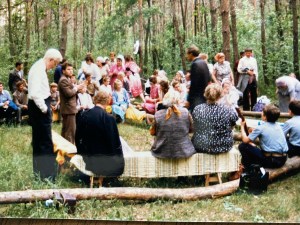
In June of 1989, it was my privilege to visit the Soviet Union with Evangelist Ed Nelson and Natasha Vins, daughter of former imprisoned Russian Baptist pastor, Georgi Vins. At that time, the Soviet Union had not fragmented, and Ukraine was still in what was known as Russia. We visited believers and worshipped in churches in Moscow, Kiev, Kharkov, Leningrad, and other cities. On Sunday, June 4, we met with a church in Kiev where 150 believers were present. The service began at 11 a.m. and concluded with the Lord’s table at 3:30 p.m. I mentioned in my notes that afternoon, concerning the “fruit of the vine,” which every person drank as the common cup was passed from person to person, that it “burned all the way down.” That evening we met in a forest clearing on the outskirts of town with another group of believers. Fallen tree limbs served as benches (pews) while Pastor Nelson preached a message on “The Ascension of Christ.” We stood and joined hands to close the service by singing “God Be With You Till We Meet Again.” Many Russian believers in those services, and in all the meetings we participated in on that trip, either had been in prison for their faith in Christ or had loved ones or pastors who had been. Communion on Sunday morning, June 4, 1989, in Kiev was as precious as communion this side of heaven could be.
“For as often as ye eat this bread, and drink this cup, ye do shew the Lord’s death till he come.” (I Cor.11:26)
 YOU and GOD