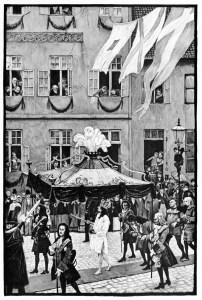
Maybe you remember the fairy tale by Danish Author Hans Christian Andersen, published in 1837, about a vain emperor who lived only for wearing new clothes, spending every moment and much of his kingdom’s capital on a new suit of clothes for every occasion, every day. His pride and obsession were to the detriment of his subjects and soldiers—those who were taxed to pay for their emperor’s foolish, faddish fanaticism.
One day a couple of rogue “weavers” visited the emperor and convinced him that they had discovered a new method of weaving cloth into the most beautiful garments ever admired by human eyes. They also convinced the ruler that only simpletons, or those not qualified to hold any position in his administration, would not be able to visually see these clothes. The deceived emperor at once hired the “weavers” to make a new outfit for him that he would wear at an upcoming national procession.
Over the next weeks the con men, in their assigned room, with two new looms in place, began to “weave” feverishly. Occasionally, the emperor would send his trusted minister, or a court officer, into the work room to see how the new outfit was coming along. All of these “scouts,” however, not wanting to be considered unfit for the emperor’s administration or, even worse, simpletons, came back with a glowing report that the new outfit was looking very good, even though none of them saw a single woven thread. They all agreed with the weavers’ tale that the threads were the most beautiful they had ever beheld. And, they responded to the weavers’ request for more gold ribbons, which, at night, they stashed away in their knapsacks.
Finally, the day of the procession came. The weavers had the emperor take his garments off while they pretended to take his new outfit out of the bag, then “putting it piece by piece” on the stark naked emperor. All the while, the deceived despot looked at himself in the mirror, and, not wanting to be considered a simpleton or unfit for the position of emperor, he too spoke with enthusiasm about his beautiful new suit of clothes, the finest he had ever worn.
Leaving the castle, now before the crowds, people gawked with amazement and wonder (none wanting to be considered a simpleton or unfit for a position) as the bare emperor with apparent pride strode before his subjects, who ooed and awed in utter disbelief.
Finally, though, one child in the crowd hollered out, “He hasn’t got anything on!” The words were whispered, then the words swept through the throngs until, at last, all were laughing and exclaiming their emperor was naked! Out of the mouths of babes and sucklings!
Pretty much, as a nation, we have been conned into saying that what we have seen we really haven’t seen!
It was just a slow start. Or, it was a bad night. It was 90 minutes that we will not let define our “emperor.”
But, most of us saw it. With our own eyes it was undeniable. With our ears, it was at times unbelievable. But there it was. For all to see. The whole world was watching our unveiled “emperor!” National and international audiences tuned in to behold the debacle.
But, did we really see it! Did we hear what we thought we heard? No, it was just a slow start, the emperor’s handlers would proclaim in chorus the next morning. You really didn’t see an emperor totally exposed! “It was just a bad night. Trust us! We are those who are closest to him. He is sharp as a tack!”
Step down? Not on your life! He is a good emperor, one of the finest . No matter that he appeared undressed that dreaded night. He had more than a dozen “weavers” spending an entire week getting him dressed up for this big night.
What you thought you heard, you did not hear. What you thought you saw, you did not see! He was all dressed up and outfitted specially for the occasion.
“Long live our emperor!” Wait, who said, ‘He hasn’t got anything on!’ Where is that trouble maker? Don’t believe those whisperers! What! The chorus is gaining momentum? Those are just more lies. Trust us, it was a great night for the emperor!”
“And with all deceivableness of unrighteousness in them that perish; because they received not the truth, that they might be saved. And for this cause God shall send them strong delusion; that they should believe a lie: that they all might be damned who believed not the truth, but had pleasure in unrighteousness.” (2 Thess.2:10-12)
 YOU and GOD