The Irish writer George Bernard Shaw skeptically wrote, “Kings are not born, they are made by universal hallucination.”
That may be true of some of the kings known to mankind throughout the history of nations. Many have ruled despotically, and their kingdoms were corrupt. Too many have had the attitude of Napoleon Bonaparte, who said, “What is the throne—a bit of wood gilded and covered with velvet. I am the State. France has more need of me than I of France.”
But this study is not concerned primarily with secular kings. I am writing with reference to two kinds of kings: those whose reigns and records are part of biblical history, specifically, the kings of Israel. Secondly, I am writing about another class of kings whose rule is yet future. These kings are born into the royal family through the new birth. Their rule is yet future. We read of them in Rev. 5:10: “And hast made us unto our God kings and priests: and we shall reign on earth.”
The lives of the Old Testament kings of Israel—their strengths and weaknesses, their faith and failures—can afford us lessons on how to prepare for our future reign with Christ. We can learn what to do and what not to do—and gain wisdom, learning important lessons—by looking at their lives.
This article focuses on Solomon, son of David. Saul reigned first, then David, then Solomon, and after Solomon’s reign the kingdom was divided into a northern sector, commonly called Israel, and a southern sector, known as Judah—comprised of just two tribes, Judah and Benjamin.
Solomon is the classic enigma as a person and as a king. No king before or after, in Biblical or in non-Biblical history, was his equal. He enjoyed more power, more wealth, more wisdom—more of everything—than any person born into this race called “human.” We will look briefly at his blessings, his blemishes, and his blame:
Blessings
- Solomon was blessed with immeasurable wealth. He was served by a host of subjects; he possessed a navy of ships; he enjoyed a worldwide reputation; he had a magnificent throne; his was a storehouse of gold and silver as well as other precious things. (I Kings 9:20,21; 26-28; 10:1ff.)
- He was also blessed with wisdom unsurpassed before or after him. He prayed for wisdom, and God gave him a “wise and understanding heart, so that there was none like thee before thee, neither shall any arise like unto thee. And I have also given thee that which thou hast not asked, both riches, and honor, so that there shall not be any among the kings like unto thee all thy days.” (I Kings 3:12,13)
Blemishes (I Kings 11:1-8)
- Solomon’s fundamental weakness was that he “loved many strange women.” The sins that he warned his son of (Proverbs 5 & 6) were the ones that he so lavishly embraced.
- Solomon compounded his sin of “loving” many strange women by willfully bringing these women into his home, the palace, ignoring God’s warning that “they will turn away your heart after their gods.” (I Kings 11:2)
- Solomon’s weakness and willfulness were followed by his wickedness in polygamy, taking 700 wives and 300 concubines, building for them a high place of abominable idolatry, so that it was plainly said, “Solomon did evil in the sight of the Lord.” (I Kings 11:6)
- All of the above resulted in Solomon’s woefulness: “For it came to pass, when Solomon was old, that his wives turned away his heart after other gods; and his heart was not perfect with the Lord his God, as was the heart of David his father.” (I Kings 11:4)
Blame
- God indicted Solomon severely for what he had not done, that is, he had not kept God’s commands: “’And the Lord was angry with Solomon, because his heart was turned from the Lord God of Israel, which had appeared unto him twice, and had commanded him that he should not go after other gods; but he kept not that which the Lord commanded.” (I Kings 11:10)
- God indicted Solomon, as well, for what he had done: “Wherefore the Lord said unto Solomon, forasmuch as this is done of thee…I will surely rend the kingdom from thee, and will give it to thy servant.” (I Kings 11:11)
Such is the sad saga of Solomon. “His morning sun rose beautifully; it sank in the evening clouded and dark.”
Of his wealth, world power, and wisdom, the visiting Queen of Sheba said: “It was a true report which I heard in mine own land of thine acts and wisdom; howbeit I believed not their words until I came, and mine eyes have seen it; and, behold, the one half of the greatness of thy wisdom was not told me.” (II Chr. 9:5,6)
In Ecclesiastes, Solomon catalogues his wealth, power, and pleasure as being limitless. Yet, his life ended dismally, with God pronouncing severe judgment upon his posterity. Five-hundred years later, Nehemiah remembers Solomon, not for his wisdom and righteous reign, but for his willful sin: “Did not Solomon king of Israel sin by these many things?” (Nehemiah 13:26)
Some takeaways from the study of Solomon’s sad saga: (1) A perfect environment, with every advantage known to man, is no guarantee that one will not fall into Satan’s trap; (2) Favor with God does not make one immune to succumbing to the weakness of the flesh, and yielding in disobedience to sin; (3) Sin comes with an astronomical price tag; (4) Wisdom (with knowledge) is no guaranteed shield against the fiery darts of the wicked one.
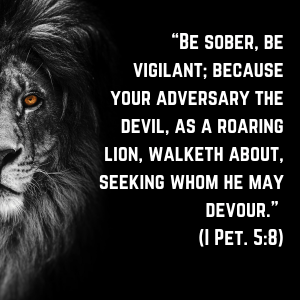
“Be sober, be vigilant; because your adversary the devil, as a roaring lion, walketh about, seeking whom he may devour.” (I Pet. 5:8)
 YOU and GOD