If someone asked whether you hoped to succeed or fail on your journey through life, you would surely respond positively with, “Well, I want to succeed.”
Nobody wants or plans to fail. “In the lexicon of youth,” one has said, “there is no such word as fail.”
But, if we could somehow survey all who first heard this message (which I delivered 41 years ago at Thompson Road Baptist Church in Indianapolis), it might be alarming to learn whether—looking back—they felt they had succeeded or failed in achieving their youthful dreams.
Many do fail, even if no one plans to. Some who read these lines just now may be in the process of failing. Things are not going the way you had planned. A third-century philosopher quoted another philosopher who spoke of this universal, age-old dilemma by saying, “It was a saying of Demetrius that men, having often abandoned what was visible for the sake of what was uncertain, have not got what they expected and have lost what they had.”
I believe Amaziah, ninth king of Judah after the kingdom split following Solomon’s death, did not plan to fail. He had every reason to succeed. With a good heritage from his father, Joash, who was for the most part a good king, his future looked bright. But before his 29-year reign ended, Amaziah was disgraced, and his whole reign was marked by a colossal failure.
This king of the past can serve for us, who are “kings and priests” of God, as a lesson on the dangers of success—success that leads to, and ends in, failure.
Consider, then, the rise and demise of King Amaziah, as recorded in II Chronicles 25 and II Kings 14.
The Rise of Amaziah
- We read that Amaziah was 25 years old when he began to reign. One of the first things he did, following his coronation, was to slay the servants who had murdered his father on his sick bed. Yet, in doing this, Amaziah showed a respect for the Word of God, for we read in II Chr. 25:4: “But he slew not their children, but did as it is written in the law in the book of Moses, where the Lord commanded, saying, ‘The fathers shall not die for the children, neither shall the children die for the fathers, but every man shall die for his own sin.’” In doing this, the newly crowned king of Judah acted as “the minister of God” in executing justice, but he did not step over the Biblical bounds in discharging his responsibility. He did not violate God’s sixth commandment: “Thou shalt do no murder.”
Shortly afterwards, Amaziah marshaled his troops, organizing an army of 300,000 men skilled in handling sword and spear. To augment that, he hired 100,000 soldiers out of Israel for 100 talents of silver. Whereupon, a prophet of God warned Amaziah, King of Judah, that he was making a mistake by hiring the soldiers of Israel, “for the Lord is not with Israel.” (II Chr. 25:7) The prophet predicted defeat should Amaziah go to war against Seir with the hired Israeli soldiers. Amaziah heeded the prophet’s warning, paid the soldiers from Ephraim what he had promised them, and, to their chagrin and in spite of their protests, sent them home. Amaziah and his thinned-down army then wrought a great victory over the Edomites. (II Chr. 25:11-13)
The Demise of Amaziah
- Inexplicably, coming home from the great military victory over the Edomites, God’s Word says “he brought the gods of the children of Seir, and set them up to be his gods, and bowed down himself before them, and burned incense unto them.” (II Chr. 25:14) God sent a prophet to rebuke Amaziah for this idolatry, and the king pretty much told the prophet to “shut up.” (II Chr. 25:16) The prophet complied, announcing to Amaziah that “God hath determined to destroy thee because thou hast done this, and hast not hearkened unto my counsel.”
The rest of the story is sad. Amaziah, swelled with pride following his resounding defeat of the Edomites, challenged Joash, king of Israel, to a fight. Joash tried to dissuade him with the thistle/cedar parable (25:18), but to no avail. The two kings/armies met, and Judah was “put to the worse,” fleeing every man to his tent. Amaziah was taken captive back to Jerusalem, where he watched as Joash sacked the city, pillaging treasures from the temple and taking hostages with him back to Samaria. Amaziah lived several more years, but in the end some of his subjects in Jerusalem conspired against him. Finding him in Lachish, to which he had fled, they slew him and returned his body back to Judah, where they buried him.
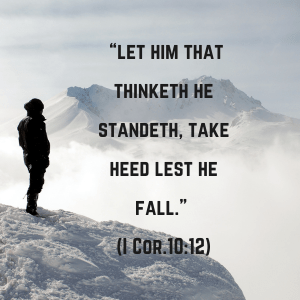
There is no understanding why this king, with such a brilliant beginning, turned from the Lord and brought on himself and his fellow Judeans such a colossal failure. It must fall under the heading, “The mystery of iniquity.” It defies reason or explanation. Pride was surely a factor; when the man of God warned Amaziah with a message from God, the king, pumped up following the massive defeat of tens of thousands of Edomites, would not even listen to the admonition. Thus, a king who had such a promising rise to power spent his last years in humiliation and defeat. So, “let him that thinketh he standeth, take heed lest he fall.” (I Cor.10:12)
“His own iniquities shall take the wicked himself, and he shall be holden with the cords of his own sins.” (Provs. 5:22)
 YOU and GOD
One thought on “The Rise and Demise of Amaziah (8th in a series on Kings and Priests)”