If you achieve every goal, reach the pinnacle of your profession, enjoy every imaginable luxury in life, and leave this world with banks full of money for your posterity—but fail to possess and practice what God calls wisdom—you will have been an utter failure.
God says: “The fear of the Lord is the beginning of wisdom.” (Provs. 9:10) Solomon, the wisest of mere men, expanded on the worth of wisdom: “Get wisdom, get understanding: forget it not; neither decline from the words of my mouth. Forsake her not, and she shall preserve thee; love her, and she shall keep thee. Wisdom is the principal thing; therefore get wisdom: and with all thy getting get understanding.” (Provs. 4:5-7)
Of course, Solomon was speaking of God’s wisdom, not man-centered wisdom, called by James “the wisdom that descendeth not from above.” (James 3:15) James characterized this worldly wisdom as that which is “earthly, sensual, devilish,” the fruit of which is “bitter envying and strife in your hearts, confusion and every evil work.” (James 3:14,16) Contrasted with that low-level wisdom, James goes on to characterize “wisdom that is from above” as being that which is ”first pure, then peaceable, gentle, and easy to be entreated, full of mercy and good fruits, without hypocrisy;” (James 3:17)—the fruit of which is “righteousness…sown in peace of them that make peace.” (James 3:18)
Wisdom is the principal thing, for here are some of the things that wisdom has accomplished since creation: It founded the earth; will bring man happiness; will yield length of days; will cause one to inherit glory; will preserve one’s being; will give one’s heart rest; will help a person to build a home and establish it; and will instruct the warrior on when and how to conduct war. (See Provs. 3:19; 3:13,16,35; 4:6,33; 24:3,6)
Where could you find something that would do all of the above? What would it cost? What in creation matches it?
T.S. Eliot—poet, playwright and literary critic—affirms that knowledge is not enough: “All our knowledge only brings us closer to our ignorance, and all our ignorance, closer to death, no closer to God. Where, then, is the life we have lost in living?”
The English preacher Charles Spurgeon clarified the difference between knowledge (“the fear of the Lord is the beginning of knowledge”) and wisdom: “Wisdom is the right use of knowledge. To know is not to be wise. Many men know a great deal, and are all the greater fools for it. There is no fool so great as a knowing fool. But to know how to use knowledge is to have wisdom.” (Provs. 1:7)
So, we need to fear God in order to get knowledge that squares with God’s truth; then we need wisdom in order to make use of the knowledge that we have acquired from God.
After listening to Job and Job’s friends, plus Elihu, God puts it all into His perspective: “Doth the hawk fly by thy wisdom, and stretch her wings toward the south?” (Job 39:26) “Shall he that contendeth with the Almighty instruct Him? (Job 40:2) And God uses illustrations from the natural world to demonstrate His incomparable wisdom. Jeremiah picked up that theme in his prophecy: “Yea, the stork in the heaven knoweth her appointed times; and the turtledove and the crane and the swallow observe the time of their coming.” (Jer. 8:7)
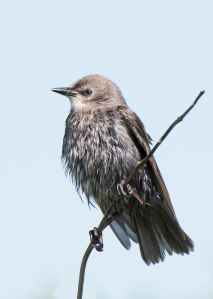
Here is a splendid example of the creative wisdom of the Almighty: “A tiny bird weighing less than half an ounce and only 5 to 5 and one-half inches long, the blackpoll warbler, takes off on its annual migration from the coast of North America to fly over the Atlantic and Caribbean of South America. Its ocean, nonstop flight is 2,300 miles, lasting an average of 86 hours. A scientist, Dr. Williams, in “Mysteries of Bird Migration”by Allan C. Fisher, Jr. (National Geographic, January 1979) says that the metabolic equivalent for a man of that nonstop flight would be to run four-minute miles continuously for eighty hours. During one part of its incredible journey, it will fly at the cold, oxygen-starved altitude of 21,000 feet in order to find favorable winds. In a year’s time, the blackpoll warbler may journey as much as 10,000 miles.” (copied)
The answer of God to Job and his “miserable friends,” continued in Job 39: “Knowest thou the time when the wild goats of the rock bring forth? or canst thou mark when the hinds do calve? Canst thou number the months that they fulfill? or knowest thou the time when they bring forth? They bow themselves; they bring forth their young ones, they cast out their sorrows. Their young ones are in good liking, they grow up with corn, they go forth and return not unto them.”
And, for the rest of Job 39 through chapter 41, God continues to take Job and the others to school. The result: “Then Job answered the Lord, and said, I know that thou canst do every thing and, and that no thought can be withholden from thee.” (Job 42:1,2)
Oh, the unsearchable wisdom of the Almighty! We can never achieve such knowledge or wisdom in our finiteness, but we can realize all the knowledge and wisdom that it pleases God to grant us from and through His matchless Word. Let us therefore “say unto wisdom, thou art my sister; and call understanding (our) kinswoman.” (Provs. 7:2)
“There is no wisdom but that which is founded on the fear of God.” (John Calvin)
 YOU and GOD