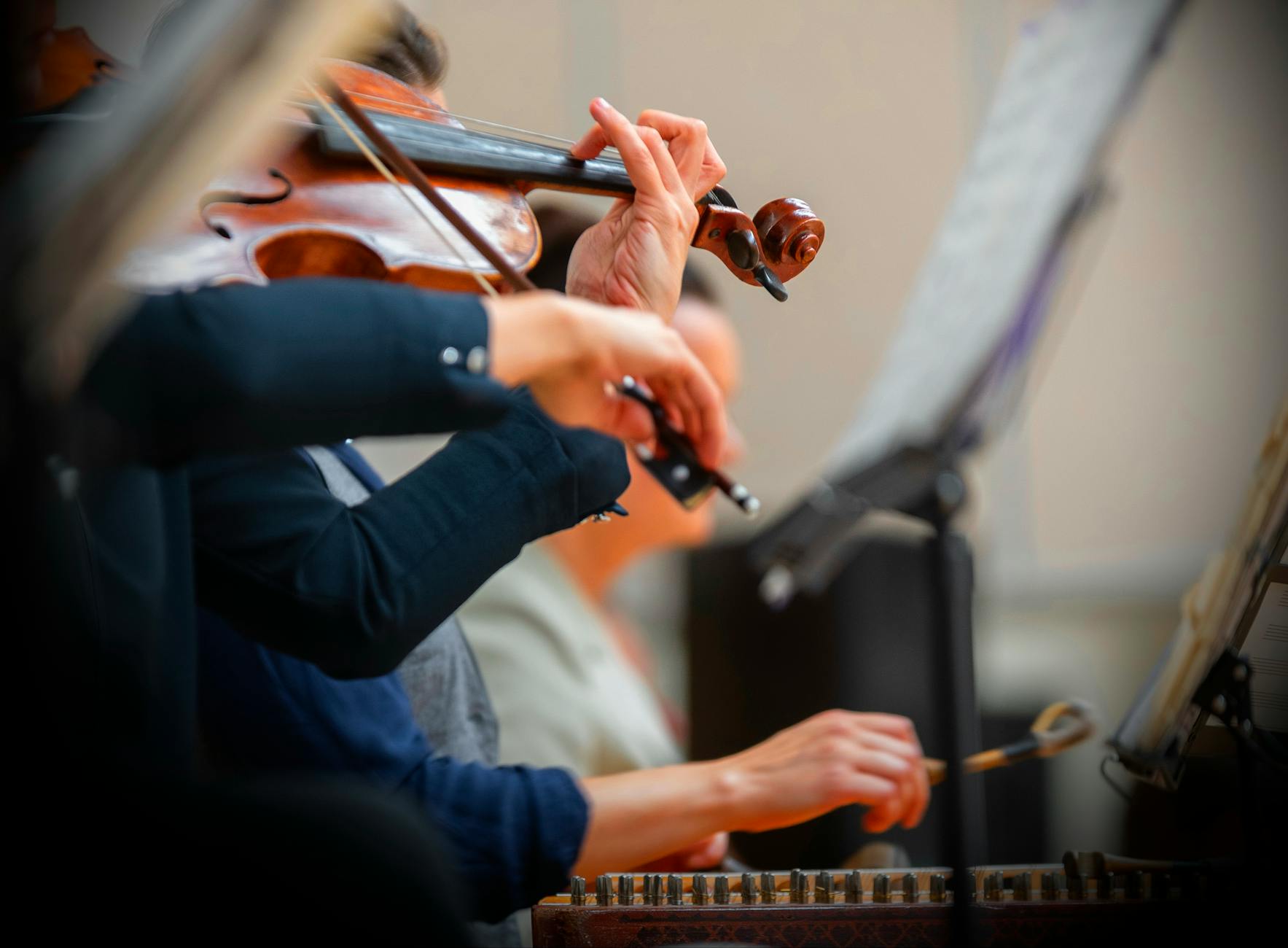
A great conductor was once asked: “What is the hardest position in your orchestra to fill?” His reply: “2nd fiddle. Everyone wants to fill the first chair, but not many enjoy being 2nd fiddle.”
Andrew, the apostle, was a man who in many ways was “2nd fiddle.”
He wrote no books that bear his name.
He preached no great sermons that were recorded for posterity.
He has no heroic endeavors or wise words attributed to him.
He was not chosen to go with Jesus into the Garden of Gethsemane to pray, just prior to the arrest and subsequent crucifixion of Jesus.
Unlike his brother Peter, Andrew was not chosen to accompany John and Peter with Jesus to the Mount of Transfiguration, where Christ’s unveiled glory was made manifest to His inner-circle of followers.
His only claim to fame, one might say, is that he was Simon Peter’s brother!
Andrew was one of those very special people who, like many in life, are best known because they are the brother or sister of so and so, or someone’s son or daughter.
Some might resent that role; but the gospels give no hint that Andrew entertained an ounce of resentment because he lived in the shadow of the towering figure of his brother, Simon Peter.
He was, in many respects, a model disciple. Though we have only two or three brief snapshots of him in scripture, and only a handful of words are attributed to him, enough is said and seen of Andrew to reveal a man whose character and conduct merit, in many ways, emulation. Note with me the life, labors, and last of Andrew:
- The Life of Andrew.
- With his brother, Simon, he was a fisherman. Jesus, walking by the Sea of Galilee, saw “Simon, and his brother, casting a net into the sea, for they were fishers.” (Mark 1:16)
- They hailed from Bethsaida, a town on the north shore of Galilee, near where Jesus fed 5,000 and where He also healed a blind man. (John 1:44) Jesus denounced this fishing village (also home to Phillip), along with Capernaum and Chorazin, for its unbelief: “Woe unto thee Chorazin! Woe unto thee Bethsaida; for if the mighty works had been done in Tyre and Sidon which have been done in you, they had a great while ago repented, sititing in sackcloth and ashes.” (Luke 10:14,15)
- Andrew was a disciple of John the Baptist. (John 1:36-40) He believed the kingdom of Heaven was at hand (Matt.3:2) and was baptized by the “Baptizer” to identify with this kingdom message and messenger. John announced the coming of one whose shoe latchet he was not worthy to stoop down to loose, one whom He would identify as “the Son of God, the Lamb of God.” (Mark 1:7; John 1:34-36)
- Andrew was one of the first followers of Jesus, calling Him “Rabbi” and announcing to his brother that “we have found the Messiah.” (John 1:38-41)
- The Labors of Andrew.
- Andrew was a soul-winner. (John 1:41) Think of all that Peter did; the thousands that were saved at Pentecost; the multiplied millions who have read his epistles. When you consider all that Peter did, never forget it was Andrew who FOUND and brought Peter to Jesus. The testimonies of men like D.L. Moody and C.H. Spurgeon can often be traced back to an otherwise unknown, unseen, and unsung believer who had a burden to share the gospel message—which, in turn, was driven by God’s Holy Spirit into the hearts of men who would, in turn, broadcast it to the world for His kingdom’s sake.
- He was a serious student of God’s Word. (Mark 13:3)
- He was a man of humility. Peter was named before Andrew in every list of the apostles, and in many respects Andrew’s identity was that he was the brother of Simon Peter. “Grace humbles a man without degrading him, and exalts a man without inflating him.”
- He was a man of faith, cf. John 6:8.
- He was a man of compassion and love. (John 12:20-22) The first and last glimpse of Andrew in the gospels is that of him bringing someone to meet Jesus.
- The Last of Andrew (according to “extra-biblical” records and tradition).
- He is said to have taken the gospel to Russia, Greece, Asia Minor, and Turkey.
- He lived to be old and died a martyr’s death in A.D. 69.
“In the city of Patras, in Achaea, Greece, Andrew’s missionary work was very successful. Many turned to him including Maximilla, wife of the Roman proconsul Aegeas. Enraged at Andrew’s success in the city—and especially in his own household—Aegeas ordered Andrew to lead the people in a sacrifice to a heathen god. Refusing to do so, Andrew was beaten severely and then crucified, on a X-shaped cross. He was fastened with cords rather than nailed on so that he would linger longer in death. While on the cross for two days, Andrew preached to the people, praising God and exhorting his listeners to repentance and faith. After his death, Maximilla, the wife of the proconsul, claimed Andrew’s body and buried it with loving care.” (copied/unknown)
“Fear none of those things which thou shalt suffer: behold, the devil shall cast some of you into prison, that ye may be tried; and ye shall have tribulation ten days; be thou faithful unto death, and I will give thee a crown of life.” (Rev. 2:10)
 YOU and GOD