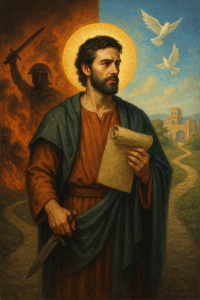
To understand the apostle who is called “the zealot,” it is necessary to know something of the party after which he was named, the Zealots.
The Zealots were a nationalistic group of extremists before and after the time of Christ’s ministry on the earth. The main goal of the party was the overthrow—by any means possible—of Roman rule in Palestine. They were fiercely bent on restoring “divine” rule, and they were intensely “religious.”
Whereas the Scribes and Pharisees—religious groups that were also prominent in the same time period—were either indifferent or resigned to Roman rule, the Zealots refused to accept and acknowledge foreign domination of their motherland. They despised Rome and thought of them as “the enemy.” One of their leaders gathered about himself a large and mostly young following at about the time that Jesus was 10 or 11 years of age. Their slogan was “No God but Jehovah, No tax but the Temple tax, No Friend but a Zealot.” To advance their cause, they resorted to terrorist tactics.
It was one of these Zealots, named Simon the Canaanite or Simon Zelotes (Matt. 10:4; Acts 1:13), that Jesus called to follow Him—one of the chosen 12. His name occurs only four times in the Bible, and each of these times he’s only mentioned in a list of the 12 Apostles.
Yet, though nothing of significance is said about Simon, the Zealot, there are several things a careful contemplation of God’s Word will reveal.
First, he had a saving faith in Jesus Christ. He knew that his “good works”—even on behalf of his beloved motherland, if indeed those works could have been considered “good”—were not going to “pass muster” at the Judgment Bar of God Almighty. He was saved, like every other person who has ever been saved, by believing through faith in Jesus as Lord, and then by confessing Him and calling upon Him for salvation—all of grace. (Eph. 2:8,9)
After Simon was called and ordained by Christ as an apostle, he was sent out with the other apostles on preaching missions, during which endeavors Simon exercised the “signs of an apostle.” (II Cor. 12:12) These included casting out demons, raising the dead, healing the sick and, on occasion, speaking in tongues. But none of these apostolic wonder-works saved Simon; he was only a sinner, saved by grace!
Simon, when called by Christ to be His follower, left family and friends. He was, like his compatriot apostles, willing to forsake all to follow Christ. (Matt.19:27) When the time came, he obeyed Christ’s commission to go on a preaching/healing/miracle-working tour for His kingdom’s sake. (Matt. 10:5,6) The field for these men was the Jewish field of Israel—which, Jesus said, were “lost sheep.” (Matt. 10:6) Their message: “The kingdom of Heaven is at hand.”
There is never an indication that Simon, having put his hand to the plow, ever looked back. His life as a Zealot was past; his mission as an apostle was ever and always present and future. On the first appearance of Jesus to the apostles after the resurrection, Judas Iscariot and Thomas were absent; Simon, though, was present. He was with the Apostles watching Christ ascend up into the heavens. (Acts 1:11) He met with the 120 in a room in Jerusalem, waiting for the coming of the Holy Spirit, as Christ had instructed them to do. Simon was in the number of willing, watching, waiting followers of Jesus.
Simon the Zealot met Christ, was converted—and his life was radically transformed. His battles with blades would be abandoned for a fight for the faith with the Sword of the Spirit, the Word of God. His greatest ambition after conversion to Christ would no longer be national, but spiritual. His first concern would be about a heavenly rule rather than an earthly reign. His affections would be set on things above and not on things of the earth. Now he would not be a zealot against something; he would be zealous for Someone.
Simon would recognize Caesar as someone to whom he ought to pay taxes, as Christ had wisely taught; but he would bow to Christ as One for whom He would be willing to die and, like Paul, his mantra would be “For me to live is Christ, to die is gain.” (Phil. 1:21)
Those whom Simon at one time hated and felt murder in his heart for, now—as one of His—he loved and longed to see accept the One as Savior Who would make them “new creatures.” Rather than working against them, Simon would—with his heart, head, and hands—work for their deliverance from Satan’s bondage.
Simon would never write a New Testament epistle or preach a powerful message recorded for the ages, as did Peter on the day of Pentecost. But he was faithful unto death and, like most of the apostles, he died, according to history, a martyr’s death.
His mark—many may have thought to have been minor—but forevermore his name will be engraved on one of the 12 foundations of the heavenly, holy city, the New Jerusalem.
Not too shabby for a former Zealot, huh?
“And the wall of the city had 12 foundations, and in them the names of the 12 apostles.” (Rev. 21:14)
 YOU and GOD