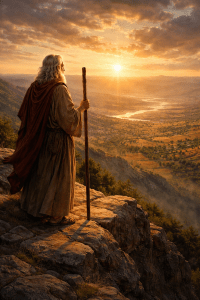
One of the most unusual deaths in all of recorded history is that of Israel’s great emancipator, Moses.
In fact, the record of it—as given in Deuteronomy 34—is singularly strange in itself. For if we believe that Moses wrote the first five books of the Bible, it seems that Moses pre-recorded the facts of his burial. That is not impossible, for God’s Holy Spirit is the author of all scripture. But no one would argue that it is not unusual! It is more probable, though, that Joshua later added the account of the death and burial of Moses.
His death is unusual in other respects. God buried him, we are told. Then, Jesus’s brother Jude informs us in his epistle that the Devil and Michael, the archangel, fought over the body of Moses. Why they fought is not known. Some conjecture that it had to do with the appearance of Moses with Elijah at the Mt. of Transfiguration. (Matt.17) But there is some truth in the assessment by one writer that “there is a special secret and mystery regarding the burial of Moses that would be a profanity to disturb.”
Without disturbing that mystery now, consider with me what we can know about his death:
1) The disqualification of Moses: The greatest leader this side of heaven that Israel has ever known was denied setting foot into the “Promised Land” because he “sanctified me not in the midst of the children of Israel.” (Deut. 32:51) Plain and simple, it was a matter of disobedience in striking the rock for water rather than speaking to it as God commanded. It harkens to what Samuel the prophet said to the disobedient King Saul later on in the history of God’s people: “Wherefore then dost thou not obey the voice of the Lord?” (I Sam. 15:19)
To obey is better than sacrifice. Disobedience in both cases came with a terrible price. Moses could view the promised land from afar but could not set foot onto it; Saul was rejected as King. Not only was the sin of disobedience in play here, but also the root cause of all disobedience—the sin of disbelief. When Moses—who had been told by God to speak to the rock—smote it with the rod in his hand, God said: “Because ye believed me not, to sanctify me in the eyes of the children of Israel…therefore ye shall not bring this people into the land which I have given them.” (Num. 20:8-12) Some centuries later, the Apostle to the Gentiles would share that he constantly gave attention to keeping “under my body and bring it into subjection—lest that by any means when I have preached to others, I myself should be a castaway.” (I Cor. 9:27) Disobedience, the offspring of disbelief, comes with a horrendous price-tag—and that price is often disqualification.
2) Consider with me also the disappointment of Moses. God took him to the top of Mt. Nebo and showed him all the land of Gilead, then said to the great leader: “This is the land which I sware unto Abraham…I have caused thee to see it with thine eyes, but thou shalt not go over thither. So Moses the servant of the Lord died there in the land of Moab.” (Deut. 34:4,5) Do you think that Moses said (to himself), “That’s all right—at least I got to see the land, and my successor, Joshua, will get to go in and set foot there, and I am so happy for him!” Not on your life! Moses had to have been sorely disappointed when he died! His dream of a lifetime would not be fully realized! His place as the leader was forsaken; his plans of going into the long anticipated land were abandoned; and his privileges as the Lord’s guide in this most thrilling last leg of the 40-year journey were forfeited.
3) Finally, we come to the death of Moses—a death mandated by God as to its time and place. We each have a time and place to die—for our times are in His hands. The prophet’s eyes were not dimmed, nor was his natural force abated. He was not crippled nor hard of hearing. One poet said that God “kissed him, withdrew his breath, and took him.” His passing was followed by weeping and mourning for thirty days. Moses had lived 120 years. He was buried in a valley of Moab and succeeded by his protégé and hand-picked successor, Joshua.
So, there is sweet sorrow in reading of the last days of this larger-than-life figure out of the pages of Old Testament history. His life was such a saga of greatness; yet one definable act of disobedience brought about the sorrow surrounding his death—buried by God, yes, but buried in the plains of Moab, the land of a people that perpetually hated Moses and his kind. A story strangely, sweetly kind.
Something surely can be learned here. No matter what mountain peaks you have trekked in through life’s journey, you have not gotten so far up that disobedience to God will not bring you down. You can be forgiven; but the awful price of sin, with its unalterable consequences, will still need to be dealt with. “And there arose not a prophet since in all Israel like unto Moses, whom the Lord knew face to face.”(Numbers 34:10)
“Hath the Lord as great delight in burnt offerings and sacrifices, as in obeying the voice of the Lord? Behold, to obey is better than sacrifice, and to hearken than the fat of rams.” (I Sam. 15:22)
 YOU and GOD