Kings and Priests, Then and Now (1st in a series)

Revelation 5:10 reads: “And hath made us unto our God kings and priests: and we shall reign on the earth.” That was a revelatory peek into heaven recorded by the apostle John as he saw and heard a great throng of redeemed of every kindred, tongue, people, and nation singing a new song of victory, in which they praised God for their redemption through His being slain, but also for their reclamation for His kingdom in which they are going to serve as kings and priests on earth. (Rev. 5:8-10) If you are reading this and are one of His redeemed, blood-bought believers, this fore-glimpse of the heavenly throng before the Lamb includes you and speaks to your eternal future.

There are noteworthy contrasts between the Old Testament kingdoms of Judah and Israel, with their combined total of 39 kings, plus their myriad priests, and the kings and priests mentioned in Rev. 5:10:

In the kingdom of old, kings reigned; believers of this dispensation look forward to a kingdom in which “we shall reign on earth.” (Rev. 5:10b; Rev. 20:6)

Yet, we have already been made kings: “He hath made us unto our God kings and priests.”

Saul was anointed king before he actually wore the crown and reigned; David was made king long before he actually wore the crown and reigned as king.

Old Testament kings reigned under God and for God; we shall reign under God and with Christ: “…and they lived and reigned with Christ a thousand years.” (Rev. 20:4b) Jesus is said to have “on His vesture and on His thigh a name written— “KING OF KINGS, AND LORD OF LORDS.” (Revelation 19:16)

Old Testament kings reigned on earth and had literal thrones; we shall reign with Christ, and our domain will be literal, physical, and spiritual: “And I saw thrones, and they sat upon them, and judgment was given unto them…and they lived and reigned with Christ a thousand years.” (Rev. 20:4). “To him that overcometh will I grant to sit with me in my throne.” (Rev. 3:21)

What an unspeakable privilege to be called, even now, kings and priests. But, with unspeakable privileges come great responsibilities. We ought to act like kings and priests; to think like kings and priests: “But ye are a chosen generation, a royal priesthood, a holy nation, a peculiar people; that ye should shew forth the praises of Him who hath called you out of darkness into His marvelous light.” (I Pet. 2:9) Note: it is not that we shall be a holy nation and a royal priesthood; Peter says we “are” that now!

With these thoughts as a basis, I want to look at some of the Old Testament kings, keeping in mind what Paul said: “For whatsoever things were written aforetime were written for our learning, that we through patience and comfort of the scriptures might have hope;” and “Now all these things happened unto them for ensamples; and they are written for our admonition, upon whom the ends of the world are come.” (Rom. 15:4; I Cor. 10:11) So, we can and should benefit from a study of these monarchs of old—all allowed to fill their place in history through the providential working of a sovereign God—so that, by His grace, we might avoid some of their weaknesses and embrace some of their strengths, as we even now prepare for our future reign as kings on earth in the millennium, with and for the King of kings and Lord of Lords, Jesus Christ.

By way of review, the first King of Israel was Saul, followed by David and then Solomon. Following Solomon’s death, the kingdom was divided into a northern confederacy of 10 tribes; and two tribes in the southern sector, Judah and Benjamin, most often referred to as Judah, the dominant of the two. The capital of the southern kingdom was Jerusalem, and the capital of the northern kingdom, usually referred to as Israel, was Samaria. The division of the kingdom occurred about 975 B.C. with Rehoboam, son of Solomon, acceding to the throne of Judah, and Jeroboam becoming the 1st king of the northern confederacy of Israel.

There were a total of 20 kings of the northern confederacy, beginning with Jeroboam and continuing until 722 B.C. when, because of rank apostasy and total idolatry, God allowed the kingdom of Assyria to carry Israel away captive: “For the children of Israel walked in all the sins of Jeroboam which he did; they departed not from them.” (2 Kings 17:22) “And they rejected his statutes and his covenant that he made with them…and they followed vanity and went after the heathen that were round about them…and they left all the commandments of the Lord their God, and made them molten images.” (2 Kings 17:15,16) Every one of the 20 kings who ruled over Israel from Jeroboam to Hoshea were said to have done “evil in the sight of the Lord.”

Rehoboam led the list of kings of the southern sector of the divided kingdom, ruling from Jerusalem, after the northern ten tribes split off under Jeroboam. 18 kings would follow in procession after him until 605-586 B.C., when Nebuchadnezzar and his Babylonian armies sacked the city and carried off many of the Jews into a 70-year captivity. Of the 19 kings who ruled from Jerusalem, beginning with Rehoboam and continuing until Zedekiah (2 Kings 24:19), all but 8 were said to have “done evil in the sight of the Lord.” The “good” kings of Judah were Asa, Jehoshaphat, Joash, Amaziah, Uzziah, Jotham, Hezekiah, and Josiah. (Most of the deeds of all of these kings are recorded in I & II Kings and II Chronicles.)

Stay tuned for future installments in this series of “Kings and Priests, Then and Now.”

And I saw thrones, and they sat upon them, and judgment was given unto them…and they lived and reigned with Christ a thousand years. (Rev.20:4) “Blessed and holy is he that hath part in the first resurrection: on such the second death hath no power, but they shall be priests of God and of Christ, and shall reign with him a thousand years.” (Rev. 20:6)

“I Will Come Again”

My sister and I had been staying with our grandmother in a small town in southeastern Iowa for a couple of days, having been left there by our parents, who assured us they would be back to pick us up on a certain day. That day had come, and our eyes were glued on the top of a hill that marked the edge of that little town, looking for the familiar family car to come over that hill and down the main street of the town, stopping at grandmother’s house to pick us up. Two days in this little place with our dear grandmother, who surely tried every way imaginable to make us feel at home, including a trip to the general store to get a stick or two of candy, was about all it took to make us homesick! So we longed to see our mother and father come over that yonder hill as they had promised they would.

Centuries before, Jesus, meeting with His disciples in an Upper Room somewhere in Jerusalem, promised them that though He would be separated from them for a time, He would come back to receive them unto Himself, so that they could be “Home” with Him in the Father’s house, where there were many mansions. That promise became the watchword of the early church and has remained so to this present day: “Jesus is coming again!” 

A Scottish preacher spoke of the promise of His return: “The doctrine of the Lord’s second coming, as it appears in the New Testament, is like a lofty mountain that dominates the entire landscape.” Author and Baptist preacher A.J. Gordon commented on that statement: “No matter what road you take, no matter what pass you tread, you will find the mountain bursting on your vision at every turn of the way, and at every parting of the hills. What first struck me in reading the New Testament was this: Whatever doctrine I was pursuing, whatever precept I was enforcing, I found it fronting toward and terminating in the hope of the Lord’s second coming. All paths of obedience and service lead to that mountain.”

Pastor and Bible teacher John MacArthur contrasted the first and second comings of our Lord and Savior: “The first time, He came veiled in the form of a child. The next time He comes, and soon we believe it will be, He comes unveiled and it will be abundantly clear and immediately clear to all the world just who He is. The first time He came, a star marked His arrival. The next time He comes, the whole heaven will roll up like a scroll and all the stars will fall out of the sky, and He Himself will light it. The first time He came, wise men and shepherds brought Him gifts; the next time He comes, He will bring gifts, rewards for His own. The first time He came, there was no room for Him. The next time He comes, the whole world will not be able to contain His glory. The first time He came, a few attended His arrival—some shepherds and wise men. The next time He comes, every eye shall see Him. The first time He came as a baby. Soon He will come as Sovereign King and Lord.” (Sermon, “The Alpha and the Omega”)

Jesus will come for His Church—and, later, with His Church. These two are often simply referred to His second coming: phase one, the rapture or catching up of the church to be with Christ; phase two, the coming back to the earth with His church to establish His millennial reign on earth. Between the first and second phases of His coming, there will be a seven-year period of tribulation on earth (outlined in Revelation 6-18). These seven years will consist of three series of judgements levied by God upon the earth: seven seal judgements, seven trumpet judgements and, just before His return to earth in power and great glory, seven bowl judgements. It will be an unspeakably awful time to be alive on the earth. For instance, the seven bowl judgements are (1) a noisome and grievous sore inflicted upon all who have the mark of the beast and worship his image; (2) the seas turn to blood and all sea-life dies; (3) the rivers and waters turn to blood; (4) men will be scorched with great heat; (5) there will be darkness that causes people to gnaw their tongues for pain; (6) the Euphrates river will be dried up, so that the kings of the east can march through to the Middle East for war; (7) a great earthquake, unlike none other of all time, will occur, along with 100-pound hailstones falling upon men out of the heavens, resulting in men blaspheming God. (Rev. 16:1-12; 17-21)

The only way to make certain that YOU will not be alive on earth to witness any of the aforementioned universal calamities is to put your trust in Jesus Christ as Savior today. After He told the disciples in the Upper Room that He was coming back to receive them unto Himself, He said, “I am the Way, the Truth, and the Life: No man cometh unto the Father, but by Me.” (John 14:6)

Are you ready for His return? Are you looking for His return? Today is the day of salvation. Trust Christ. Take Him at His word. Believe. Receive the gift of God, which is eternal life. The Bible says that whoever calls upon the name of the Lord will be saved. (Rom. 10:13) You can be one of the “whosoevers!”

Looking for that blessed hope, and the glorious appearing of the great God and our Savior Jesus Christ.” (Titus 2:13)

Ancient Wisdom For Today’s Nations

In a recent post, I spoke to the Biblical admonition found in Psalms 9:17: “The wicked shall be turned into Hell, and all the nations that forget God.”

America has forgotten God. It didn’t happen overnight. Our 16th President faithfully raised the warning when he said that a nation (1) Cannot bring about prosperity by discouraging thrift; (2) Cannot strengthen the weak by weakening the strong; (3) Cannot help the small man by tearing down the big man; (4) Cannot help the poor by destroying the rich; (5) Cannot lift the wage earner by pulling down the wage payer; (6) Cannot keep out of trouble by spending more than our income; (7) Cannot further brotherhood by inciting class hatred; (8) Cannot establish sound security on borrowed money; (9) Cannot build character and courage by taking away a person’s initiative; and (10) Cannot really help people by having the government tax them to do for them what they can and should do for themselves.

Those wise words from a highly esteemed leader of a nation that was at war with itself should be heard and heeded yet today.

But centuries before Lincoln penned the aforementioned principles, another wise sage wrote something that will be universally true as long as time lasts. Job, in a discourse that overflows with emotion, having lost every earthly possession by a Satanic blast; and having been ill-advised by his wife to “curse God and die”; and having been falsely accused by the three men in the world that he thought were his friends, burst out with 10 profound, timeless truths that God governs His creation by, world without end:

  1.  “He increaseth the nations, and destroyeth them: He enlargeth the nations and straighteneth them again.” (Job 12:23) God is sovereign over all and rules with an unseen hand in all the affairs of men, nationally and personally. Egypt, Babylon, Greece, Rome, Italy, Germany, England—a long line of once world powers have “bitten the dust” of history. (That unseen hand spared former president Trump from certain and sudden death at a political rally on July 13, 2024, in Butler, PA.)
  2. God works powerfully and irresistibly to arrange and rearrange the stage of history. Job 12:14: “Behold, He breaketh down, and it cannot be built again: He shutteth up a man and there can be no opening.” (Example: Richard Nixon’s rise to and fall from power; elected by a landslide to a second term in 1972, he left office in disgrace in August of 1974. God tightened up the screws on a powerfully corrupt administration, and many of Nixon’s cohorts ended up in prison.)
  3. God uses draughts, floods, and natural calamities to shake the nations. Job 12:15: “Behold, He withholdeth the waters and they dry up: also He sendeth them out, and they overturn the earth.”
  4. God uses truth or even error to accomplish His divine purposes. Job 12:16: “With Him is strength and wisdom: the deceived and the deceiver are His.” (For instance, the wicked shenanigans of Joseph’s brothers…”But as for you, ye thought to do evil against me, but God meant it unto good.” Gen.50:20.) 
  5. Lawyers and judges are His pawns. Job 12:17: “He leadeth counsellors away spoiled, and maketh the judges fools.” Who would not agree that many fools today sit on judicial benches, calling good evil and evil good?
  6. Kings and princes are not beyond His reach. Job 12:19: “He leadeth princes away spoiled, and overthroweth the mighty.”
  7. Men of great renown will not be able turn around the nation against whom the Lord in judgement is set. Job 12:20: “He removeth away the speech of the trusty, and taketh away the understanding of the aged.”
  8. Powerful politicians and rulers are no match for His might. Job 12:21: “He poureth contempt upon princes, and weakeneth the strength of the mighty.”
  9. God ultimately exposes all evil plots of darkness. Job 12:22: “He discovereth deep things out of darkness, and bringeth out to light the shadow of death.”
  10. Men of great power will be brought low under His mighty hand. Job 12:24,25: “He taketh away the heart of the chief people of the earth, and causeth them to wander in a wilderness where there is no way. They grope in the dark without light, and He maketh them to stagger like a drunken man.” 

Job’s message in response to His “miserable” friends is as pertinent today as it was when he first spoke it thousands of years ago. America is bleeding, and the wound could be a mortal one. But there IS HOPE!

Not, however, in social or political or economic reform, but in soul-scraping repentance! God can and will once again bless America, but only when “my people which are called by my name shall humble themselves and pray, and seek my face, and turn from their wicked ways; then will I hear from heaven and forgive their sin and will heal their land.” (II Chr. 7:14)

Put them in fear, O Lord: that the nations may know themselves to be but men. Selah.” (Psalm 9:20)

One is as Good as Another

One excuse, it has been said, is as good as another. The Duke of Wellington is credited with saying that “a person good at making excuses is seldom good at anything else.” And George Washington Carver said, “99% of failures come from people who have the habit of making excuses.”

An inmate at the Butte County Jail in California explained his brief absence from jail to skeptical sheriff’s deputies thusly: “I was practicing pole-vaulting and got too close to the wall and fell over the wall; when I regained my senses, I ran around trying to find my way back; but being unfamiliar with the area, I got lost and the next thing I knew I was in Chico.”

That makes about as much sense as this explanation for why fire trucks are red: “Fire trucks have four wheels and eight men. Four and eight are 12 and there are 12 inches in a foot. A foot is a ruler. Queen Elizabeth is a ruler, and her ships sail the seven seas. Seas have fish and fish have fins and Finns fought the Russians, who are always red. Since fire trucks are always ‘rushin’…therefore, fire trucks are red!”

A pastor, evidently exasperated by hearing one excuse after another, wrote to an aspirin company: “Dear Sir: You manufacture aspirins that relieve sufferings, colds, and fevers. The mixture used in your tablets makes it possible for people to get out of bed and fight off headaches, bad nerves, and muscle-spasms. I have noticed these tablets work wonders on Monday, Tuesday, Wednesday, Thursday, Friday, and especially on Saturday, BUT, people who take them on Sunday seem to get no relief. They cannot get rid of their aches and pains and are not able to attend Sunday School and Church. Is it possible to put in an ingredient that will work on Sunday?”

Jesus dealt with worn-out excuses when He walked amongst His own here on earth. One of the most absurd was resorted to by Pharisees, who had excused the neglect of their aged parents by saying that the money it would cost to support them was money that they had dedicated to God; or, as they would put it, “It is corban—a gift to God.” Therefore, they had no money with which to care for their parents. Jesus cut the props out of this super-pious excuse by saying that when they said this they were “making the Word of God of none effect.” (Mark 7:13)

Does such silliness resonate with anyone in today’s world, where people, often those who consider themselves church members in good standing, never bother to support their local church financially, offering up all sorts of excuses for why they just cannot afford to part with their money to support God’s visible work on earth?

Solomon spoke of the slothful person, who—too lazy to get out of bed or out of the house to go to work—would say, “There is a lion in the way; a lion is in the streets.” (Provs. 26:13) Again, one excuse is as good as another.

Someone compiled a list of the “10 most used excuses”: 1) I forgot; 2) No one told me to go ahead; 3) I didn’t think it was that important; 4) Wait until the boss comes back so we can ask him; 5) I didn’t know you were in a hurry for it; 6) That’s the way we’ve always done it; 7) That’s not in my department; 8) How was I to know that this was different?; 9) I’m waiting for an OK; 10) That’s his job, not mine.”

I once read: “Once upon a time there was a church staff looking for teachers for their young people, children, and preschoolers for the new Sunday School year.

And some adults said, ‘I don’t want to leave the sweet fellowship and study of my adult class,’ but the drug pusher on the street said, ‘Not even the threat of jail will keep me from working with your children.’

And some adults said, ‘We have to be out of town too often on weekends,’ but the porn dealer said, ‘We’re willing to stay in town weekends, too, to accommodate your children.’

And some adults said, ‘I’m unsuited, unable to work with children or preschoolers,’ but the movie producer said, ‘We’ll study, survey, spend millions to produce whatever turns kids on.’

And some adults said, ‘I could never give the time required to plan and to go to teachers’ meetings.’ But the pusher, the porn dealer, and movie producer said, ‘We’ll stay open whatever hours are necessary every day to win the minds of your kids.’

So the adults stayed in their classes and enjoyed the sweet fellowship and absorbed the good Bible study, and could go out of town often on the weekends, and were available to do whatever was good to do in place of teachers’ meetings.

And when Sunday came, the children came to their classes and no one was there except the church staff going from one room to the next, trying to assure the children that someone would surely come to teach them. But no one ever came, and the young children and the preschoolers soon quit coming because they had gone to listen to others who did care about the things they did and what went through their minds.” (Vero Christian Church Newsletter)

One excuse is as good as another! Selah.

And he (Jesus) said unto them, ‘Full well ye reject the commandment of God, that ye may keep your own tradition.’” (Mark 10:9)

Undressed and Unaware

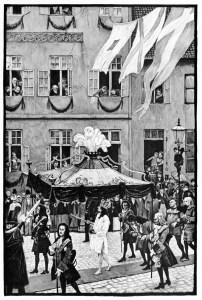
Maybe you remember the fairy tale by Danish Author Hans Christian Andersen, published in 1837, about a vain emperor who lived only for wearing new clothes, spending every moment and much of his kingdom’s capital on a new suit of clothes for every occasion, every day. His pride and obsession were to the detriment of his subjects and soldiers—those who were taxed to pay for their emperor’s foolish, faddish fanaticism.

One day a couple of rogue “weavers” visited the emperor and convinced him that they had discovered a new method of weaving cloth into the most beautiful garments ever admired by human eyes. They also convinced the ruler that only simpletons, or those not qualified to hold any position in his administration, would not be able to visually see these clothes. The deceived emperor at once hired the “weavers” to make a new outfit for him that he would wear at an upcoming national procession.

Over the next weeks the con men, in their assigned room, with two new looms in place, began to “weave” feverishly. Occasionally, the emperor would send his trusted minister, or a court officer, into the work room to see how the new outfit was coming along. All of these “scouts,” however, not wanting to be considered unfit for the emperor’s administration or, even worse, simpletons, came back with a glowing report that the new outfit was looking very good, even though none of them saw a single woven thread. They all agreed with the weavers’ tale that the threads were the most beautiful they had ever beheld. And, they responded to the weavers’ request for more gold ribbons, which, at night, they stashed away in their knapsacks.

Finally, the day of the procession came. The weavers had the emperor take his garments off while they pretended to take his new outfit out of the bag, then “putting it piece by piece” on the stark naked emperor. All the while, the deceived despot looked at himself in the mirror, and, not wanting to be considered a simpleton or unfit for the position of emperor, he too spoke with enthusiasm about his beautiful new suit of clothes, the finest he had ever worn.

Leaving the castle, now before the crowds, people gawked with amazement and wonder (none wanting to be considered a simpleton or unfit for a position) as the bare emperor with apparent pride strode before his subjects, who ooed and awed in utter disbelief.

Finally, though, one child in the crowd hollered out, “He hasn’t got anything on!” The words were whispered, then the words swept through the throngs until, at last, all were laughing and exclaiming their emperor was naked! Out of the mouths of babes and sucklings!

Pretty much, as a nation, we have been conned into saying that what we have seen we really haven’t seen!

It was just a slow start. Or, it was a bad night. It was 90 minutes that we will not let define our “emperor.”

But, most of us saw it. With our own eyes it was undeniable. With our ears, it was at times unbelievable. But there it was. For all to see. The whole world was watching our unveiled “emperor!”  National and international audiences tuned in to behold the debacle.

But, did we really see it! Did we hear what we thought we heard? No, it was just a slow start, the emperor’s handlers would proclaim in chorus the next morning. You really didn’t see an emperor totally exposed! “It was just a bad night. Trust us! We are those who are closest to him. He is sharp as a tack!”

Step down? Not on your life! He is a good emperor, one of the finest . No matter that he appeared undressed that dreaded night. He had more than a dozen “weavers” spending an entire week getting him dressed up for this big night.

What you thought you heard, you did not hear. What you thought you saw, you did not see! He was all dressed up and outfitted specially for the occasion.

“Long live our emperor!” Wait, who said, ‘He hasn’t got anything on!’ Where is that trouble maker? Don’t believe those whisperers! What! The chorus is gaining momentum? Those are just more lies. Trust us, it was a great night for the emperor!”

And with all deceivableness of unrighteousness in them that perish; because they received not the truth, that they might be saved. And for this cause God shall send them strong delusion; that they should believe a lie: that they all might be damned who believed not the truth, but had pleasure in unrighteousness.” (2 Thess.2:10-12)

All The Nations That Forget God

“I am a nation of unparalleled prestige and prosperity. A vast network of highways tie together every major city that is stretched under my flag. Magnificent public buildings and edifices stand as monuments to my greatness. The citizens of my domain are much like the citizens of every country. Humanism has influenced society in every way. Homes are collapsing; women are demanding more rights. The government is taking control in areas once reserved for cities and states. People are complaining about housing shortages, soaring rents, congested traffic, polluted air, crime in the streets and the high cost of living. Unemployment is a perennial problem. To solve it, government has created a mass of civil service jobs, including building inspectors, health inspectors and tax collectors.”

What is my name? America? No, that description was written of the great Roman Empire of the 1st century A.D.!

Rome ruled the world but could never conquer herself—and was finally brought to ruin. It was destroyed not from without but from corruption within; devastated not militarily but spiritually.

She was a “great nation” but a godless nation; and a nation that is godless is never truly great.

Before Rome dominated the world, Greece did. Alexander the Great conquered the known world of his day—just 300 years before Christ. Greece, like Rome, was destined to self-destruction, for the Greeks were equally godless. They tried to build an ideal society on the premise that “man is the measure of all things.” The human body was the object of Greek worship. Deformed or weak children were thrown over the cliffs. Seven-year-old boys were sent off to train for war. Like the Roman government, bureaucracy reigned supreme in Greece. Medicare for all citizens was tax-financed. Red tape and taxation were a way of life. Before the end came, there was even a tax levied on the tax!*

Greece ignored God, worshipped the creature rather than the creator, and fell to God’s judgment.

America, our beloved America, has ascended to heights of power, prestige, and prosperity excelling any nation, past or present. But on this 248th anniversary of our independence day, we stand at a crossroads!

In 1620, Pilgrims came to the shores of this continent under a charter, signed by King James I of England, for the purpose of “advancing the enlargement of the Christian religion to the glory of God Almighty.”

In 1638, the 13 colonies in the Rhode Island Charter affirmed the goal of government thusly: “We submit our persons, lives and estates unto our Lord Jesus Christ, the King of Kings and Lord of Lords, and to all those perfect and most absolute laws of His given to us in His Holy Word.”

We were indeed “One Nation Under God!” Our first president, at the age of 20, prayed, “Almighty God, most merciful Heavenly Father, since Thou art a God of pure eyes and wilt be sanctified in all who draw near unto Thee; Who dost not regard the sacrifice of fools, nor hear sinners who tread in Thy courts…Be our God and Guide this day and forever for His sake who lay in the grave and rose again for us—Jesus Christ, our Lord. Amen.”

That’s why America has been singularly blessed; God has blessed her because we have been One Nation Under God. We’ve invoked His blessings; we’ve acknowledged His sovereignty! We’ve stamped His name on our currency and acknowledged His sovereignty in our Constitution.

We are not great because of what we have; we have what we have because we are great! And we have been great because we have paid allegiance to the living God and His Son, Jesus Christ. As Alexis de Tocqueville said, when he visited our country to find out why we were so blessed: “America is great because America is good; and if America ever ceases to be good, America will cease to be great.”

America is not a nation like Rome and Greece that never knew God; we have known Him, but we have forgotten Him!

  • We’ve known a day in America when every preacher of the gospel believed the Bible was the Word of God;
  • We’ve known a day in America when every seminary professor believed in the virgin birth of Jesus Christ;
  • We’ve known a day in America when in every public school you could find a copy of the Word of God, and when it was more common to hear it read from than not;
  • We’ve known a day in America when murderers were executed for their crime, and when mothers were not afraid to stroll through public parks with their babies; and when pornography and homosexuality were words most of could not spell much less speak;
  • We’ve known a day when men elected to public office were basically honest men whose number one interest was America—and life, liberty, and the pursuit of happiness for all;
  • We’ve known a day in America when, because Bible morality ruled, a man’s word was his honor;
  • We’ve known a day in America when mothers felt that rearing children and ruling as Queen in the home was the highest calling under heaven known to women;
  • We’ve known a day in America when children were expected to obey parents, respect elders, and render honor to their teachers;
  • We’ve known a day in America when to hear a band playing the Star Spangled Banner, carrying Old Glory, would bring goosebumps to the back of our necks;
  • We’ve known a day in America when Sunday was considered a HOLY day; when stores did not traffic in all sorts of merchandise and when people thought it more important to attend church worship services than to attend everything else under the sun;
  • We’ve known a day when government was considered to be the protector not the persecutor of the people—a day when an American could walk anywhere in the world safely and proudly without fear of being spat upon, kidnapped, shot, or arrested on phony charges;
  • We’ve known a day when a dollar would buy more than a loaf of bread;

Yes, we’ve known these days in America! But we cannot say that all is well today in our beloved Motherland! Freedom’s torch is not burning so brightly as once it was. Somehow, we forgot along the way that what we sow, we reap; that “the wicked shall be turned into Hell, and all the nations that forget God” (Ps. 9:17); and that “righteousness exalts nation” (Provs. 14:34).

May God help us. May God bless America.

*Note: The above text is, in part, a message I delivered in 1982 at Thompson Road Baptist Church—more than 40 years ago! Some of the material is not original with me, but I am not sure which is and which is not. If it was true then, how much more so today. Let us repent as a people and beg God for His mercies yet again.

May your 4th of July be filled with good memories, solemn reflections, and heartfelt prayers. 

Pastor Anthony Slutz

Grandma Moore

She was born well before the turn of the 20th century, lived through the terrible Great Depression, rearing four children without her husband who died in 1922, and witnessed two World Wars, and the Vietnam war. She was a grandmother that, due to unavoidable circumstances on her part, I knew mostly from a distance. But her character, faith and quiet spirit of determination still influences my life though she has been “resting” in her eternal habitation now for 47 years.

She was always a bit unknown to me, and still is, so when I was called upon to conduct her memorial service in 1977 while pastoring in Newton, Kansas, at a graveside service in a little cemetery in southeastern Iowa, I quoted a poem that I could not have fully appreciated the truth of: “God has not promised skies always blue, flower strewn pathways all our lives through…But God has promised strength for the day, rest for the labor, light for the way; grace for the trials, help from above, unfailing sympathy, undying love.” (Annie Johnson Flint)

And Grandma Moore had a bundle of trials. She was pregnant with her fourth child when her husband died of what was believed to have been complications from the flu that he had suffered with during the 1918 flu pandemic that claimed 675,000 lives in the U.S. He was a farmer, so after his death, Grandma sold the farm and moved to the small town of Stockport, IA. She somehow managed to eke out a living by housekeeping for people, earning a dollar a day. Her only son, Robert, enlisted in the Army and served with distinction. Her daughters, including my mother, survived until they graduated from high school and married, my mother at the age of 17; she and my father enjoyed 72 years of marriage together; and though married at a very young age, God gave Mom a husband who loved her dearly and, as best he could, provided for her every need.

Back to Grandma Moore. When the children were gone from the home, she took jobs caring for aged people, often living in with them as a caregiver. This made visits with her few and far between–until she finally retired and moved to Ottumwa into a house close to ours. I was a teenager by then, and after basketball and baseball, (no time then for girls) getting to make up for lost time in knowing Grandma Moore was not high on my list. I remember she read the newspaper word for word, and would verbalize, in soft but distinguishable sounds each word, reading out loud to herself. It pretty much drove a kid into another room! But, she read the Bible, too, and always faithfully attended church services with us. She never drove a car in her life.

I do not know when she became a Christ-one. It was thought to have been during a revival meeting. In those early decades of the 20th century, churches in small towns would often band together to invite an evangelist in for a revival meeting. There were Methodist and Baptist churches, and some Presbyterians, and regardless of the denominational title, churches of that era generally believed the fundamentals of the faith, even though differing on modes of baptism and eschatological matters, as well as church polity. So an evangelist that preached faith and repentance, usually an evangelist with fire in his bones, could preach to the whole town and often there were many conversions. We think our grandmother was saved in such a meeting, but she never had the opportunity of attending a Bible-preaching church where she could hear good Bible doctrine taught until later in life, though no one doubted that she loved God, His Word and His Son. No one else in her birth family was ever known to have trusted Christ.

As I have indicated, her early struggles in life as a single parent, left with four children to provide for, made her a woman of strength and independence. To her dying day, she adamantly refused governmental programs designed to assist the elderly. Thankfully, she was always in pretty good health until, at the ripe old age of 87, she dropped dead in her kitchen, probably of heart failure or a stroke. Once, she visited us (Ellen and me) when we lived in Minnesota. I was going to seminary and working full-time, so when I heard her call my name in the middle of the night saying, “Tony, bring me a spoon-full of baking soda in a glass of water,” I dutifully, half asleep, got up and went to the medicine cabinet and put my hands on a box of powder that was on the top shelf, stirring up a spoon-full of its powdery contents– still half asleep—in a glass of water, taking it to Grandma.  Back to bed, and then more awake, it dawned on me that baking powder was probably not in the medicine cabinet. I woke Ellen up long enough to ask her what it was that was in the box on the top shelf of the medicine cabinet, and found out that it was indeed not baking soda, but rather 20 Mule-Team Borax powder! I was gripped with fear. Would grandma live through the night? Should I tell her what she had just drunk? I chose to wait until morning and was so very glad to see her up and getting ready for breakfast. Her first words to me were, “Tony, you saved my life last night. Thanks for bringing me that baking soda.” I am sure I mumbled “You’re welcome,” and you can be sure that Grandma never ever knew that she drank a glass of 20 Mule-Team Borax powder!

When I pastored in Kansas in the early 70’s Grandma got to visit with us a couple of weeks. Ellen will never forget that during that visit Grandma taught her the art of making the best homemade yeast rolls ever! Nor will she forget walking by the bedroom seeing Grandma Moore on her knees in prayer. We were thankful that the Grandmother that was known to most of us only from a distance become better known and dearly loved during those brief but blessed visits.

Interestingly, when Evangelist Bill Hall held a revival meeting in our home church in Ottumwa, Iowa, Grandma Moore kept him and Shirley (motels were usually not an option in those years). I know they must have enjoyed some of those homemade rolls and some of the jelly that she would can each summer.

Well, I have spent a bit extra time and space on this personal post. I hope you have endured to the end and, maybe, have enjoyed the reflections. Thanks for taking the time to read.

She looketh well to the ways of her household, and eateth not the bread of idleness. Her children arise up, and call her blessed….”(Provs.31:27,28a)

“I Passed!”

Those words, “I passed,” introduced a missionary prayer letter that our missionary in the Far East sent to supporting churches 20 years ago. With those words, he told a story about a member of their church who had taken a series of medical exams required for her to continue in her profession at a higher level of practice. He wrote: “She failed them. Instead of cutting back on her service in the church to prepare for her second try, she increased her service. She also added a three-hour Bible course to her schedule. Moreover, when two of those exams came on a Sunday afternoon, she did not miss church. The results? 1) Her influence among the young adults has helped move them forward, spiritually; 2) She passed her exams. It has been a blessing to be her pastor.”

Sharing a brief word of exhortation to the first-century church in Smyrna, Jesus encouraged this steadfast flock with these words: “Be thou faithful unto death, and I will give thee a crown of life.” (Rev. 2:10)

Paul could say, on the eve of his death at the hands of a Roman executioner, “I have fought a good fight, I have finished my course, I have kept the faith.” (II Tim. 4:7)

Fans of horse racing say that the greatest race ever run was the 1973 Kentucky Derby. Secretariat not only won, he gained speed the longer he ran—completing each successive quarter mile faster than the one before.

We may not get faster, but those who are “running the race” set before us are praying that the longer the race lasts, the more patient we will become, compassed about with a great cloud of witnesses who have run their race before us; laying aside every weight, and the sin which doth so easily beset us; running with patience the race that is set before us, and “looking unto Jesus.” (Hebrews 12:1,2) Let us run, then, getting stronger.

And, let us finish! David Livingstone was 14 years in Africa, serving faithfully, before he witnessed his first conversion. William Carey, known as the “father of modern missions,” labored faithfully for seven years in India before he baptized his first convert. He said of his work: “I am just a plodder.” But this plodder translated all or part of the Bible into 34 languages and dialects of India in the 40 years that he labored there. Livingstone and Carey finished well.

Robertson McQuilkin, the third president of Columbia International University (Columbia Bible College) passed away in 2016 at the age of 88. He had served in Japan as a missionary, planting five churches there, before returning to serve for 22 years as Columbia’s president. McQuilkin, at one time, expressed his desire to finish his course fully and faithfully in this prayer: “It’s sundown, Lord. The shadows of my life stretch back into the dimness of the years long spent. I fear not death for that grim foe betrays himself at last, thrusting me forever into life: life with You, unsoiled and free. But I do fear, I fear the Dark Spectre may come too soon—or do I mean, too late?  That I should end before I finish or finish, but not well. That I should stain your honor, shame your name, grieve your loving heart. Few, they tell me, finish well…Lord, let me get home before dark.”

D.L. Moody, the evangelist that “shook two continents for Christ,” evidently was also concerned about finishing well. Asked to grant permission for his biography to be written, Moody refused and replied: “A man’s life should never be written while he is living. What is important is how a man ends, not how he begins.”

During the 1992 Olympics, British runner Derek Redmond suffered a torn hamstring in the 400-meters semifinal race, sending him to the track in excruciating pain. When medics came to carry him off the track on a stretcher, he refused help, hobbling toward the finish line. His father, watching from the stands, pushed past security to join his crippled son on the track, helping him to cross the finish line. Redmond’s cherished dream of winning gold was crushed that day. Yet, with his father’s help, he finished the race.

Our “dreams” may be crushed, and maybe some of them should be. But with our heavenly Father’s help, we too can cross the finish line—and, in the victor’s circle, hear Him say, “Well done, good and faithful servant.” Paul’s final moments were with his head on a block as he waited the death blow; but, drawing his last breath here, he found himself There with that great cloud of witnesses, having finished his course. Can we do less?

Henceforth there is laid up for me a crown of righteousness, which the Lord, the righteous judge, shall give me at that day: and not to me only, but unto all them also that love his appearing.” (2 Tim.4:8)

Let Us Therewith Be Content

Two little teardrops were floating down the river of life; one said to the other, “Who are you?”

“I am a teardrop from a girl who loved a man and lost him. Who are you?”

“Well, I am a teardrop from the girl who got him.”

Ever feel that life is sometimes like that? We cry over the things we don’t or can’t have; but if we ever got them, we might just cry much more!

A story is told of a Puritan who sat down to his meal and found that he had only a little bread and some water. His response was to exclaim, “What! All this and Jesus, too!”

Most of us have not yet learned the blessedness of pure contentment. There is something that we still long for that seems forever out of reach. What Paul admonished seems so first-century to those of us living two thousand years later: “And having food and raiment let us therewith be content.” (I Tim.6:8)

The theologian Thomas a Kempis was on to it in the 15th century: “Choose rather to want less, than to have more.”

And, the missionary martyr Jim Elliot once wisely wrote to his wife, Elizabeth: “Let not our longing slay the appetite of our living. We accept and thank God for what is given, not allowing what is not given to spoil it.”

A diseased toddler learned what it would do all of us well to learn. She had worked on mastering the 23rd Psalm by using her fingers. Starting with her small finger, she would grab each finger as she said each word, “The Lord is my shepherd;” and, as she said the word “shepherd,” she would clasp her thumb in recognition of the care He has for her. One morning, after a long and hard fight against the disease, she was found dead with her hand clasped around her thumb. (Told by Elizabeth Elliot in a 1978 Missions Conference in Dallas, Texas.)

In his book A Shepherd Looks at Psalm 23, Phillip Keller noted that it is almost impossible to get sheep to lie down unless four essentials are in place: (1) They must be free from all fear; (2) They must be free from friction with others of their kind; (3) They must be free from flies or parasites so that they can relax; and (4) They must be free from hunger. Only a good shepherd can provide the sheep in his care what is needed to make them free from anxieties, so that they will lie down to rest. Jesus, our good shepherd, provides all of what we need so that we can “lie down in green pastures,” knowing that we “shall not want.”

A British actor, idolized by millions of fans for his roles in popular movies, once told an interviewer that fame had let him down, so that he struggled with depression and career anxiety. He said, “I went through a big time of depression. I couldn’t go where I wanted to go; I was in tabloids every day, and I didn’t have access to the roles I really wanted. I wanted more on every level.”

The poor soul had fame and fortune as few would ever know, yet he suffered from career anxiety and severe depression. How crucial are the words of the prophet Jeremiah, who affirmed: “Blessed is the man that trusteth in the Lord, and whose hope is in the Lord. For he shall be as a tree planted by the waters, and that spreadeth out her roots by the river.” (Jeremiah 17:7,8)

Are you content with how God made you? With where God has placed you? With how God has equipped you? And with how God is using you?

“I don’t know how to say it, but somehow it seems to me, That maybe we are stationed where God wanted us to be; That little place I’m filling is the reason for my birth, and just to do the work I do He put me on this earth.” (Unknown)

Paul, writing to his protégé and son in the faith, warned Timothy about falling into the “seeking for riches” trap. He bluntly said, “For we brought nothing into this world, and it is certain we can carry nothing out. And having food and raiment let us therewith be content.” (I Tim. 6:7,8)

And let us therewith be content. What is your contentment level today? Are you content with how God made you, equipped you, placed you, is using you?

“But godliness with contentment is great gain.” (I Tim.6:6)

Christ’s Church

Jesus promised “I will build my church….” He began the work officially on the Day of Pentecost, when 3,000 souls were added to the infant church. He is still building it, one person at a time, and will continue to do so until Christ comes back “in the air” for the church. (I Thess. 4:13-18) The church, therefore, has never, since that historic day recorded in Acts 2, met as one body. But it will meet together when Christ “raptures” it. All believers since the Day of Pentecost, from every nation on earth, will be caught up together to meet the Lord in the air.

Nine out of ten references to the church in the New Testament are to local assemblies. The “general assembly and church of the firstborn” (Hebs. 12:23) has never had a meeting and will not until the rapture of the church. The Church Universal is comprised of His body—all believers from the birth of the church to the rapture—waiting for that longed-for meeting.

Until then, we gather worldwide in local assemblies. In the New Testament, it was the church at Ephesus, the churches of Galatia, the churches in Macedonia, the Jerusalem church, the church at Antioch, etc. Local assemblies—churches, with people and pastors and deacons—are the subject of most of the epistles of Paul and other writers of the New Testament. Some of the New Testament letters were, to be sure, written to “saints scattered abroad,” such as the books of James and I and II Peter. But even those letters were written to believers in association with local churches.

It was a church meeting (recorded in Acts 15) when the Antioch assembly and the Jerusalem body hashed out the issue of salvation by grace through faith plus nothing. The demands of certain Judaizers that converts to Christianity be circumcised was rejected after some discussion and testimonies. James, the pastor, rose and issued his summation of the disputing after everyone had spoken, affirming that Gentiles who come in repentance and faith to Christ ought not to be troubled by any further constraints, but that “they abstain from pollutions of idols, and from fornication, and from things strangled, and from blood.” (Acts 15:19-21) Following that summation, Luke records: “Then pleased it the apostles and elders, with the whole church, to send chosen men of their own company to Antioch.” (Acts 15:22) So, the debate and the decision were settled by an agreement of the whole church, including the elders, or pastors, the senior pastor being James.

That illustrates how the New Testament churches conducted themselves. A careful study of each church reveals that each was independent, with its own pastor(s) and people autonomously governing its affairs, sending out missionaries (Acts 13), disciplining unruly members (I Cor. 5), and teaching sound doctrine—all the while fellowshipping with other churches of like faith and practice.

So, though there is a sense in which the church is universal, it is also local. Members worship together, keep the ordinances together (baptism and the Lord’s table), gather up offerings for other churches where hardships prevail (II Cor. 8,9), ordain pastors, send from their ranks evangelists (missionaries) who will start churches in other locales, contend earnestly for the faith, train disciples, faithfully proclaim the Word of God, meet regularly for praise, prayer, and preaching, not forsaking their assembling together, and minister to one another by the exercise of spiritual gifts, with which the Holy Spirit equips believers. (I Pet. 4:10)

One can see, then, that it is impossible to be a “lone-ranger” kind of believer. Every saved person ought to be a member, actively and faithfully serving in a local church.

I am thankful that, from the time I was a child, God led my parents to a local, Bible-believing church where they could learn from the faithful teaching of a godly pastor, and where they could serve the Lord. I learned so very much about God’s will and work and Word by listening to and looking at the model that it was my privilege to be a part of as a young person who loved Christ and His church. A perfect church? No! But a New Testament assembly of believers, sincerely attempting to do all the things that were incumbent on any group of New Testament believers assembled together as a “local church.”

God called me to preach, eventually, because of the Word that I had learned and had responded to in and through a local church ministry—led by a God-called, Spirit-filled pastor who loved the Word of God and the people of God.

It has been my unspeakable privilege to have pastored three local churches for a total of 48 years. Never did I feel worthy of that high calling of God through Christ Jesus. But I was always deeply grateful that in some way He allowed me, with my devoted wife, Ellen, to give ourselves to the ministry of His (local) church.

The last words of Jesus, literally, were directed to seven of these local, New Testament churches. (Rev. 2,3) They are words of encouragement, admonishment, rebuke, and praise. They speak volumes to churches yet today. So, if our Lord and Savior prioritized His words and works to local churches, should we not also determine that we will serve Him fully and faithfully in and through the Body that He gave Himself for, His church, meeting in big cities and small hamlets, in ornate edifices and in the simplest of structures—all for the sole purpose of worship, fellowship, and worldwide evangelism?

Find a church. Join it. Support it. Faithfully serve your Lord through it “even as Christ also loved the church and gave Himself for it.” (Eph. 5:25)

That He might present it to Himself a glorious church, not having spot, or wrinkle, or any such thing; but that it should be holy and without blemish.” (Eph. 5:27)