
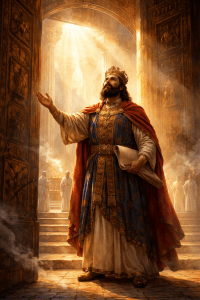
Jeremiah, the prophet who had said that there was no sorrow like his sorrow, (Lam. 1:12) could later say, recalling to mind the Lord’s mercies, compassions, and faithfulness: “This I recall to my mind, therefore have I hope.” (Lam. 3:21)
Helen Keller, born blind and deaf, said: “Once I knew the depth where no hope was and darkness lay on the face of all things. Then love came and set my soul free.” Her life had been “without a past or future,” with death a consummation “devoutly to be wished.” But she found, through the fingers of another, the rapture of living with life-changing hope.
Paul said that if in this life only we have hope, we are of all men most miserable. (I Cor. 15:19) Pastor and author Charles Allen put it this way: “Without Christ, there is no ultimate anticipation. There may be momentary prospects and incremental excitement, but lasting expectancy is missing. The future has no promise; it holds no hope. Everything is perishing or will perish. Death is the termination of our lives, our families, our fortunes, our civilization, and even of the universe itself.” Physician Jerome Groopman, in The Measure of our Days, told of a physician who remembered his terminally ill patient’s words before surgery: “I know this is my last chance and I’ll probably die, and after death, it’s just nothingness…I don’t ask for heaven. I’d take hell. Just to be.”
But, for the followers of Jesus Christ, the bleakness of blackness of a life—and death—apart from hope is emphatically absent! “For thou art my hope, O Lord God: thou art my trust from my youth.” (Ps. 71:5) “I wait for the Lord, my soul doth wait, and in His Word do I hope.” (Ps. 130:5)
Those who know not the assurances of God’s precious promises bid their departing loved ones a hopeless farewell. For instance, when Leonid Brezhnev, Soviet dictator and atheist Marxist through and through, passed away, Vice President George H. W. Bush—who represented the United States at the Kremlin funeral—noted that while the casket was still open, Brezhnev’s widow stared motionless at her husband’s body. Just before the soldiers closed the lid, though, she reached in and made the sign of the cross over his chest. It must have been a “desperate gesture,” suggesting at least a glimmer of hope that what her husband had unyieldingly denied just might somehow be true. (From Our Daily Bread)
Jeremiah affirmed, against a midnight backdrop, “I have hope!” So can anyone who may be reading this! Hear what God’s Word says:
- We can have hope of living eternally with God: “In hope of eternal life, which God, that cannot lie, promised before the world began.” (Titus 1:2)
- We can be assured of being saved by hope: “Which hope we have as an anchor of the soul, both sure and steadfast, and which entereth into that within the veil.” (Hebs. 6:19)
- We are privileged to serve God because of hope: “Who against hope believed in hope, that he (Abraham) might become the father of many nations, according to that which was spoken, so shall thy seed be.” (Romans 4:18)
- We may be called to suffer; even then, we can suffer with hope: “And not only so, but we glory in tribulations also: knowing that tribulation worketh patience; and patience experience; and experience hope: and hope maketh not ashamed: because the love of God is shed abroad in our hearts by the Holy Ghost which is given to us.” (Romans 5:3-5)
- Finally, we do always “stand” by hope: “Looking for that blessed hope, and the glorious appearing of the great God and our Savior Jesus Christ.” (Titus 2:13)
Hope is what a 14 year-old boy drew upon when his mother breathed her last breath: “When I was 14 years old, I knelt by my dying mother’s bed. She smiled at me through the death shadow on her face and said she was going Home, and she asked me to meet her in heaven. I gave her my promise. Her body sleeps in a lonely cemetery in the state of Alabama. As I have sat by her grave and listened to a funeral dirge played by the wind in the pine trees nearby, I have said, ‘Mother, I will see you again someday.’ Some people say I am dreaming. If I am, don’t wake me. If this world were all, I would want my Christian faith. My faith hangs a rainbow of hope over the dust of my dead, and kindles a smile on the brow of bereavement.” (Dr. Bob Jones, Sr.)
“I have hope.” We are, indeed, of those “who by Him do believe in God, that raised him (Jesus) up from the dead, and gave Him glory that (our) faith and hope might be in God.” (I Pet. 1:21) Have hope!
“But I would not have you to be ignorant, brethren, concerning them which are asleep, that ye sorrow not, even as others which have no hope. For if we believe that Jesus died and rose again, even so them also which sleep in Jesus shall God bring with Him.” (I Thess. 4:13,14)




 YOU and GOD