Precious Memories

You may have heard of the J.B.F. Wright song (1925) “Precious Memories,” the second stanza of which reads, “Precious Memories, how they linger; how they ever flood my soul. In the stillness of the midnight, precious sacred scenes unfold.”

This post, and maybe a follow-up or two in time, is a simple compilation of some of the precious ministry memories that come to me in the “stillness of the midnight.” I have written almost 400 “You and God” installments since the spring of 2020, and I do not know how many more the Lord will allow me to offer up. Some of these have featured people, some have spoken to issues, and some have been Bible lessons. This one, and surely at least one to follow, will be different. I am going to my memory bank and just listing people who come to mind, people who have been at some time significant in my ministry. I will, of course, forget some and not mention all by name. People who are still current, I may save for a future date.

I will start with my first pastorate in Wichita, KS, beginning in the fall of 1971. I can only make a brief statement about each person or couple:

Ira and Goldie Pray: He an engineer at Beechcraft/farmer; first chairman of deacons; good folk;
Gary and Leah Wickham: Loved God, supportive of our work;
Mike & Amy Maguire: Very young/in Air Force, Catholic background, could not get enough of the Word, eventually attended Central Seminary and pastored in RI.
Bob & Cheryl Poliquin: In Air Force, very young; his life verses: Provs.30:7-9; Godly couple;
Larry and Jerrie Beery: He was killed while on duty as a Deputy Sheriff; a few weeks before he was murdered, he and Jerrie sang, “We’ve Come This Far by Faith”; Larry said, “I’d like to see this auditorium filled with people one day.” It was full of Troopers from everywhere the day of his funeral. We have kept in touch with Jerrie through the years and over the miles.
Ronnie and Pat White: They loved God’s Word and encouraged this young pastor and his family in so very many ways.
John and Nancy Healey: Got excited about Bob Jones U. and moved there to put their children in the Academy; I just heard from their grandson that they both passed away this year; their son also died this past week; he was a dentist in Greenville (Matthew Healey); their grandson—a current student at BJU—is heading eventually toward a seminary in Detroit;
Fred and Lillian Liebau: She had cancer and prayed that God would allow her to see her children grown; He did and then she was graduated to glory;
Mrs. Stanley: A widow whose husband had sung in the choir; a wonderful, godly woman who prayed for us but was “inactive” because of her frail health;
Archie & Pat Conduff: Their 13-year-old son died of cancer, and as young pastor, it was my first time dealing with such an agonizing loss; it was a totally inadequate feeling but God’s grace was, as ever, sufficient.

These are some of the names and faces that pop into my mind and heart, sometimes in the middle of the night. Voices and faces out of the past. This list of Wichita co-laborers is not complete; there are many more, but these are some that are on my heart as I write today. God was so good to give us a core of committed people to assist us in our fledgling first attempt at ministry to a local church.

Next, God led us to a startup ministry in Newton, KS. There were about 40-50 people who had come together and had organized the Liberty Baptist Church, with an interim pastor, Sammy Hartzler, leading them. They assured me that they were not a split out of any other local church, but that God had led them to come together. Some of their names and a sentence or two that comes to my mind are as follows:

Wayne and Helen Partridge: His business was the largest salvage yard at that time in Kansas. He was rough around the edges but had gotten saved and totally committed to Christ, to getting the good news out to whomever—and however and whenever—he could. Wayne eventually moved his family to Greenville, SC, where he would head up the maintenance department at Bob Jones University.
Bill and Billie Krehbiel: These wonderful people lived in the neighboring town of Halstead, where Bill served as the high school football coach. They loved Christ, His Word, and the church. Bill was a World War II veteran and had fought for his country in the European theatre. They visited us several times on their way to Division reunions. Both are now with the Lord. Billie was a sweet Christian woman whose countenance exuded the love of Christ and His virtues.
Charlie and Della Mae Harr were graduates of Baptist Bible College (Springfield) in its early years. They were members of this young church, and Della Mae owned the piano keyboard. Charlie led the singing, and we made the little Methodist Chapel on Broadway in Newton ring with joyful music. The chapel was our temporary meeting place. We were there two and one-half years. The Harr’s son, Brian, was a teen-ager then; after my one-year interim pastorate at Coatesville Missionary Baptist Church in Coatesville, IN, Brian became the pastor there in 2021. He had pastored in Greenville, SC, and had been on the Bob Jones University Security staff for several years.

There were, of course, many other key people in this Mennonite community that became good Baptists and were part of our fellowship. That church got its permanent building built and is still a lighthouse in that community.

In 1979, after Dr. Fred Moritz went into full-time evangelism, Thompson Road Baptist Church in Indianapolis was seeking the Lord’s will about a pastor. A friend of mine, Pastor Tom Kent (Joy Baptist Church), gave my name to the pulpit committee, and in August of that year I candidated. The first Sunday after Labor Day, I began what was to become a 40-year assignment at this good church. I will share some memories of people (except those currently in the church family) that have made indelible impressions upon my mind/soul in an upcoming “You and God.”

“The Grace of our Lord Jesus Christ be with you all. Amen.” (Romans 16:24)

Tripp and Shelli

I delight in remembering people who have made a difference in my life, the lives of others, and in the Body of Christ. I have written several tributes to missionaries and evangelists, and some about those with whom I have been privileged to serve alongside of in the work of ministry through the local church. This post is about a special couple that God, in His wise providence, melded together through matrimony for a lifetime of Christian service. Their names are Tripp and Shelli Grossman, and their identity has been “servants of Christ.” Tripp joined that heavenly hosts of servants in glory four years ago; Shelli continues serving, with significant physical limitations, to this date.

I met Shelli sometime after she had graduated from Tennessee Temple University, having received her degree in Education. Her parents were charter members of the Edgewood Baptist Church, which merged in the mid-1960’s with the Grace Memorial Baptist Church to become Thompson Road Baptist Church (TRBC). The Edgewood Church was founded in the late 1950’s in a garage a few houses from the current location of the church I pastored from 1979 to 2019, TRBC. Shelli’s parents were faithful members of the church, and they were the kind of people who loved ministry, missions, and missionaries, entertaining God’s servants often in their large, white, two-story house just a few blocks from their church.

When Ellen and I first met Shelli, she was a single college graduate and already involved in public education. She eventually became the Indianapolis Public Schools Supervisor of Special Education. She is a masterful educator, with a heart as big as a full moon for children, a head full of practical, common sense, and a mind wholly consumed with a desire to please her Lord and Savior.

That is why, when we met the man that she married, Tripp, we were a bit taken aback at first. She met Tripp in Nashville, IN, where he was selling leather goods he made. He had a business or two and had met Christ as His Savior while serving a prison sentence in California. He said the story of his parole amounted to a “God Thing,” as there was no way he should have been released by the parole board. Yet he went into the meeting with every confidence and assurance from God, through prayer, that he would be released. And he was! He grew up in Indy in a staunch Catholic home and had his fingers, shoulders, and head rapped many times by his nun teachers, who were trying to maintain order in their classroom. He ended up in California, was incarcerated for the crime of manslaughter, met Christ in his prison cell as he sought Him through reading the scriptures, and became a new creation in Christ. (2 Cor. 5:17) We lived to see the day that we gave God thanks that Shelli did not see Tripp on their first meeting as an ex-convict but as a trophy of the amazing grace of God!

Upon moving back to his hometown in Indiana, he still had some of the trappings of his old life and had not yet found a mentor or a good, Bible-believing church in which to grow. Enter Shelli. She wanted to bring him to church and introduce him to her godly, very conservative mother (her father had gone home to Heaven already), but she told him he’d have to get his hair cut, shave, and clean up a bit before she would even entertain the idea. Why would she even pursue a relationship with this man? She was young, intelligent, attractive, etc. Tripp, though gentle, kind, and personable, was an ex-convict who had ridden with the “Hell’s Angels” before being saved. He knew by experience the seamiest side of life. There was, in the mind of any reasoning person, no way these two would ever be a match. But God!

Tripp got the haircut and shave, cleaned up nicely, and met Shelli’s Mom, Ruby (who was one of Ellen’s best friends). I cannot say for certain how Ruby responded on that first meeting, but I am confident in surmising that she was less than impressed. But, in time, Tripp and Shelli married and began a journey together with Jesus that touched literally thousands of lives for Christ.

Shelli is an excellent interpreter for the deaf in the American Sign Language. Tripp was a bus driver and picked up children (along with many adults) on one of our church busses, bringing them to Sunday School. Shelli taught many of these little ones in our Church-Time Children’s ministries, with Tripp assisting. They pursued the hearts and souls of the littlest and least amongst us for many years this way. When Shelli was not teaching the children in Church-Time, she could be found interpreting a message being delivered from the TRBC pulpit to one of our deaf attendees. For several years, we had two members who were deaf and blind. Shelli and some of the other interpreters were able to “spell” into the palms of the deaf-blind the messages preached. It was an amazing service done out of love.

Tripp and Shelli bought a house east of the city and made it their home for about 20 years. It had been, I believe, a house where Jehovah Witnesses met. Well, they fixed it up with skillets, pots, and pans hanging from the rafters, old vintage machines of all kinds, and two or three beautiful big dogs watching “guard” over the place. To visit their house was like going to a Cracker Barrel. Their door was always open to guests, friends, and church members, and they had a place for bonfires, church picnics, go-carts, trap shoots, and you name it. Shelli’s mother became sick one December night when Shelli had prepared and planned for a traditional after-church (Christmas Cantata) party at their place. When the ambulance arrived to take Ruby to the hospital, she told one of the EMS workers she was “going home.” The EMS attendant assured her that they were taking her to the hospital. Ruby assured him that she was “going home,” and she did! Before they had reached the Emergency Room, Ruby was in heaven. Shelli had gotten word that her mom had “gone home,” and she hosted the party start to finish.

Tripp drove busloads of kids to camp in the summer, often with his golden retriever by his side. He loved to see these boys and girls, many of them from the inner-city, run and play, splash in the lake, and eat three meals a day—some of them like they had never eaten before. It was at these camps that a young lady from our church, serving as a counsellor, Michelle Young, was further prepared for a life of missionary service. She and her husband, Harrison Banda, are serving (and have served multiple terms) in Zambia, building lives for His Kingdom there.

I have shared some snapshots from the lives of two of His choice servants. Shelli still serves, still teaches junior church, and still teaches the Bible in our Perry Township Religious Education outreach. It has been, for Ellen and myself, a profound honor to have been fellow servants of Tripp and Shelli these past many years. To God be all the glory and all the praise.

Unto Him be glory in the Church by Christ Jesus throughout all ages, world without end. Amen.” (Eph.3:21)

Happily Ever After

“Four-year-old Susie had just heard the story of ‘Snow White’ for the first time. Excited she came home and retold her mother the fairy-tale. After relating how Prince Charming had arrived on his beautiful white horse and kissed Snow White back to life, Susie asked loudly, ‘And do you know what happened then?’ Her mother replied, ‘Yes, they lived happily ever after.’ ‘No,’ Susie said, ‘they got married!’ Susie in her child-like innocence got it right! Getting married is not synonymous with living happily ever after.” (Strike the Original Match, by Chuck Swindoll)

(I am sharing some truthful tidbits on the subject of marriage in this post. Hardly anything here will be original. But this is like some needed, practical “nectar” that I have gained in years of reading, and I hope something of what you read in this and maybe in a follow-up post will be helpful to you. I will cite the source when I can.)

Ed Wheat in Love-Life for Every Married Couple: “These ties are not like the pretty silken ribbons attached to wedding presents. Instead, they must be forged like steel in the heat of daily life and the pressures of crisis in order to form a union that cannot be severed.”

Someone added, “Even if marriages are made in heaven, man is responsible for the maintenance.”

John MacArthur in his sermon “Divine Guidelines for Marriage,” offers ‘How could God command you to marry and not provide the right partner?’ But, listen to me people, if you’re not the right person, you’ll never meet the right partner. That’s the whole key. If you’re not the right person, you’ll never meet the right partner. So instead of looking for the right girl, start being the right man. And girls, instead of looking for the right man, start being the right woman. And then, the right man will start recognizing the right woman.”

Or, as Howard Hendricks, late eminent professor of Bible Exposition at Dallas Theological Seminary for more than fifty years, put it: “Marriage is not finding the person with whom you can live, but finding that person with whom you cannot live without.” (BTW, that was a favorite quote of my dear mother!—and thankfully, I did find that person in Ellen Beshears!)

George Clinebell in Intimate Marriage, says, “Marriage has been described as the relationship of ‘Two reasonable human beings who have agreed to abide by each other’s intolerabilities.”

And, “The wedding ring is that small piece of jewelry placed on the finger that cuts off your circulation.”

W.A. Criswell, who pastored First Baptist Church of Dallas, Texas, for forty-eight years, following the fifty-year pastorate of George Truett, said, “Two can live as cheaply as one—if one doesn’t eat and the other goes naked.”

“When Brother Andrew became engaged to his wife, Corrie, he said, ‘Corrie, we don’t know where the road leads us, do we?’ ‘But Andy,’ she said, ‘Let’s go there together.’” (God’s Smuggler) Brother Andrew

Michael McManus in Christian News, (5/26/96) spoke to the subject of cohabitation or “living together” as it has become known as rather than the original euphemism of “shaking up.” He said that it is the “greatest destroyer of marriage in America…a double cancer of marriage. In 1996 he noted that (even then) “the majority of all unions between American men and women begin with cohabitation—not marriage, according to the National Survey of Families and Households—in depth interviews of a large sample of 13,000 people by the University of Wisconsin. This is a shocking finding. Being unmarried is not synonymous with being single, the study asserts. Many who begin cohabitating believe they can screen out a risky marriage. They are wrong. Cohabiting unions are much less stable than unions that begin as marriages…Marriage is one shoe you cannot try on before buying it.”

McManus, cited above, states that 40% of cohabiting couples break up before marriage; marriages that are preceded by cohabitation have a fifty-percent higher divorce rate than those which are not. Of the 60 couples who get married (after cohabiting) 45 of them will divorce. “That means that only 15 couples out of 100 who cohabit before marriage will make it. Cohabitation is almost a guarantee for failure.”

In my home state of Iowa there stood an historic church, the Little Brown Church. Hundreds of weddings took place there every year. It is said that the preacher adopted a special farewell to the couple when, after the ceremony, he took the couple to the entrance of the little chapel and said, “Before you go, the Bride has the honor of ringing the church bell.” He placed the rope in her hands and though she pulled with all her might, the heavy bell would not budge. Then the preacher turned to the groom and asked that he lend a hand to help his bride. Together they pull and the bell rings, sending out over the countryside the news of another wedding. Then the preacher says, “As you go out into life, never forget that as long as you pull together, you can ring the bell.” (Discovery, Little Rock AR)

Again, I turn to Pastor Chuck Swindoll, married more than sixty years, for some distilled wisdom on marriage: On an article entitled “We Rent Wedding Rings,” Chuck commented, “Doesn’t that just sum up the state of our world? Seven days after our first date, I knew that Cynthia was ‘the girl of my dreams’. She was 16 and I was 19 when I proposed. Twenty months later…we said, “I do.” We could never have imagined our life together…but four kids, ten grandchildren, seven great grandchildren and a worldwide ministry later, we still say I do.”

“Cynthia will always be the girl of my dreams. But that doesn’t mean I can sit back and relax! Loving her means being the man of HER dreams. It means practicing patience, kindness, and humility. It means faithfulness and trust…love notes and a few elegant dinners for two…thoughtful words and listening ears. It means making time for prayer, coffee, and especially thunderstorms. Every time a storm rolls in, Cynthia and I press pause on our busy lives. We prefer to go out on our screened-in back porch, where we watch the Creator’s light show, together.

Contrary to popular opinion, our more than six decades together haven’t been pure bliss. Neither of us is ‘easy to live with.’ We’re together for two reasons: God’s unfaltering grace and our uncompromising commitment.”

(So there you have it. Some of the choicest statements, observations and words of wisdom about marriage that I have clipped the past fifty plus years. I hope they will bless you and maybe even help you as you work on fine tuning your marriage (I still am after 58 years!), or as you strive to encourage others who may be struggling in this first and foremost of relational ties established immediately after God created the heavens and the earth.)

Pastoral Ethics

I vaguely recall some course or some lessons taught in seminary on “Pastoral Ethics,” though I cannot find any notes on the subject. However, there always has been (and still is) a need for basic reminders to all who are in the ministry—especially for those whom Paul labels as “bishops” or pastors—about the matter of ethics in our labors as Christ’s servants.

In I Timothy 3, Paul begins a list of qualifications for a man who desires the office of a bishop with the word “blameless.” This would include, above all, a person’s morality: is he honest, trustworthy, pure, Christlike? What about his standard of ethics? The word ethics is defined as “moral principles that govern a person’s behavior or the conducting of an activity.” So, applied to those in ministry—specifically, in this discussion, to pastors—does he conduct his ministry on the basis of universally accepted moral principles? Is his ministry built upon a consistent ethical standard? In a generally deteriorating culture, it is not surprising that time-tested moral principles are being “stretched” today, and in some instances set aside entirely, even by men in ministry.

Since I am a pastor—or, for 50 years, was a senior pastor—I am going to speak to pastors in this post. Those of you who are not pastors may feel free to “listen” in, but again, I am speaking as a pastor to pastors. Yet the basic ethical principles demanded scripturally of men in ministry should also govern the lives of those to whom they minister, so there is probably something by way of application for anyone who reads this article. I am going to list some areas in which pastors, missionaries, and Christian-ministry laborers ought to be blameless in:

1) Do you pay your bills in a timely fashion?

2) Do you return things borrowed?

3) When members from another congregation of like faith visit your services, indicating they are looking for a church, do you contact their pastor to inform him that some of his flock are visiting your church?

4) When a person who is under church discipline, administered by another church of like faith, visits your church, do you accept them into your membership with no questions asked?

5) Do you sign checks on any of your church accounts as the sole signature required?

6) Do you sometimes mix church/personal purchases made when using a church-issued credit card?

7) Do you label as “heretic” (or similar names) people who differ with you on matters on which good men have historically differed? For instance, on communion (open, close or closed); eternal security; pre-trib, mid-trib or post-trib; mode of baptism; version of scripture?

8) Do you exercise “dictator-like” authority in your leadership of the congregation over which God has given you oversight? Is anyone allowed to differ with you, or even to criticize you?

9) When you give an evangelist or guest speaker a “free-will” offering, do you deduct any part of it for church expenses, or for any other reason, before giving your guest his offering?

10) Do you carefully protect confidentiality of those with whom you counsel?

11) Do you meet with women on church matters when there is no other person on-site while your meeting is taking place?

12) Do you cultivate friendships or relationships with members of churches you have formerly pastored because that relationship is financially advantageous to you?

13) When you sell bonds or have a fund-raiser for a project, are you careful not to use funds donated or given for said project for other pressing church needs?

14) Do you send missionaries the support you have promised to give them on a current, regular basis, or do you let several months transpire before you get around to sending them the support upon which they are dependent?

15) If you use a sermon or message that you read or heard another preacher deliver, do you give him credit for his original presentation?

16) Do you show preferential treatment in using people in your church/ministry because they are financially well-off?

17) Are you OK with the fact that you are accountable to your church through a group of deacons, or elders or advisors to the pastor?

18) Are you reticent to say “I’m sorry,” or “Please forgive me,” when it is apparent that you have offended another believer?

19) When relating to other pastors or ministries, are you genuinely interested in how God is blessing their work? Does rejoicing with them in victories come easy for you?

20) Would you accept a call to a ministry knowing that you differed with the church on a matter of faith or practice, but with the determination to bring the church in time to agree with your practice or position?

These are some questions that I have raised in light of my observations and experiences as a pastor and as a friend of pastors for half a century. Let me hasten to say that pastors, generally, are the finest people I know. Some of them are my closest friends. By far and away, those who have proven to be less than scrupulous in their ethics have been a minuscule minority. But, there are some out there who are the exception (just like undertakers, who are some of the finest people in the world—then you hear of one who has packed away scores of bodies for who knows what reason!).

So, pastor, I trust you passed the self-test above. No pastor is perfect, and we should be our own unrelenting watchdog; but, as long as we are in the body, there will be temptations. So I trust these reminders will have a positive effect upon you and your ministry so that the standard Paul set for Timothy and Titus (I Tim. 3:2; Titus 1:6), “blameless,” will not be a problem to you. God bless you as you labor in love in ministry to the chosen flock over which God has placed you as His “under shepherd,” waiting the call and coming of the “Good Shepherd,” the “Chief Shepherd,” the “Bishop of our souls,” the Lord Jesus, Head of the Church.

“And when the Chief Shepherd shall appear, ye shall receive a crown of glory.” (I Pet.5:4)

What Not To And What To Glory In

We live in a success-oriented world.  Bigger is better, and biggest is best. Whether in the business world, the sports arena, the science lab, or the archeological dig site, it’s being the first—the most, the best—that motivates many to not rest until the gold chain hangs around their neck. This is not altogether bad. We ought to desire to give every task our best effort. But, only one can be at the very top, and having done our very best, we ought to be able to thank God for allowing us to serve, to compete, to participate in whatever endeavor we engage in.

There is a danger, though, in being the best, in being better than most, or in merely thinking we are the best or better than most. The danger is that, human nature being what it is, one can easily be tempted to succumb to pride, boasting, arrogance, and glorying in self-accomplishments. Politicians are almost across-the-board boasters; it seems to be a matter of political survival. They are not alone in this American pastime. Most who read this will never have attended a “pastors fellowship” meeting, but those of you who have might acknowledge that there was perhaps some pride in the air when Dr. So and So asked his fellow pastors how many folk were in attendance at last Sunday’s service. Pride surfaces even in such spiritual atmospheres.

Paul plainly warned that “he that glorieth, let him glory in the Lord.” (2 Cor.10:7) If a servant of Christ has anything to glory in, it is only that God’s grace, goodness, and sufficiency are always abundant—along with His mercies, which are new every morning.

We dare not glory in the works of men. Humans have accomplished unimaginable plateaus of success in science, agricultural, technology, and medicine, to mention just a few areas. But, John the Apostle puts it all in perspective when he reminds us that “the world passeth away, and the lust thereof, but he that doeth the will of God abideth forever.” (I John 2:15-17)

Nor should anyone glory in the words of men. Words can move and mold the world at times. Great orators can be tools for the cause of evil (Hitler) or for the cause of good (Churchill).  Peter warns against “great swelling words of vanity.” (2 Pet.2:18) One wag quipped that oratory is the “ability to make deep sounds from the chest sound like great thoughts from the mind.”

Neither should the wisdom of the world mesmerize us. Educators, philosophers, lawyers, and even clergy can wow with worldly wisdom. But Paul admonishes that God hath made foolish the wisdom of this world, so that no flesh should glory in His presence. (I Cor. 1:19,20,29)

Then again, the wealth of this world is nothing more than vanity. Solomon, the king that had amassed an incalculable amount of this world’s riches, said that when it was all said and done, nothing amounted to anything more that vanity, nothingness! Jeremiah summarizes what we should not glory in when he said, “Thus saith the Lord, let not the wise man glory in his wisdom, neither let the mighty man glory in his might, let not the rich man glory in his riches.” (Jer. 9:23)

Nebuchadnezzar, king of Babylon, learned this lesson the hard way. He had built ancient Babylon, a city incomparable in beauty and grandeur, and boasted: “Is not this great Babylon, that I have built…by the might of my power, and for the honor of my majesty?” (Daniel 4:30) But God brought the great king to the lowest level possible. For seven years, Nebuchadnezzar groveled in the forest like a beast of the field. When God mercifully restored the pathetic sovereign to his right mind, Nebuchadnezzar said: “Now I Nebuchadnezzar praise and extol and honor the King of heaven, all whose works are truth, and his ways judgment: and those that walk in pride He is able to abase.” (Daniel 4:37)

So, we must not glory in that which is temporal, worldly, man-made, and earthbound. But the Word of God specifies some things that we ought to glory in:

(1) David said, “Glory ye in His holy name.” (Ps.105:3) It is the name which is above every name; the name at which every knee shall bow, (Phil.2:10) and the only name under heaven given among men whereby we must be saved. (Acts 4:12) Give glory to His name!

(2) We should glory in the fact that we can know our Creator God. Jeremiah continues his word after warning us of that in which we should not glory: “But let him that glorieth glory in this, that he understandeth and knoweth me, that I am the Lord which exercise lovingkindness, judgment, and righteousness, in the earth: for these things I delight in, saith the Lord.” (Jer. 9:24)

(3) We also ought to glory in the purging process that comes our way when God is maturing us. We will have tribulations and trials in this world. Paul said, “Not only so, but we glory in tribulations also; knowing that tribulation worketh patience; and patience experience; and experience hope: and hope maketh not ashamed.” (Romans 5:3-5) Paul, who wrote that we can glory in tribulation, enumerated what trials he had suffered when writing to the church at Corinth. (2 Cor. 12:9ff.) He had suffered every kind of physical and mental deprivation and hardship—yet Paul acknowledged that the process ultimately produces patience, experience, and hope. We therefore can and should “glory” in tribulations.

(4) Finally, we can, and we must, glory in the cross! Paul was adamant in declaring, “But God forbid that I should glory save in the cross of our Lord Jesus Christ.” (Gal.6:14) It was on the cross—cruel instrument of shame and suffering—that Christ bore the curse of, paying the penalty for, our sins. He satisfied the wrath of His holy Father, becoming the propitiation for our sins, so that we can—and should, above all other things—glory in the cross. Jesus died for the sins of the world. He did so upon an old rugged cross. His death was substitutionary for every sinner. His death was atoning and sufficient. Calvary covers it all. Let us never cease glorying in the cross!

For the preaching of the cross is to them that perish foolishness; but unto us who are saved it is the power of God.” (I Cor. 1:18)

Do It With All Thy Might

Well, Labor Day has come and gone, but considering God’s plan and purpose for us regarding labor is always appropriate. Work was imbedded into the purposes of God for mankind from day one. His first words to Adam and Eve included a mandate to work: “Be fruitful and multiply, and replenish the earth, and subdue it.” (Gen. 1:28) Further, in the expanded account of creation, recorded in Genesis 2, we read that “the Lord planted a garden eastward in Eden, and there he put the man whom he had formed…And the Lord God took the man, and put him into the garden of Eden to dress it and keep it.” (Gen. 2:8,15)

Work by the “sweat of thy face” was part of the curse placed upon mankind because of Adam’s disobedience to God. (Gen. 3:17-19) So, work is righteous, for it is the will of God for those of us who are His created beings. Through work, we shall eat bread, but God announces that “in sorrow shalt thou eat of it all the days of thy life.” It is righteous, for it is God’s will; and it is honorable, for it is the designed destiny of man, and it yields life-sustaining nutrients vital to our physical well-being.

Fast forward from the Garden to 2023, or even to 50 A.D. When Paul wrote his epistles, there were those, even then, who looked upon work with disdain. Paul quoted a Cretian poet when writing to Titus of the challenges he would face as a pastor on that island, where men were commonly known as “slow bellies.” That graphic term describes men who were indolent, slothful hogs. They enjoyed filling their bellies with food, but they refused to work for their fare. The Apostle acknowledged, when writing to the church at Thessalonica, that there were people there who were known as “working not at all.” (2 Thess. 3:10-12) Of these people Paul flatly stated that if they were not willing to work, they should not be afforded the privilege of eating.

There have always been men and women who refuse to live by wise King Solomon’s counsel, as written in Ecclesiastes 9:10, which was and is: “Whatsoever thy had findeth to do, do it with all thy might; for there is no work, nor device, nor knowledge, nor wisdom, in the grave whither thou goest.” (Prov. 9:10)

The wise king affirms that labor is good—labor done with a good attitude and a right spirit. Some years back, U.S. News and World Report reported that employees, on average, spent 34% of their paid time not working. This aversion to diligent labor is expressed in the following poem: “I wish I was a rock, sitting on a hill; doing nothing all day long, just a sittin’ still. I wouldn’t eat, I wouldn’t sleep, I wouldn’t ever wash, I’d just sit still a thousand years and rest myself by gosh!”

Well, the world has changed a good bit! In the days of Thomas Jefferson, someone in Philadelphia said that the work week should be 60 hours, or six 10-hour days, rather than the 72-hour work week they were accustomed to. Even the thought of trimming the standard work week down 12 hours caused quite a stir, as the longer work week had been common since the days of the Revolutionary War.

John Wesley, the 18th-century English preacher who founded the first Methodist church in the U.S. in 1784, knew nothing of a 72-hour work week. It is said that he preached three sermons a day for 54 years, traveling by horseback and carriage more than 200,000 miles. All the while, he authored a four-volume commentary on the whole Bible; a dictionary of the English language; a five-volume work on natural philosophy; a four-volume work on church history; histories of England and Rome; grammars on the Hebrew, Latin, Greek, French, and English languages; three works on medicine; six volumes of church music; and seven volumes of sermons and papers. He also edited a library of 50 volumes, known as the Christian Library—all of this while devoting himself to his pastoral ministry. Rising at 4 a.m., he would work solidly until 10 p.m. At age 83, he was chagrined that he could write no more than 15 hours a day without hurting his eyes. At age 86, he had to cut back from preaching three times a day to preaching just twice. In his 86th year, he preached in almost every town in England and Wales, often riding 30 to 50 miles a day! (Selected)

Harlow Curtis, who led General Motors in those golden years of 1953-58, was selected as Man of the Year in 1955 by Time. Here is how he spoke of a good work ethic: “Do it the hard way! Think ahead of your job, then nothing in the world can stop you. Do it better than it need be done; next time, doing it well will be child’s play. Let no one stand between you and the difficult task; let nothing deny you this rich chance to gain strength by adversity, confidence by mastery, success by deserving. Do it better than anyone else can do it. I know that sounds old-fashioned. It is, but it has built the world.”

Jesus said, “I must work the works of Him that sent me, while it is day: the night cometh, when no man can work.” (John 9:4) Those who name His name as our Lord ought to cultivate His attitude toward work. We must work the works of our Heavenly Father with the urgency that He had, because the time will come when we can work no more. We dare not be “slow bellies.” We must not allow others to work for our food when we are able-bodied and can work ourselves. We should work with a thankful attitude for work to do, and for the privilege of “keeping” our plot in the garden of His world. “Work for the night is coming, work through the morning hours; work while the dew is sparkling, work ‘mid springing flowers. Work when the day grows brighter, work in the glowing sun; work for the night is coming, when man’s work is done.” (Anna Coghill, Lowell Mason)

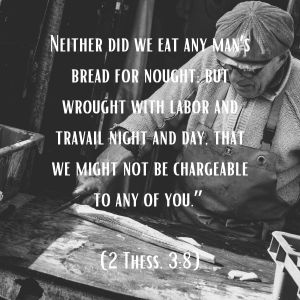
Neither did we eat any man’s bread for nought; but wrought with labor and travail night and day, that we might not be chargeable to any of you.” (2 Thess. 3:8)

How God Leads His Children Today

“For as many as are led by the Spirit of God, they are the sons of God.” (Rom. 8:14) That verse affirms that every believer in this age can be assured that God leads them by His Holy Spirit. This is not to say that Christians are espousing what some call “extra-biblical revelation.” Not in the least. Rightly understood, everything about God’s leading is based upon what is in the Word of God, the Bible.

Before the present Church age began, God led His people in various and sundry ways. In the wilderness, the pillar of cloud by day and the pillar of fire by night directed the Children of Israel to start or to stop, to go or to stay. (Numbers 9:15-23) Before that, it was sometimes an appearance of the “angel of the Lord,” or a vision or dream in the night, or the voice of God—as when God gave His first recorded direction to the newly created couple, whose address was simply The Garden of Eden: “And God blessed them, and God said unto them, be fruitful, and multiply, and replenish the earth.” (Gen. 1:28) During the era of prophets, God spoke to and led His people through directives uttered by Him via the prophets to His people. Then, upon the birth of the Church that Jesus founded, the Holy Spirit of God came to and indwelt each believer. He is the indwelling person of the Godhead, leading each of His people in this church age, and He will continue to do so until the Church is raptured out of this world just before the seven years of tribulation begin.

So, in this church age, let it be clearly stated: God leads believers by His Holy Spirit through, as we will see, His Word.

A young lady is seriously interested in the young man she’s been dating. He has told her that he loves her and wants to marry her. She wants the will of God for her life, her marriage, and future home. How can she decide whether this man is the right match for her life?

A high-school student is confronted with the reality of “life after high school.” What should he do. Go to college? If so, where? What should his major be?

A businessman is faced with a decision about a possibly lucrative business opportunity. What should he do? Should he sign the contract or not?

A factory worker notices on the work bulletin board that three new job openings have been posted. Two of them would mean better pay, though both would necessitate a transfer out of the department he has worked in for years. Should he bid for the jobs or stay where he is?

People seek answers to questions like these every day. Major and mundane decisions face us daily. The answer to each of the above scenarios would require that one determine the will of God. If believers are indwelt by God’s Holy Spirit today, how does He factor in helping us find God’s will as we seek answers to how, when, and where the pieces of life’s puzzle fit together?

1) The Holy Spirit leads through the Word of God. In ages past, God spoke to and led His children in a variety of ways. (Hebs. 1:1,2) Today, He leads through His Word, Jesus, the living and written Word of God, as revealed by the lamp and light of the written Word, illumined and interpreted for us by the Holy Spirit of God. (Ps. 119:105) This means that God will never lead you to do anything contrary to His Word. (Isa.8:20)
2) God can and does arrange circumstances in our lives. He does this, no doubt, more often than we recognize, but every child of God can look back and testify that if he or she had not been delayed a few minutes, they would probably have met head-on with a disaster. This is just one simple illustration; the almost daily happenings give evidence that causes us to most assuredly affirm with Paul the Apostle that “all things work together for good to them that love God, to them who are the called according to His purpose.” (Romans 8:28) These things are engineered by the guidance of God through the work of the Holy Spirit. (See Acts 16:6,7)
3) God directs by His Spirit through common sense. When the early Church hit a brick wall concerning whether converted Gentiles were required to keep certain aspects of the Law, such as circumcision, parties for and against the idea met in Jerusalem for a full and free discussion, hearing testimonies from Peter, Paul and others. Here is what the conclusion of the whole matter boiled down to, as stated by Pastor James: “For it seemed good to the Holy Ghost, and to us, to lay upon you no greater burden than these necessary things.” (Acts 15:28) Note that the Holy Ghost was leading these searching saints to the conclusion; but they also drew upon their own common sense, i.e., “it seemed good to us.”
4) He leads when believers are acting in faith, for whatsoever is not of faith is sin. (Rom. 14:23) And He, the Holy Spirit, leads when we have renounced sin, for sin grieves the Spirit. (Eph. 4:30) When we are dead to self, we are in a place that God’s Spirit can and will lead us. (Gal.5:16ff.)
5) He leads and empowers in crises in our work and witness for Christ: “For the Holy Ghost shall teach you in the same hour what ye ought to say.” (Luke 12:11,12)
6) He leads us through the counsel of other servants of God. Paul was entreated by many believers not to go to Jerusalem; a prophet of God, through the Spirit, warned him not to go, but he went anyway and found much trouble there. (Acts 21:4) God, though, did graciously appear to Paul, assuring him that He would still be with him—and that good could and would come, even though Paul had not previously followed good counsel. (Acts 23:11)

The Holy Spirit indwells, illumines, guides, teaches, empowers, and comforts each individual member of the Body of Christ. He will never leave you. He has all the power and knowledge you will ever need for any situation this side of heaven. Stay in tune with Him. Draw moment by moment upon Him for His power and direction—for the BIG questions as well as the everyday ones.

“But ye shall receive power after that the Holy Ghost is come upon you: and ye shall be witnesses unto me….” (Acts 1:8)

Jesus Wept

He was dead at the age of 11, our precious grandson, David Nye. How could that be? He was so active, so much a vital part of this family consisting of Mom, Dad and four sons (but two weeks away from adding a beautiful daughter, and another two years away from the birth of a second equally beautiful daughter). It was sudden. It was shocking. David’s brothers had been suffering with the flu that cold, late February 2007, and he had all the symptoms. Doctors and nurses assured David’s mother that he no doubt had the flu, also, and it was not necessary to bring him in for an examination. But on that fateful, final night of his so-short life, David became disoriented. His Dad, with the eldest son, Anthony, a 14-year-old teenager at that time, whisked David up and headed for the closest emergency room.

Anthony would later testify that David died in his arms on the way to the hospital on the southside of Indianapolis. From there, he was rushed to Riley Hospital for Children, where doctors determined that David had succumbed to a ruptured appendix. My last and heart-rending picture of David in the hospital was with his mother in the hospital bed with him, the two of them as close as close could be. As I write this, I do so with tear-filled eyes. I had begged God on the way to the hospital to please let me take whatever sickness David had, and if need be let me die rather than him. Racing through my mind were a thousand questions, as I asked myself whether God was dealing with me through David.

Sixty years earlier, my mom and dad had experienced the same hopeless feelings. Their 11-year-old son, my brother Teddy, had gone swimming one August afternoon with his cousin on the farm where he and a sister had spent the night with their aunt and her family. Teddy said he could swim, though he probably never had the opportunity to learn how to. On that fateful day in a creek that ran through the farm, just outside of Douds, Iowa, Teddy got into a hole that, with swift currents pulling at him, he could not get out of. His 8-year-old sister watched in horror from the creek bank, and the trauma of it all impacted her life from then until she met Jesus just a couple of years ago. So, our family had already tragically lost an 11- year-old boy, just as he was about to bloom into full-blown youth.

How do you handle such awful tragedies that come so shockingly and so suddenly? My parents had professed Christ as Savior but were attending a liberal, mainline denominational church, where they had not grown in their faith. After this loss, they moved to Ottumwa, Iowa, and began to seek God, trying one church after another. One Sunday afternoon, a neighbor knocked on their door and invited them to attend church with them. They did so that evening, and they heard a faithful pastor preach a Bible message. It required only one visit for them to know that this was “the end of their search for a Bible Church.” I trusted Christ soon thereafter, at the age of five, and grew up under the sound of good Bible teaching, as did our entire family. My folks spoke sparingly of that dark day when their son lost his life; but they were never in doubt, the rest of their days, that God was not taken by surprise when Teddy was called to heaven, and they testified that God used that sorrowful separation to bring our family to Himself.

Every family handles these sudden, shocking losses differently. It is safe to say, though, that families grounded in truth and faith have the spiritual resources to grieve and mourn their loss, which is absolutely necessary, without losing their spiritual equilibrium. It is without doubt a soul-trying test. The grieving does not last a couple of days or weeks or months. But, daylight will come even as joy does come after a night of weeping. The process must not be denied, and the prolongation of it differs with each person. The promises of God become more precious and one’s knowledge of, and relationship to, the eternal God—whose everlasting arms are never absent—deepens to a depth that one has never known before. Friends are loved for their caring concern, their gracious words, and their loving deeds. But at the end of the day, it is the Word of God—His absolute promises and pledges, that He will never leave you nor forsake you and that “all things work together for good to them that are the called according to His purposes,” (Rom.8:28)—that will give you the strength to go to bed with the resolve to get up the next morning and do whatever is your responsibility to do.

So, yes, we sorrow, but not as those who have no hope. (I Thess. 4:13 ) We look and long for the day of His coming back, as He said He would: “I go to prepare a place for you; and if I go to prepare a place for you, I will come again to receive you unto myself that where I am there ye may be also.” (John. 14: 3) That’s good enough, dear God! And we cling to, and cherish, the promise that we shall be caught up “together with them in the clouds to meet the Lord in the air, and so shall we ever be with the Lord.” (I Thess. 4:17)

“Wherefore, comfort one another with these words.” (I Thess. 4:18 )

I believe that everyone who reads this post has lost a child, a parent, a sibling, a spouse, a life-long friend through death. You each have dealt with death differently. Some may have at first slipped into denial; into doubting (God’s goodness); disbelief; into depression; or into simply an extended paralysis of the soul and spirit. But your confidence in the Word of God alone; your clutching by faith to the hope of heaven; and the ultimate healing of your wounded spirit have buoyed you and brought you through to where you face today and tomorrow with a once-shaken but now steadfast confidence in His goodness, grace, and greatness.

He stood with you and by you in the darkest night. You remembered Mary and Martha, who wondered why Jesus had not answered their desperate call to come before their dearest brother died. And then those two words landed right in the middle of your despairing heart, “Jesus wept.” And He wept with you, too, time and again. And the darkness gave way to dawn, and your soul found its resting place in the heart of Jesus, Lord and Savior.

O death, where is thy sting? O grave, where is thy victory? The sting of death is sin; and the strength of sin is the law. But thanks be to God, which giveth us the victory through our Lord Jesus Christ.” (I Cor. 15:55-57)

The Building of a Christian Home, Part 3


Author and physician Alan Beck said, “The family is a storehouse in which the world’s finest treasures are kept. Yet the purest gold you’ll find there is golden laughter. The most precious silver is in the hair of Mom and Dad. The family’s only real diamond is on Mother’s left hand, yet it can sparkle like children’s eyes at Christmas or shine half as bright as the candles on a birthday cake.”

Thomas Jefferson noted that “the happiness of the domestic fireplace is the first boon of heaven.”

Edgar Guest is known for his quip: “It takes a heap ‘o living’ to make a house a home.”

In our previous posts on the building of a home, I noted that Christ and His wisdom–the wisdom needed for right resolves—is the foundation necessary for building a home that will not be swept away by the storms of life. We also saw that, as wise King Solomon posited, we need understanding to cultivate right relationships. (Provs. 24:3,4)

Today, I want to discuss the third vital ingredient in establishing a home that will last—its furnishings, which require knowledge and produce pleasant riches. Solomon put it this way: “In the house  of the righteous is much treasure.” (Provs.24:34)

We will need wisdom for right resolves; understanding for right relationships; and knowledge for the right stewardship of life’s most precious treasures, our children. In Psalms, sons are presented as plants grown up in their youth; daughters are polished cornerstones, the ingredients in our homes that will add beauty, grace and adornment. (Ps.144:11,12)

So, consider the rearing of our children.

We will need knowledge for administering discipline that is both biblical and loving. Solomon instructed us that if we will train up a child in the way that he should go, when he is old he will not depart from it. (Provs.22:6). Discipline of children is both biblical and practical. It is a principle underscored in the New Testament when, in Hebrews 12:11, we read that chastening yields the peaceable fruit of righteousness. Again, Solomon said that we should “chasten thy son while there is hope and let not thy soul spare for his crying.” (Provs. 19:18) Other points that are germane from the wise king’s pen can be pondered by reading Provs.13:24; 29:15,17;  23:13,14; and 21:11.

How are you doing in this critical area of discipline?  Here are some questions that might help: (1) Do you have to tell your child more than once to do something? (2) Does your child fail to answer immediately and respectfully when you or some other authority figure, address him or her? (3) Has your child gotten the impression that he or she can sometimes get away with disobedience? (4) Do you seldom or ever hear your child say, “I’m sorry”? (5) Do you sometimes allow your child to withdraw in silence when she fails to get her way? (I can provide you with a complete list of about 20 questions but for space in this post I have only listed a few: reply and ask for self-test questions and I will be glad to share the remaining with you).

A great pastor of yesteryear, T. Dewitt Talmadge wisely said, “The reason we don’t succeed with our children in reclaiming all of them from worldliness is because we begin too late. Parents wait until their children lie before they teach them the value of truth. They wait until they swear before they teach them the value of righteous conversation. They wait until their children are all wrapped up in this world before they tell them of a better world. Too late with your prayers. Too late with your discipline. Too late with your benediction. You put all your care upon your children between 12 and 18. Why do you not put the chief care between 4 and 9? It is too late to repair a vessel when it has got out of the dry dock.”

Discipline is a priority and it is also productive. God will honor the parent who honors God and He will honor the child who is taught to honor his parents. The late evangelist Phil Shuler once said, “My brother Jack did not obey his parents, did not honor his parents and at 45 he was dead.” Radio evangelist and author Oliver B. Greene, who died in his 50’s’ also testified that he did not honor his parents. Discipline is productive in many ways.  It should, therefore, be a practice. Practiced righteously, discipline is motivated by obedience, bathed in love, administered in reason and accompanied by affirmation. It should be not only righteous but regular, consistent.

One-time newspaper columnist, Ann Landers, once asked 10,000 of her readers whether–if they could do it over–they would have children. She said that 70% of those who responded said they would choose not to have children.

One exasperated mother wrote: “Anger is not really what I feel. It’s alienation. Turn off. I feel in kind of a sad, resigned way, that the past 20 years were a total waste. My husband and I have nothing to show for it. It’s not that we’re sitting around crying. We have jobs, travel, live full lives, but the child raising part of our lives was a waste because the kids are nothing. Just nothing.”

One can only hope that the aforementioned parental remonstrance is the exception! It should be–and will be, if biblical principles concerning the rearing and training of our children are followed.

No parent would boast of having done a perfect job. Even Solomon– who gave good, God -inspired counsel–failed in many respects, but that does not lessen our responsibility, nor does it minimize in a loving parent’s heart the desire to get it right knowing that we only have one opportunity at it.

I close this solemn discussion with something a bit amusing (at least I thought it was):  “A young preacher, still single and in college, became known for his sermon, ‘The Ten Commandments for Rearing Children.’ After college he was married. Two years later he and his wife were blessed with their first child. He vigorously preached the sermon until the little bundle of joy was 2 years old. Then he changed the title to ‘Ten Rules for Rearing Children.’ When the child went to grammar school, he changed the title again to ‘Ten Suggestions for Rearing Children.’ When the youngster went to Junior High school, the title became ‘Ten Helpful Hints for Rearing Children.’ At last count, since his child entered high school, he has not preached his famous sermon!” Selah!

Children, obey your parents in the Lord: for this is right. And, ye fathers, provoke not your children to wrath: but bring them up in the nurture and admonition of the Lord.” (Eph.6:1,4)

On a Personal Note

I want to devote this post to my friends and family who not only read the “You and God” blog regularly but also pray for Ellen and myself. 

It was 19 months ago that, having gone to a couple of doctors because of a sore hip that would not stop hurting, I was diagnosed with multiple myeloma, a disease of the white blood cells. If left unattended, the damaged cells attack the bones and eventually overwhelm the body’s ability to fight back. Though there is no known cause or cure, there are treatments that will sometimes put the disease into remission. I have not yet reached that state, but the chemo that I take—three weeks on and one week off every month—is so far holding the myeloma “at bay.” My excellent cancer doctors are very positive, and my wife is the best “caretaker” in the world. My stamina is quite a bit abated, physically, but my spirit is strong. I am able to do some writing, to preach some when called upon, and to do periods of daily of light work inside or out (weather permitting).

My “2nd opinion” cancer specialist at Indiana University said I’d probably die of something other than myeloma. At the age of (almost) 81, that could be a good guess, although my heart tests good and all systems are apparently in working order. The strong chemo produces side effects that are mostly annoying, and I am not having any significant pain to speak of. At my last (Aug. 15) visit to my primary cancer doctor, he said with a smile, having reviewed a complete battery of blood tests, “Everything looks stable.” I take that to mean nothing is getting worse as far as the progression of this disease in my body is concerned, and that is cause for rejoicing and thanksgiving to our great God!

All of the above is to say: I am surely blessed. I have been retired from the senior pastorate for four years and, until I was diagnosed with this ailment, have been very healthy all my life. My passion in ministry for half a century was shepherding the flock of God’s people that He entrusted to my care, and promoting world missions through the local church. I was able to travel much, visiting missionaries, and have enjoyed visiting many mission fields. Ellen and I are celebrating 58 years of marriage, and we are deeply grateful for our daughters and son who are plugged into our lives and demonstrate their loving concern for us in many ways.

To those of you who pray for us, I want to say, “Thank you!” That seems so inadequate, but I hope you will know it comes from the depths of our hearts. I am awed at hearing often the words, “You are on our daily prayer list,” sometimes from people that we do not even know that well. The family of God is incomparable, and to be a part of that great Body of blood-bought believers is a blessing unspeakable. Again, thank you all very much!

Writing the bi-weekly “You and God” post is most gratifying to me, too. It keeps my mind working and gives me an outlet for sharing what is on my heart, and some of what I have been able to glean from studying God’s Word. It is very rewarding for me, and I love to hear from those of you who are able to take the time to reply with a comment or even a disagreement. I welcome the discussion and feel that one should always be open to learning, so keep the responses coming, please! If you have a particular subject you’d like for me to address, please let me know. I try to limit each post to two pages, double-spaced, so cannot usually explore topics in depth. But at least our “pure minds” can be stirred up to give some thought to issues that matter!

I will keep this post brief, as I just wanted to give you an update primarily on my health, since I know many of you pray for us and there are quite a few who live at a distance and are not in communication with us in person regularly. But feel free to call at any time! Our schedule is pretty flexible, though we do manage to stay busy. Of late, I have been preaching for a pastor friend who is rehabbing from a bad fall he suffered a month or so ago. At age 88, his recovery is going slowly. It is a privilege for me to be able to “pinch-hit” for him while he is at home recovering. We enjoy attending and serving in our local church, too, and are thankful for opportunities to sub for Pastor Stevens when called upon. For locals, the next opportunity will be, Lord willing, tomorrow night at prayer meeting in Grace Place!

Best wishes to all. We pray for you, too, and are humbled and deeply grateful to God for His family with whom we can worship and serve our Lord as we wait for His coming from Heaven.

Therefore, my beloved brethren, be ye steadfast, unmoveable, always abounding in the work of the Lord, forasmuch as ye know that your labor is not in vain in the Lord.” (I Cor. 15:58)