A Lesson Learned the Hard Way

A nephew of ours is a pastor to members of the Cherokee nation in northwestern North Carolina. He recently shared a personal testimony that, with his permission, I’d like to pass along in hopes that it may help others. I was struck by this post of his, because  a very similar incident happened to me, some of the details of which I will rehearse at the close of Aaron’s article:

“I’d like to share a personal story if I may. About six years ago, we had just gotten married and were in a very difficult spot financially speaking. I wasn’t pastoring at that time, but I was an ordained minister and active in a different type of full-time ministry that only paid a part-time salary.

Christmas was tough that year. I was going through a season that seemed like everything was breaking and tearing me up. I received a $200 bonus for Christmas about two weeks before the holiday, and I’d already made up my mind that week to bypass paying tithes so I could afford everyone’s Christmas presents. After all, I reasoned to myself, ‘It’s just one week. It won’t hurt.’

I was convicted in my spirit for even thinking that way, but I decided to do it anyway. So, I went to the mall in Gastonia and spent a few hundred bucks and got my family’s Christmas presents. On the way out of the mall, I curbed my tire, pinching it, immediately hearing that dreaded sound. Literally, I looked up, and across the road from the mall was an NTB Tire shop that was still open. Guess how much the new tire with installation was? Yep. You guessed it. $200.

I got home that night, and because I was getting out of the car in a hurry, I dropped my cell phone in a few inches of puddled, melted snow that was now a mud hole. So. My cell phone died. In my hurry, I left the gifts in the car.

Next morning, I came outside and discovered that ALL 3 bags of gifts had been STOLEN! Now, I am not saying this is how God always operates, but this is one instance that I believe I heard the voice of God directly to my spirit. He said to me, ‘Aaron! We can do this the easy way, or the hard way. All this would’ve been prevented if you’d simply obeyed what I’ve commanded you to do with the tithe.’

Honestly, I’ve not missed a single week of tithe since then. I’m hard-headed, and God sometimes has to wake me up with a little harder shake or lesson than He has to use with others. That day I learned my lesson. The tithe is His. Don’t touch what belongs to Him!”

Thanks, Aaron, for your transparency and willingness to be a blessing and challenge to others who may be spared learning “the hard way!”

When Ellen and I were on our honeymoon—traveling with a small camper trailer that my folks had loaned us, pulled behind Dad’s ’59 Chevy Impala—we spent about two weeks moving from (first) the Cumberland Gap National Park to various camping sites, enjoying the summer days of August. When we got to the town of Keokuk, Iowa, not far from where I grew up in the southeastern corner of the Hawkeye state, there happened to be a roadside carnival going on as we drove by. For something to do, we pulled in, parked, and wandered through the small “fair,” stopping at a booth where, for a quarter, you could throw a ball at several props, such as stuffed animals, and win whatever you hit or get another chance at a bigger and better prize. I got sucked into the moment and made some good throws until, in a matter of minutes, I was going for a “big” prize (I forget now just what!).

Well, just married and “macho,” I wanted to impress my new bride and win the big prize for her. But, I did not win. I lost! And, leaving that “sucker trap,” I had to face the awful pain of realizing that I had gambled with $200 of our precious money. We were heading for Minneapolis in a couple of weeks without a place to live, without a job, and not knowing a soul there.  I was enrolled as a first-year seminary student at Central Baptist Theological seminary. I knew immediately what God was teaching me that evening.

I had not been practicing any form of stewardship—not tithing, tipping, nothing. I had worked in a Christian camp all summer before our wedding and did not make a great deal of money, but I had never yet begun to give God a portion of my income. I wept with my new bride, prayed, confessed to God my sin, and covenanted with him that we would give a tithe and more of what He entrusted to our stewardship. We have kept that promise from that date for the past 58 years, and could not begin to tell you how God has blessed us.

I got a job the first day we were in Minneapolis and God gave us a fully furnished apartment to live in for $50 a month for the four years we were in seminary there. We left the Twin Cities with two children, all bills paid, and $1,000 in the bank. I have never shared this story with anyone except a handful of people. It was so very painful to experience. But I am deeply grateful that God so graciously drove that lesson home to me that evening. I had not been under conviction about it, nor had it been on my mind. But believe me, my heavenly Father did not have to send an angel to tell me what I needed to hear at that stage in my Christian walk. When I left the roadside park that evening I had immediately heard, in a not so still and not so small voice, “This is the way, walk ye in it.” Thank you, Lord!  

Honor the Lord with thy substance, and with the first fruits of all thine increase: so shall thy barns be filled with plenty, and thy presses shall burst out with new wine.” (Provs. 3:9, 10)

Victory!

On Sunday, July 2, Pastor Mark Felber celebrated, with his family and church family, 40 years as pastor of Victory Baptist Church of Whiteland, Indiana. It was a day of thanksgiving, praise, rejoicing, and lifting of hands and hearts in recognition of God’s unspeakable goodness, grace, and faithfulness through these past four decades.

Ellen and I were privileged to attend this special day, along with more than 200 church members and other guests. Most of Pastor Felber’s family was in attendance, including his brother Mike Felber (a pastor in North Dakota) and nephews and nieces.

The Felber family has always loved good music, and they joined their voices in beautiful songs of praise to their great God. One special that eight of the Felber men sang was “Be Strong in the Lord,” a song that Pastor Felber’s mother had requested for the 10th anniversary of her son’s ministry in this church in south-central Indiana, not more that 30 miles from where the Felber sons grew up in the great church their father, DeWayne Felber, pastored for many years, Burge Terrace Baptist Church. The Felber men who sang were, to a man, all “tenors.” They were somehow able to blend those trained voices into an ensemble that would have brought tears to Lena Felber’s eyes had she been present to hear her sons and grandsons sing that favorite song.

Pastor Felber, in the morning hour, shared some of the history of Victory Baptist Church, and how he had received a call 40 years ago—as a 24-year-old, single staff member of his Dad’s church—to accept the church’s invitation to be their pastor.

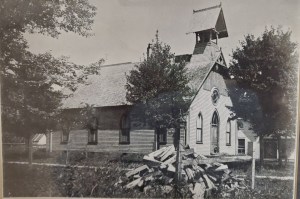
Meeting in a 100-plus years-old, 40 x 60 ft. building, it had declared itself an “independent” Baptist Church. Over the years it had benefited from the ministry of several pastors, but most of them were short-term ministers. Some served on an “interim” basis, and in 1983 one of those interims suggested the church leadership contact Burge Terrace Baptist Church in Indianapolis to ask if someone there could help out as a pulpit supply until they found someone to serve on a more permanent basis. They took that advice and contacted the senior Pastor Felber. After  some discussion, father and son agreed that Mark could help the Whiteland church as a supply for a few weeks. 

This arrangement was extended a couple of times until, lo and behold, the church asked Mark if he would consider “candidating” for the pastorate.  The young, fresh-from-grad school church staffer was a bit taken aback by the invitation, but as the idea began to “gel,” Pastor Felber sought counsel from older men in the ministry, including his father. To a man, they counseled him that he should give it prayerful consideration and, as the Lord would lead, proceed until the door closed. It never did. Forty years ago, the church voted in the young Felber as its pastor—a choice that has proven to be a very wise move on their part!

Mark faithfully served that flock for another 12 years—in a building that might have the furnace cut off and on in the winter, as the cold air gushed through decades-old cracks in the little (but really quite quaint and beautiful) white-framed church building, with a steeple stretching heavenward—before God gifted him with a beautiful wife whose life had been one of surrender and service to her Lord and Savior. Caryn Moody was living in Greenville, SC, and she and Mark had been acquaintances from their student years at Bob Jones University, but there was no romance between them during those years. That all changed sometime during late 1994, and by May of the following year they were married. Pastor Felber testifies that Caryn has been not only a perfect wife but a God-given complement to his ministry. Her eyes saw many things that would enhance the ministry of the little Baptist Church, which was soon cramped for space and desperately in need of a larger facility.

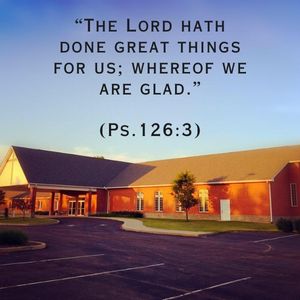
Not to worry. God had that covered, too. In time, they were able to purchase an excellent piece of property on which they built a stunning, attractive facility that continues to serve its congregation in a more than adequate way. Over the years, Pastor Felber’s humility, compassion, love of his people, skilled exposition of God’s Word, and steady hand at the helm have attracted like-minded people, who have worked together to cultivate a culture and an assembly of Christ-ones that have been a beacon of gospel truth in their community, carrying on the heritage of faith and faithfulness that Pastor Mark inherited when, with the trepidation of youth, he assumed the mantle of spiritual leadership bestowed upon him by the call of the church and the direction its Head, Jesus Christ, through the work of the Holy Spirit. Sunday’s victory service was a testimony to the faithfulness, goodness, and blessings of our Heavenly Father upon a work and workers committed to Him, His Word, and each other.

Yes, Sunday, July 2, was a celebration of praise for Victory Baptist Church, its pastor and people, and for all of us who got to share in that memorable day. To God be the glory, great things He hath done!

Have Hope!

In a radio broadcast on Christmas Day, 1939, with darkening war clouds looming large over Europe and England, King George VI quoted what was then an unknown poet’s words: “And I said to the man who stood at the gate of the year, ‘Give me a light that I may tread safely into the unknown.’ And he replied, ‘Go out into the darkness and put your hand into the hand of God. That shall be to you better than light and safer than a known way.’ So I went forth and finding the Hand of God, trod gladly into the night. And He led me towards the hills and the breaking of day in the lone East.” (Minnie Louise Haskins)

American radio-show host Michael Medved spoke of the current culture as having a plague of pessimism, infecting millions of Americans. A survey of revealed that the word that least described “Generation X” was not “lucky” but “angry” and “stressed out.” Kurt Cobain, lead singer of the hard rock band, Nirvana, killed himself at the height of his career in 1994, dying at his own hands with all the wealth and fame a young person might have dreamed of. That generation (mid-60’s to late 70’s) was not alone in its pessimism. The current Alpha Generation (2010-2024) of tech-savvy, screen-glued young people has little more hope than their predecessors, called by various names. The cynicism of previous generations has been passed on from generation to generation, so that the outlook today is no rosier than it was when Gen X dealt with its peculiar darkness. It has always been so to a world estranged from God. “If in this life only we have hope…,” Paul muses. Yet some do not have hope in this life only—just despair, deep darkness and thoughts of death as a desired alternative.

But, there is hope! In the direst of circumstances, Jeremiah recalled God’s mercies and affirmed that “therefore have I hope…because his compassions fail not.” (Lam. 3:21,22).

We can rejoice in that we are saved by hope: “For we are saved by hope: but hope that is seen is not hope.” (Rom. 8:24)

We are secured by hope. “That by two immutable things, in which it was impossible for God to lie, we might have a strong consolation, who have fled for refuge to lay hold upon the hope set before us. Which hope we have as an anchor of the soul, both sure and steadfast.” (Hebs. 6:18,19)

We serve by hope. “Who (Abraham) against hope believed in hope, that he might become the father of many nations.” (Rom. 4:18)

We suffer in hope. “And not only so, but we glory in tribulations also: knowing that tribulation worketh patience; and patience, experience; and experience, hope: and hope maketh not ashamed; because the love of God is shed abroad in our hearts by the Holy Ghost which is given to us.” (Rom. 5:3-5)

We stand in hope. “Looking for that blessed hope and the glorious appearing of the great God and our Savior Jesus Christ.” (Titus 2:13)

So, for the believer, life begins and ends in hope! It is what caused an old-time evangelist to once say: “When I was 14 years old, I knelt by my dying mother’s bed. She smiled at me through the death shadow on her face and said she was going Home, and she asked me to meet her in Heaven. I gave her my promise. Her body sleeps in a lonely cemetery in the state of Alabama. As I have sat by her grave and listened to a funeral dirge played by the wind in the pine trees nearby, I have said, ‘Mother, I will see you again someday.’ Some people say I am dreaming. If I am, don’t wake me. If this world were all, I would want my Christian faith. My faith hangs a rainbow of hope over the dust of my dead, and kindles a smile on the brow of bereavement. This world is not all. There is a God. There is a heaven. There is a hell. I am playing a safe game. If there were only one world I have already won. Since there is an after-life, I win for two worlds. You don’t have to take any chances with your soul.” (Dr. Bob Jones, Sr.)

Dennis Fisher, writing in Our Daily Bread, tells of an 18th-century French general finance controller, Etienne de Silhouette, who during wartime tried to increase revenues by raising taxes heavily on the wealthy. His victims complained and used the word silhouette to refer to their wealth having been reduced to a mere shadow of what it had been. Fisher makes the analogy between that and what Jeremiah the prophet felt as he lamented over the city of Jerusalem, which had been reduced to less than a shadow of what it had been in its greatness. But, in Lamentations 3, the weeping prophet embraces hope over despair when he affirms that because of God’s faithfulness and never-failing mercies, he did have hope!

Whatever your present miseries or anticipated future difficulties, there is always hope. George H.W. Bush, when he was vice-president, attended the funeral in Moscow’s Kremlin for the deceased Russian premier, Leonid Brezhnev. He noted that when the widow approached the open casket for a final farewell to her husband, she made over his body the sign of the cross, something that in a country where atheism was the official religion was a stunning move. It was as if the wife were saying, “There has got to be some hope. Even if atheism is the state religion, I am going to pin my hopes upon the message of the crucified one.”

Yes, there is always hope. After Paul said that if in this life only we have hope, we are of all men most miserable, he immediately exclaimed: “But now is Christ risen from the dead, and become the firstfruits of them that slept.” (I Cor.15:19)

Hope. Don’t leave home without it!

In hope of eternal life, which God, that cannot lie, promised before the world began.” (Titus 1:2)

July 4th, Then and Now

Today marks the 247th birthday of this great nation! I can remember July 4, 1976, in Wichita, Kansas, when our family joined other families in commemorating this special day with an all-day preaching and dinner-on-the grounds service. We so enjoyed that day, and though the 200-year-old nation then was (and is) fraught with problems, we were proud to be Americans and were gathering together to seek God’s blessings and intervening grace.  We could not have imagined what America would look like 47 years from that two hundredth birthday. We have mountainous problems, of course, but we have a noble heritage of liberty and justice—and, by God’s grace, we still have freedom of worship, speech, and assembly, though all of these freedoms seem more fragile today than in 1976.

We could never begin to give God adequate praise for the bounty of His blessings. We owe an incalculable debt of gratitude to our forefathers for their wealth of wisdom in establishing this democratic republic that has weathered world wars and a soul-wrenching civil war in its short, 247-year history. We are deeply grateful for the precious blood shed and for the ultimate sacrifice of life made by more than a million people while serving honorably in the armed forces of our nation. Because of their sacrifice, we can still raise “Old Glory” and pledge allegiance to the flag of the United States of America—one nation, under God, indivisible!

To be sure, fierce foes of liberty are firing their volleys of subversion at this old ship of state. Under the guise of “diversity,” some would banish God from our public forums. We are now asked not to pray to a specific God, and certainly not to invoke His blessings in the name of His Son, Jesus Christ, for fear that we might offend the unbelievers.

We dare not surrender this sacred ground to atheism. The best and bravest of our youth gave up their dreams, fortunes, and futures in the defense of this nation, whose God is the Lord.

We unquestionably would die to grant anyone the freedom to deny that our God exists, and to refuse to call upon His name. But do not ask us to give up that precious, life-giving privilege of prayer and practicing faith to accommodate your atheism. Our fathers, sons, and daughters have died for your right to choose unbelief, so we will never surrender our belief for fear of offending you when we call upon the Lord God by His holy name.

That’s America. And, yes, we have become a melting pot, and we are a diversified people, having come from the four corners of the earth to get here. But one thread has held us together for nearly 250 years: our common dependence upon, and belief in, a God who blesses the nation that fears and honors Him.

Long live America.  Long live our freedom. And long live the bastion of liberty in this land, where peoples from every part of the world have come to work and worship, to live and love, and to breathe fresh air. 

I hope this Day of Independence proves to be a very special day for each and every citizen of this great country. May we look back with thanksgiving for God’s special grace to us.  May we look ahead with hope and aspirations for a future hinged upon the limitless promises of His Word to those who honor Him. May we never be ashamed to pray to Him, to acknowledge Him, to confess Him in public and in private. God bless America—today and always.

Food for thought.  Pulitzer Prize winning author David McCullough, in his book 1776, though never mentioning God in that massive work on the War of Independence, could not close without a subtle but sure acknowledgement of His hand at work on behalf of the Revolutionaries. He closes with these words:  “Especially for those who had been with Washington and who knew what a close call it was from the beginning—how often circumstances, storms, contrary winds—the oddities or strengths of individual character—had made the difference. The outcome seemed little short of a miracle.”

Thank you David McCullough! And, miracle it was!  Happy 4th of July!

Happy is that people, that is in such a case: yea, happy is that people, whose God is the LORD.”

(Ps. 144:15)

One Invitation

Fifty years ago, Ed Christy graduated from Beech Grove High School in Beech Grove, Indiana. After graduation he found a job, and working alongside of him was a man who was a member of Thompson Road Baptist Church, at that time pastored by Dr. Fred Moritz.  One day, Dick Reed, Ed’s co-worker, invited Ed to attend services at TRBC (Thompson Road Baptist Church), and Ed responded saying that he would one day.

Ed had attended a local Methodist church with his family all of his life. He was a “good person” and had felt no need of any further religious experience.  But, one Sunday morning, though it was a rather cold and snowy day, remembering his promise, Ed drove the short distance to the Baptist church.

It so happened that Pastor Moritz was sick on that particular Lord’s Day and the youth pastor was filling the pulpit. He preached, and while the message was going forth the Holy Spirit was doing His work in Ed Christy’s heart. He testifies that the message he heard that day was the first time he had ever heard the gospel plan of salvation. He knew he had not had that personal experience, so when the invitation was extended he responded by going forward to meet a personal worker to whom he said, “I need to be saved.” And so he was. A layman knelt with him, explaining further the simple plan of salvation and encouraging him to by faith ask Jesus to forgive his sins and come into his heart. In a few moments of time, Ed Christy was gloriously saved and a short time later baptized by immersion and joined in membership to the local Baptist assembly where for the first time ever he had heard the gospel proclaimed. But that is just the beginning.

In the course of time, Ed enrolled at Tennessee Temple University, graduating from there with a B.S. in Secondary Education, then he attended and graduated from San Francisco Baptist Theological Seminary with an M.Div. (Masters of Divinity), and finally from Bob Jones University with a Ph.D. in Old Testament. It was at BJU that Ed met Sylvia Carr, a graduate with a nursing degree who at the time was working on staff at the university hospital. Ed had sought the Lord’s will for a life’s partner earnestly, and year after year his friends had intensified their prayers for Ed that he would find God’s choice for him. Sylvia was a “jewel,” and they have been married 37 years and have two grown children and two grandchildren, all living in France. Not by chance, Sylvia had wanted to travel with a Wilds Christian Camp team the summer that Ed met her, but her contract with the university mandated that she remain there for the duration of her commitment, so she “happened” to be there just at the time that she and her future husband would meet. God had that meeting planned and prepared in answer to the effectual, fervent prayers of His people!

When Dr. Christy was attending TTU he was challenged in a missions conference for world missions. He learned from one of the speakers that France had 35,000 villages in which there was no witness for Christ. He listened carefully over a period of time to that still small voice of God’s Spirit speaking to his heart about taking the Goods News to one or more of those villages in France. Sylvia shared that burden with her husband, so the Christys made plans to go to Europe as vocational missionaries. They were led of God to the southeastern city of Bordeaux, France, where God has used them to plant two New Testament churches.  

The work at times has been slow. When Covid-19 made its ugly appearance in France, like churches most everywhere, the in-person meetings were curtailed and “on-line” services were substituted. At the end of June, 2020, an attempt was made to resume on-site services, but the first such service had the Christys and one other person in attendance. So, back to the “virtual” services for a while longer. Not long after that, a young couple called to see if they could attend a service, and Ed said the services were on-line but that they could come to the place where he was transmitting the message if they wanted to.  They came and kept coming, and are now enrolled in the Bible Institute that Ed ministers in near Paris where they are preparing for ministry.

One Sunday morning after in-person services resumed, Ed arrived at the church site to open up finding two adolescents at the front door. Ed asked them if they were from the neighborhood and they said “no” and told the missionary that their parents were coming. When the Dad and Mom arrived, four other children were with them, so their attendance that day swelled by eight! This family still attends and the father has had some ministerial experience. They are, of course, a great blessing!

At present, the church is meeting in a restaurant. Buildings are hard to find and very expensive to rent. When Ed inquired about the restaurant as a meeting place, asking what the rent would be, the proprietor asked Ed what he would be willing to pay, something unheard of! The amount was agreed upon and though not an ideal meeting place it has met a need. Now, however, with forty or fifty or more in attendance on some Sundays it is becoming evident that a larger meeting place is an urgent need.

So, from six people on a Sunday in June of 2020, to forty or fifty people regularly in attendance, the Lord has built and blessed this church in Bordeaux, France. Missionary/pastor Ed Christy shakes his head and says it has really been “nothing we have done, but the Lord has just been bringing people to us.” If you are like me, you cannot help but think of that admonition in Gal. 6:9 where Paul wrote: “And let us not be weary in well doing; for in due season we shall reap, if we faint not.” And it all began 50 years ago when one believer extended a simple invitation to his co-worker to attend a service at his church. Think of the rewards that person will receive at the judgment seat of Christ!

But ye shall receive power, after that the Holy Ghost is come upon you: and ye shall be witnesses unto me both in Jerusalem, and in all Judaea, and in Samaria, and unto the uttermost part of the earth.” (Acts 1:8)

“Go Fever”

‘’Rest in the Lord, and wait patiently for Him.” Good counsel from the Psalmist’s pen (37:7), but experience has proven that it is often easier said than done. So many examples of disaster have been recorded when it is not heeded, however, that it behooves all who want to go the way of wisdom to think twice before ignoring the admonition to “Wait on the Lord, and keep His way.” (Ps. 37:34)

Abraham and Sarah wearied of waiting upon the Lord to fulfill His promise of a seed who would carry on their family posterity, and through whom God had promised to bless their descendants immeasurably. But their plot to take things into their own hands and involve Sarah’s handmaid, Hagar—using her as an accomplice with Abraham in birthing a son, Ishmael—was fraught with unending, calamitous results. It was all a matter of not being able to do what the Psalmist would later personalize when he wrote: “I waited patiently for the Lord, and He inclined unto me and heard my cry.” (40:1)

Or, remember Saul, newly anointed, first-ever human king of Israel, who had been instructed by the prophet Samuel to wait at Gilgal for Samuel to arrive there, so that offerings and sacrifices could be made to God? But when Samuel did not arrive just when Saul thought he should have, Saul took it upon himself to offer the burnt offerings. The price he paid for not waiting upon the Lord in that instance was huge. Samuel announced that same day to Saul: “But now thy kingdom shall not continue…because thou hast not kept that which the Lord commanded thee.” Getting out ahead of the plain directives of God is never a good idea, to which Saul’s life sadly testifies. (I Sam.13:8-14)

David, the man after God’s own heart who succeeded Saul as king, learned that lesson the hard way, too. The Ark of God had been in the cities of the Philistines, and the people of Israel had not enquired of God at the Ark in over 20 years. After having been afflicted with severe boils, the Philistines sent the Ark, in the way their “priests” had directed them, to the city of Beth Shemesh—and eventually to Kirjath-jearim, where David and his men retrieved it as they set out to move it to Jerusalem. The problem was, they got ahead of God. Rather than seeking God’s counsel as to how the Ark should be moved, they tried, unsuccessfully, using the methods of the Philistines. In the process of moving it, an Israelite, Uzza, died because he was the wrong man, doing a job that God had given specific instructions for (Numbers 4:15). His death could have been avoided, had David sought to do God’s work in God’s way. But he impatiently forged ahead with what he thought, in all sincerity, was the best, quickest, and easiest way to get the job done.

We’ve all done similar things. Maybe a young preacher, having gone to a Bible school or institute for a couple of years, feels he does not need to finish the requirements for the course that would demand two more years of schooling.  After all, he reasons, Jesus is surely coming soon, souls need to be saved, and “I have the Bible to study—that’s all I need.” So he jumps feet first into the ministry, only to soon find out that he would have been wise to have spent the extra two years in preparation; now, however, with a wife and small child to care for, he cannot possibly see his way to return for more schooling. Sadly, in time, he becomes a ministry “dropout.”

A pastor, a few years into his first pastorate, is restless about how his people are responding to the preaching and teaching of the Word. He doubtless has some good opportunities in this field, and there have been victories, but things are not moving as fast as he had anticipated they would. With very little prayer and patience, he submits his resignation and puts the word out that he is available and seeking a church. Only His heavenly Father knows what might have been in that place, which had at one time looked so promising, with some patient waiting on God.

Many of us, whether in ministry or in secular vocations, are afflicted from time to time with what has been called “Go Fever.” That is when we are so bent on doing a certain thing that we are willing to forge ahead with our plans, in spite of good counsel from the best sources, that we should pause our plans and seek more time for further wise direction.

Such was the case in the ill-fated launch of the Challenger space ship in 1986. The temperature in Houston on January 28, 1986, was a record low of 18 degrees Fahrenheit. The engineer of the rubber O-rings that were critical to the mission had raised concerns with his superiors that those rings might not be able to expand properly, given the extremely low outside temperature.  His caution was not heeded. The mission was ready to launch. Seven astronauts, including the social studies teacher Christa McAuliffe, were suited and in their places. Sadly, 73 seconds into the flight, the world watched as a terrible explosion blew the craft to bits. The entombed astronauts had no expulsion equipment, and all perished in the disaster.  Some later attributed the failed mission to “Go Fever.” Everything was set to launch. There was pressure on NASA to execute another space mission. So, in spite of concern about the possible O-rings failure, the order was given to “Go!” 

How about you? Can you wait for certainty from God that right now is the right time to “Go?” Or, might you have a case of “Go Fever?” That’s between you and God. But if you get out ahead of His clear leading, it could be dreadful.

Wait on the Lord: be of good courage, and He shall strengthen thine heart: wait, I say, on the Lord.” (Ps.27:14)

Occupy ‘Till He Comes

A boy once asked his father what a preacher does. The Dad replied, “Well, his time is his own, which means he is always on the job. You see, the man who is cursed with punching in a time-clock in the morning is also blessed with the privilege of punching one out in the evening. The preacher teaches, though he must solicit his own classes. He heals, though without pills or knife. He is sometimes a lawyer, often a social worker, something of an editor, a bit of a philosopher, and entertainer; a lecturer, a salesman, a handy decorative piece for public functions, a local representative for every relief movement in the land. He is supposed to be a scholar as well as a promotional man. People come to see him, and he goes to see people continually. And he rejoices with exceeding joy when in the midst of this an opportunity arises to be a genuine personal spiritual help. He visits the sick, marries people, buries the dead, labors to console those who sorrow, and to admonish those who sin, and labors to stay sweet when chided for not calling enough. He plans programs, appoints committees and does their work for them, spends considerable time in keeping people out of each other’s hair, and more time in trying to scramble out himself with the least possible loss. Oh, yes, and between times he prepares a sermon and preaches it on Sunday, to those who do not happen to have any other engagement for the Sunday holiday. Then on Monday he smiles when some jovial chap roars, “What a job—one hour of work a week!” (copied)

Well, we can chuckle (if you are a pastor or know one who is) at this view of the work of the ministry. But there is, of course, a grain or two of truth in it. Paul speaks of the work of the ministry. Jesus prayed “…I have finished the work, which thou gavest me to do.” (John 17:4) Jesus came from heaven on a mission and that mission involved work, much work, climaxing on Calvary when He cried, “It is finished.”

We all have work to do. The consequences of the fall were that by the sweat of his brow man would work the ground, and that sweat and that toil would be the lot of mankind.  Work was not the curse, but labor that would require tiresome toil was. So no matter what your calling, you have a job to do and it will not be finished until God calls you to your eternal rest. The key is knowing what He wants you to do and then putting your hand to the plow and doing it to the best of your ability with a positive attitude. Whoever puts his hand to that plow and looks back is not fit (ready) for the kingdom of God. (Luke 9:62)

Clare Boothe Luce, U.S. Congresswoman from Connecticut, (1943-1947) was 75 years of age when someone asked her if she had any regrets. She answered, “Yes, I should have been a better person. Kinder. More tolerant. Sometimes I wake up in the middle of the night and I remember a girlhood friend of mine who had a brain tumor and called me three times to come and see her. I was always too busy, and when she died I was profoundly ashamed. I remember that after 56 years.”

So, when one considers work and occupying, it is wise to keep in mind that it is not “busy work” that counts, but work that is meaningful and advancing the calling God has given you and with which He has equipped you.  Charles Swindoll in his book Killing Giants, Pulling Thorns said, “Busyness rapes relationships. It substitutes shallow frenzy for deep friendship. It promises satisfying dreams but delivers hollow nightmares. It feeds the ego but starves the inner man. It fills the calendar but fractures the family. It cultivates a program but plows under priorities.”

There is a barrenness in busyness. It involves lots of motion without much movement. It may be the result of a good deal of planning with little or no effort at producing. It is fraught with activity that is minus well directed action. There will be evident many leaves without much if any fruit. It might be the curse of the 21st century, as we stand here on the precipice of “Artificial Intelligence.” What on earth will we do if in seconds some robot “spits” out a paper or outlines a project that would have required days or weeks to have completed just a few years ago?  How will we then “Look Busy?” How will we then “Keep Busy?”

Some reading this post may remember a grandma who, on a cold winter day, milked cows, slopped hogs, got the children headed toward the country one-room school house, did a washing and hung it out on a backyard line to stiffen up in the winter chill; mopped the floors, what there was of them, got wood in for the pot-belly stove, pressed the Sunday-go-to meeting clothes for the entire family, baked rolls and bread, made the beds, cleaned the oil lamps and refilled them, churned butter, stewed some apples and baked a cake plus one or two pies so that she could serve her guests Sunday dinner. Oh, did we mention that she had to round up calves that had gotten out of the pastures as well as breaking up a fight between the family dog and a stray dog that had wandered into their yards. This is not to mention repairing the breach in the fence, gathering up eggs, checking on the stable, setting the table, cooking supper and then washing the dishes afterwards, mending some socks for two of the boys to wear the next day and sprinkling the clothes, all before asking herself “Where has the day gone?” Finally, the dear woman sits down at the old pump organ and plays, “When We Come to The End of the Day.” (Adapted)

Well, some of us can remember such women of old. I had a grandmother whose husband died leaving her with four small children to rear. She did so by cleaning houses for others. She brought her three girls and her son in the post Great Depression years (all of whom became productive citizens) to adulthood by menial labor at less than minimum wage. ($1 a day!)

And He called His ten servants, and delivered them ten pounds, and said unto them, Occupy till I come.” (Luke 19:13)

The Prayerful Petition of God’s PeopleLamentations 5 (Final installment)

Picture this hypothetical scene with me: It is mid-19th century and you are living on a large and beautiful plantation in a southern state. Your farm consists of hundreds of acres of good, tillable soil that generates a good income. Your daughters are beautiful and your sons are brilliant, and you have planned to leave a generous inheritance to each of them. Your wife is a charming “southern belle.” Your plantation is self-contained with delicious drinking water from deep artesian wells; and you warm yourself by the side of your hearth where fires fueled by wood hewn in your fruitful forests keep your family warm.

Now, with that pleasant picture in mind, try to imagine with me how you would feel if suddenly, virtually overnight, foreigners came onto your elegant estate and forced you to abandon your home to them. These ruthless strangers proceed to eliminate you, leaving your dear wife without a husband. Your sons they humiliate and your daughters they violate. They confiscate your property, cutting down trees and selling the wood. They commandeer your wells, and your wife and children have to buy a drink from these awful intruders to assuage their thirst. The inheritance that you had worked hard to save up to give to your sons and daughters they have squandered. Your family suffers daily from hunger. There is now no joy at all left in life for your loved ones!

If you think that’s unreal, it’s not! That’s a picture of what happened to Judah when God opened the flood-gates of divine chastisement upon His people and allowed Nebuchadnezzar to come into the holy land to take over. Someone has called the book of Lamentations “the Wailing Wall of the Old Testament.” Chapter 5 draws the conclusion to the sad lament, ending, though, on a note of praise and prayer:

Their Problem once again, v. 1

“Behold our reproach,” v. 1
“Thou hast utterly rejected us” v. 22
“Thou art very wroth against us” v. 22
The cause of it: sin, vss. 7,18 (Provs.14:3)
The completeness of it: total! vss. 1-18 (Jer.24:9)

Their Praise, v. 19 (cf. 3:22-25)

For God’s mercies, 3:22a, 23a
For God’s compassions, 3:22b
For God’s faithfulness, 3:23b
For God’s goodness, 3:25
For God’s eternality, 5:19

“When time and history shall be no more; when the earth has melted and vanished and the heavens have been rolled up like a scroll; when the last soul has been judged and assigned his place of eternal abode; when Satan shall have been cast into the Lake of Fire and when sin and sickness, death and disease, sorrow and disappointment, fear and failure, trials and tears shall have vanished, the Lord God will remain still on His throne; and He will rule, King of Kings and Lord of Lords!”

Their Prayer, v. 21

“Remember us,” 5:1
“Consider us,” 5:1b
“Turn us,” 5:21
“Renew our days,” 5:21

“Guide me O Thou great Jehovah, pilgrim through this barren land; I am weak but Thou art mighty, hold me with Thy powerful hand.”

“It is of the Lord’s mercies that we are not consumed because His compassions fail not. They are new every morning: great is thy faithfulness.” (Lamentations 3:22,23)

God’s Man From Heaven Sent

Father’s Day gives us a special opportunity to reflect not only upon our responsibility as a father, but also upon the heritage of Godly fathers and fathers-in-law that many of us have been blessed with. In this post, I want to share some memories of my father-in-law, Marvin Beshears.

Marvin grew up in the Depression years in the Blue Ridge mountains of Western North Carolina. He was one of 9 children, and though we marvel today at the lush landscape of those mountains, eking out an existence was a daily, toilsome task for Marvin and his parents and siblings. He was able to finish eighth grade in school before he felt a need to devote his full energies to helping his parents with the support of their large family.

When World War II called upon Marvin to serve his country, he reported for a routine physical but failed the exam—the doctor declaring that with his heart in the condition it was in, he would be doing good to make it back home.  Marvin never, in the ensuing 60 years or so that he lived following that exam, had any problems with his heart. He was not to be denied, though, in his effort to lend a hand to the war effort, so he went to the Virginia shipyards where he was employed in painting U.S. battle ships. It was there, on a radio broadcast, that he heard Rev. Charles E. Fuller of the Old-Fashioned Revival Hour from Los Angeles preach to and plead with soldiers—who were about to ship out for their foreign field assignments—to accept Christ as Savior. Marvin accepted Fuller’s invitation, invited Christ into his heart there in the shipyards, and would never be the same.

Returning to North Wilkesboro, NC, after the war, Marvin was employed in a factory as a painter. He also was a farmer of sorts, and in time became a pastor of an assembly of believers, a church he would shepherd for more than  50 years. He also had a local radio ministry and visited nursing homes weekly, as well as prisons when he had the opportunity. In that Northwestern North Carolina community, he was known as a “man of God,” and it has been said that his handshake on a deal was as good as any signature on a contract. He was a shrewd businessman in his own right, and though he never received a salary for his ministry, he was able to leave not only a good name as an heritage but also some material blessings for his posterity when he passed away in his mid-80s. He and his wife sacrificed to send their children (three of the five) to Bob Jones University. Their older son, Alphred attended BJU for a year before enlisting in the Marine Corps, after which he was deployed to Vietnam. Marvin’s ceaseless prayers for his soldier son—in his prayer place in the woods near his home—were answered, and “Al” returned from Vietnam but, sadly, died of leukemia in his early 30s.

Marvin and Carrie (his wife) celebrated their 50th wedding anniversary in 1991. I feel blessed beyond measure to have been a part of this special family and to have married Ellen, Marvin’s second child, whom I met when she was a freshman at BJU. Marvin’s nickname for Ellen was “fairy,” and she accompanied him to prisons and nursing homes with her accordion, on which she played hymns for the services he led.  On the occasion of their 50th wedding anniversary, I wrote the following poem as a tribute to Marvin and Carrie. The title is “Golden Reflections”:

“Down where the Blue Ridge mountains rise,

With lofty peaks toward azure skies,

A lanky man and slender maid,

Their holy marriage vows did trade.

They both drank deep from life’s sweet cup,

With grace, their Father filled it up;

Their song of praise and lifelong story:

“To our great God be all the glory!”

Five children did this couple rear,

And each was taught the Lord to fear.

One was a soldier strong and brave,

Who loyal, fearless duty gave.

He served his God and country true,

And prayers to Heaven brought him through.

Yet death did claim him for his own,

And Al did lay his armor down.

Oldest of the five was June,

Sweet as summer’s happy tune;

Loyal to her Mom and Dad,

Never made them one day sad.

After June came Ellen “fairy,”

Gentle girl and lovely, very!

She the church piano played

While her daddy preached and prayed.

Next in line came Brenda “Po,”

Pride and joy her folks did show;

Caring, kind and giving she,

Youngest of the sisters three.

Finally came a second son,

Greg was full of life and fun;

Builder with his hands is he,

Craftsman skilled all would agree.

As years on years flew by each faster,

The Cricket Church had but one pastor;

“Brother Marvin” was his name,

And preaching Jesus was his fame.

In Church of God or on the air,

He calls his fellow man to prayer;

And pleads for sinners to repent,

He is God’s man from Heaven sent.

His help-meet dear of fifty years,

Has been his stay through toil and tears;

She’s always been close by his side,

And ever faithful does abide.

Their children bless their names today,

And all who know them join to say,

“Wishes all and tidings merry,

Brother Marvin and Sister Carrie!”

ALS/September, 1991

Unbelievable!(Lamentations, Part 4)

In 1981, a roaring fire started by an arsonist raged through the downtown area of Lynn, Massachusetts. Hundreds of people, including many elderly folk, were evacuated from their homes. Millions of dollars’ worth of buildings were completely ruined. It was a horrible Thanksgiving nightmare for the town, leaving the core of the city a smoldering heap of ashes. Citizens viewed the ruins with awe; for the people of Lynn, it might have been described as simply “unbelievable!”

That’s exactly how the inhabitants of Jerusalem felt in the wake of the calamity that occurred in 586 B.C., when King Nebuchadnezzar of Babylon, having besieged the glorious city for more than 18 months, broke the walls down and swept into Jerusalem, bringing devastation and destruction to both buildings and bodies.

Jeremiah expresses the feeling that both the Jews and their neighboring nations had when they assessed what had happened (Lam. 4:12): “The kings of the earth and all the inhabitants of the world would not have believed that the adversary and the enemy should have entered into the gates of Jerusalem.”

But, really, they should have believed it! The same thing had happened more than 100 years earlier to Judah’s counterpart, Israel. In a pungent, prophetic passage to the 10 northern tribes, Amos, in like fashion as Jeremiah, delivered God’s message to the nation just before judgment was to come: “I have smitten you with blasting and mildew…I have sent among you pestilence after the manner of Egypt; and I have taken away your horses; and I have made the stink of your camps to come up to your nostrils…yet ye have not returned unto me, saith the Lord: and because I will do this unto thee, prepare to meet thy God.” (Amos 4:9-12)

But they did not return, and God turned them into captivity. And neither did the southern kingdom of Judah return; and therefore, in 586 B.C. God turned them into captivity also, and the judgment was UNBELIEVABLE!

Lamentations 4 is the pathetic picture of the people of God in the wake of the chastening hand of God upon them. The various classes of the population are described here, and a contrast is portrayed between what they once were and what they had become under judgment.

(1) The inhabitants of Jerusalem
What they once were, v. 2
They were at one time like gold, “worthy persons,” and “precious.” Like precious stones, they were highly prized, treasured, sought after. God called them a “peculiar treasure…above all people…and ye shall be unto me a kingdom of priests, and an holy nation.” (Ex. 19:5,6) Hosea said, “When Israel was a child, then I loved him and called my son out of Egypt.” (Hosea 11:1) God affirmed through Amos (3:2): “You only have I known of all the families of the earth.”
What they had become, vss. 1b,2b
The sons were like earthen pitchers; the daughters like ostriches which leave their eggs on top of the earth to hatch by the heat of the sun: “…she is hardened against her young ones as though they were not hers.” Mothers had sodden their own children (v. 10).
(2) The Nazarites
What they once were:
They were once purer than snow, whiter than milk, more ruddy than rubies, polished like sapphires.
What they had become: They had become blacker than coal; their skin cleaved to their bones.
(3) The Prophets and Priests, vss. 13-20
What they once were:
Spokesmen for God; intermediaries between God and man; examples of purity, leaders in prayer.
What they had become:
“blind wanderers; polluted sinners, as lepers, unclean.”
(4) The Edomites (enemies of the people of God who were rejoicing in Judah’s plight) 4:21,22
What they were doing: rejoicing, reveling in gladness for Judah’s misery.
What they would become: drunken, naked.
(compare Obadiah, 11-15)

And today, God’s people, like Judah and Israel, often turn away from His gracious waiting and warnings. With long-suffering, God waits for us to return to Him. He sends His prophets and preachers to plead with His people to turn from their sin. He sends blasts and mildew, pestilences, fires, floods, and billows of wild-fire smoke.

Sometimes they hear and heed; but often, His flock goes blindly on, crosses the line of God’s patience, and the floodgates of His wrath are opened! When these people have fallen into the hands of a living God and have come under His chastening, we sometimes can only exclaim, “Unbelievable!” Our God is a holy God and will not tolerate sin. He will deal with it if we will not. And when He does, it is both definite and dramatic. These are the word pictures of Lamentations. This is the message of the weeping prophet. It is a message not to be ignored, especially in these last days.

“Oh that my head were waters, and mine eyes a fountain of tears, that I might weep day and night for the slain of the daughter of my people!” (Jer.9:1)