About the Holy Spirit

Lehman Strauss, in his book The Greatest Unused Power in the World…Knowing the Holy Spirit, lamented a half-century ago the widespread lack of knowledge, amongst Christians, of the person and work of the Holy Spirit: “Wherever I go in my travels, I meet people who ask questions about the Holy Spirit. To me this is an encouraging sign, because the correct understanding of the ministry of the Holy Spirit is basic to right Christian living,” the Bible teacher wrote. Other pastors and teachers have been equally concerned about the lack of sermons preached on the subject of the Holy Spirit, and the lack of books written about Him. Yet, His presence and person permeate the pages of Scripture from Gen.1:1 to Rev. 22.

He is introduced in the second verse of the Bible as the One who moved upon the face of the waters. John Owens, in his classic work A Discourse Concerning the Holy Spirit, states: “Without Him all was a dead sea; a rude unformed chaos; a confused heap covered with darkness; but by the moving of the Spirit of God upon it, He communicated a quickening, prolific virtue.”

From early post-apostolic days, elements of Christianity have wrought confusion concerning the blessed person of the Holy Spirit. I hope, in this post and maybe a follow-up, to set forth some basic reminders that create an awareness on our part to be daily dependent upon the “third person” of the Godhead who indwells every blood-bought believer.

First, some words of caution.

Always remember that we are studying about a person—not a “thing” or “influence” or unseen force. He is, in every way, a personality, and it is wrong to think of Him impersonally and to refer to Him as “it.”

Second, just as there is God’s Holy Spirit, there is Satan’s unholy spirit, active in this world today. The Devil always attempts to confuse and confound the thinking of men and women, especially with reference to the doctrine of the Trinity. It has been a demonic effort of deceit throughout all ages, and it will continue until the False Prophet and the Beast are thrown into the Lake of Fire at the 2nd Coming, followed by Satan himself joining them in the Lake of Fire at the end of the Millennium. (Rev. 19:20; 20:10)

Third, remember that anything that causes one to exalt the Holy Spirit above the Son of God is unscriptural. Men must be pointed to the Lord Jesus Christ, who taught His disciples that when the Comforter would come “he shall testify of me.” (John 15:26).

God’s Spirit, then, was at work in creation, in the inspiration of the Holy Scriptures, and in the work of God in the Old Testament times. And He is at work now in convicting mankind of sin, of righteousness and of judgment, and in the indwelling of church-age believers, encouraging and teaching, guiding and convicting them, and interceding for them before God’s throne of mercy, daily.

The Apostolic fathers universally believed in the deity of all three persons of the Godhead. II Cor. 13:14 was commonly confessed in the early church writings and gatherings: “The grace of our Lord Jesus Christ; and the love of God and the communion of the Holy Ghost be with you all. Amen.”

Julius Africanus, about 70 years after the last of the Apostles died, wrote: “We render thanks to Him who gave us our Lord Jesus Christ to be a Savior, to whom, with the Holy Ghost, be glory and majesty forever.” The early fathers had no reason to defend or define the doctrine of the Holy Spirit.

But then along came the heresies, counteracted by creeds of councils that were convened to clarify the position of the church regarding the Holy Spirit.

First the Apostles’ Creed: “I believe in God the Father Almighty and in Jesus Christ, His only Son, our Lord who was born of the Holy Ghost and the virgin Mary, crucified under Pontius Pilate and buried. The third day He rose from the dead. He ascended into heaven, sitteth at the right hand of the Father; thence He shall come to judge the living and the dead. And in the Holy Ghost, the holy church, the remission of sins, the restoration of the flesh.”

In about 325 A.D. the Nicene Creed was formulated to combat the heresy of Sabellius, who taught that the Holy Spirit was not a distinct person of the Godhead but was merely a way of manifesting God; and the influence of Arius, who taught that the Son was created by the Father, and the Holy Spirit was created by the Son; therefore, the Holy Spirit was a creation of a creature.

The Nicene Creed: “We believe in one God, the Father Almighty, maker of all things visible and invisible; and in one Lord Jesus Christ, the Son of God, begotten of the Father, only begotten that is, of the substance of the Father, God of God, Light of Light, very God of very God, begotten not made, by whom all things were made, both those in heaven and those on earth; who for us men, and our salvation, came down and was made flesh, and lived as man among men, suffered and rose the third day, ascended into Heaven, is coming to judge the quick and the dead. And in the Holy Ghost.”

If that were not enough, the Council of Constantinople, in about 381, added to the Nicene Creed the following: “We believe in the Holy Ghost, the Lord and Giver of Life, Who proceeded from the Father, who with the Father and the Son together, is worshipped and glorified, who spake by the prophets.”

These concise statements were formulated to combat false teachings about the Holy Spirit. Confusion is sometimes still seen today—for example, in the way well-intentioned people speak of this person of the Godhead, almost equating Him to an influence: “Holy Ghost preaching,” or “Holy Ghost revival,” or “Holy Ghost praying.” The 21st-century use of the word “ghost” differs considerably from the use that early translators of the Bible were familiar with. In John 14:26 the word for spirit, pneuma, is translated “Ghost,” and in John 15:26 the same word in the Greek text is translated “Spirit.” In 1611, when the King James Version was translated, the word Ghost—an Old English word that came from the word “gist” (spirit)—was used interchangeably with the word pneuma, spirit. Through the ages, “ghost” in the English language took on the meaning of an apparition, something we most likely do not want to get too familiar with. Thus, the false view that God’s Spirit is an invisible “power” or “influence,” not a real person.

(More on the Holy Spirit in a follow-up post)

But when the Comforter is come, whom I will send unto you from the Father, even the Spirit of truth, which proceedeth from the Father, He shall testify of me.” (John 15:26)

Glory Robbers

From the earliest days when God began to work with a “people” as a congregation, He has made it known that the manifestation of His glory is paramount in His dealing with believers.

When the tabernacle was completed, the “church” in the wilderness (Acts 7:38) watched as “the glory of the Lord filled the tabernacle.” (Ex. 40:35) Similarly, when the majestic temple was finished by King Solomon hundreds of years later, “the glory of the Lord filled the house.” (II Chr. 7:1)

In time, because of apostasy and idolatry in Judah, “the glory of the Lord went up from the midst of the city [Jerusalem].” (Ezek. 11:23) But, in the fulness of time, when God sent His own Son into the world to tabernacle amongst His people, John the Apostle declared: “We beheld His glory.” (John 1:14) The glory of God that had departed from Judah returned in the second person of the Godhead so that once again, after centuries, His glory was visible.

In the ages to come, a final, dramatic, and visible appearance of God’s glory will happen when Jesus Christ, at the end of the seven-year Tribulation depicted in Revelation (chs. 6-19) will come in “power and great glory.” (Matt. 25:31)

At the present time, known commonly as the “Church age,” God is declaring and manifesting His glory in and through the Body of Christ—the called-out ecclesia, the Church: “Unto Him be glory in the church by Christ Jesus throughout all ages, world without end. Amen.” (Eph. 3:20)

So, the overriding theme of history in God’s dealings with His people is that His glory will dwell amongst them. In this present time, that is being fulfilled through the Church—His called out assembly—day by day, until He calls His Church to Himself, in the Rapture. If you are a child of God and are reading this, let me remind you that, because you have been bought with a price, it is incumbent upon you that you “glorify God in your body and in your spirit.” (I Cor. 6:20)

Sadly, that sometimes is not happening in the Church. Too often, in fact, some destructive, undermining forces are at work in the Church of the living God—forces that I have labeled “glory robbers.” Let me briefly, and without much commentary, mention just some of these glory robbers:

  1. Rebellious pastors not subject to and serving Christ. A pastor’s first and foremost assignment is to minister to the Church so that in whatever he sets himself to do—preaching, teaching, counseling, visiting—he will do all to the glory of God and to the edifying of the Church.
  2. Self-serving men who love to have the preeminence. (III John 9)
  3. Insubordinate women who try to usurp authority. (I Tim.2:11ff.)
  4. Carnal Christians who choose not to live in peace. (James 4:1ff.)
  5. Immature believers who refuse to grow up in the Lord  (I Cor. 3:11ff.)
  6. Disobedient Christians who will not quit sinning. (Hebs. 10:22ff.)
  7. Indifferent saints who just want to “sleep!” (Romans 13:11)
  8. Selfish saints who rob God in the way they give—or do not give. (II Cor. 8:19, 23; 9:13)
  9. Independent Christians who try to circumvent God’s local church, i.e., no baptism, no membership, no accountability, no service. (Matt. 16:18)
  10. Proud believers who do not pray. (I Pet. 3:12)
  11. Careless believers who abuse God’s temple. (I Cor. 6:19,20)
  12. Lazy believers who sit on their spiritual gifts. (I Pet.4:10)

What a holy occupation this is, to glorify God and enjoy Him forever. God made it known early in His dealings with those who were numbered amongst His: “I will be sanctified in them that come nigh me, and before all people I will be glorified.” (Lev. 10:3) He was glorified in Israel: “Thou art my servant O Israel, in whom I will be glorified,” (Isa. 49:3) And He assured us that even those who opposed Him would, in the end—by His power—glorify Him: “I will be glorified in the midst of thee: and they shall know that I am the Lord.” (Ezek. 28:22)

Jesus affirmed that when the world witnessed His own doing good works, the world would glorify the Father. (Matt. 5:16) Christ taught His disciples that when the Spirit of truth would come, He, the Holy Spirit, would “glorify me: for He shall receive of mine, and shall show it unto you.” (John 16:14). Paul exhorted the saints at Rome that they should be “of one mind and one mouth glorify God, even the Father of our Lord Jesus Christ.” (Rom. 15:6)

So as believers occupied with doing His will by engaging in His work, done in His way, according to His Word—through His church now in this age—our daily employment in body and in spirit ought to be to glorify God. To do less is to “rob” Him of His due. He alone is worthy to receive GLORY and honor and power—for He has created all things for His pleasure. (Rev. 4:11) And, as Isaiah reminds his readers, “I am the Lord: that is my name: and my glory will I not give to another.” (Isa. 42:8) Early on, He made it known to all that He was a “jealous God.” (Exodus 20:5—a word from God expanding on the 2nd of 10 commandments, which stated: “Thou shalt not make unto thee any graven image, or any likeness.”) It was the breaking of this commandment, idolatry, that was Israel’s besetting sin, eventuating in their captivity, first to Assyria in 722 B.C. (the northern 10 tribes of Israel), and second to Babylon in 605-597 B.C. (the southern tribes of Judah and Benjamin). God’s glory mattered, as His people painfully learned!

Do you breathe to bring glory to Him? Do you strive in word and deed to glorify God? Are you glorifying Him through His church, the body of Christ? Did you see yourself in the list of glory robbers? If so, will you repent and begin this moment to declare with David that “I will praise thee, O Lord my God, with all my heart: and I will glorify thy name for evermore.” (Ps. 86:12)

Whether therefore ye eat, or drink, or whatsoever ye do, do all to the glory of God.” (I Cor. 10:31)    

Preachers, Take Note!

I am taking the liberty in this post to share with you some thoughts by the 19th-century evangelist Charles Finney on the subject of “how to preach so as to convert nobody.” Here are 30 strategies to use if you aspire to ineffective preaching, according to Finney: 

  1. Let your supreme motive be to secure your own popularity; then, of course, your preaching will be adapted to that end and not to convert souls to Christ.
  2. Aim at pleasing, rather than at converting, your hearers. Aim to make your hearers pleased with themselves and pleased with you, and be careful not to wound the feelings of anyone.
  3. Aim at securing for yourself the reputation of a beautiful writer.
  4. Let your sermons be written with a high degree of literary finish. Let your style be flowery, ornate, and quite above the comprehension of the common people. Give your sermons the form and substance of a beautifully written, but never to be remembered, essay, so that your hearers will say, “It was a beautiful sermon,” but can give you no further account of it.
  5. Be sparing of thought, lest your sermon contain truth enough to convert a soul. Make no distinct points, and take up no disturbing issues with the consciences of your hearers, lest they remember these issues and become alarmed about their souls.
  6. Avoid preaching doctrines that are offensive to the carnal mind, lest they should say of you as they said of Christ, “This is a hard saying; who can hear it?” and lest you should injure your influence.
  7. Denounce sin in the abstract, but make no allusions to the sins of your present audience. Avoid preaching especially to those who are present. Preach about sinners, and not to them. Say, they and not you, lest anyone should make a personal application of your subject.
  8. Keep the spirituality of God’s holy law, by which is the knowledge of sin, out of sight, lest the sinner should see his own lost condition, and flee from the wrath to come.
  9. Preach salvation by grace, but ignore the condemned and lost condition of the sinner, lest he should understand what you mean by grace, and feel his need of it.
  10. Preach no searching sermons, lest you convict and convert the worldly members of your church.
  11. Do not make the impression that God commands your hearers here and now to obey the truth.
  12. Do not make the impression that you expect your hearers to commit themselves upon the spot, to give their hearts to God.
  13. Leave the impression that they are expected to go away in their sins, and to consider the matter at their convenience.
  14. Dwell much upon their inability to obey, and leave the impression that they must wait for God to change their natures.
  15. Make no appeals to the fears of sinners; but leave the impression that they have no reason to fear.
  16. Make the impression that if God is as good as you are He will send no one to hell.
  17. Preach the love of God, but ignore the holiness of His love that will by no means clear the impenitent sinner.
  18. Try to convert sinners to Christ without producing any uncomfortable convictions of sin.
  19. Flatter the rich, so as to repel the poor, and you will convert none of either class.
  20. Make no disagreeable allusions to the doctrines of self-denial, cross-bearing, and crucifixion to the world, lest you should convict and convert some of your church members.
  21. Do not rebuke the worldly tendencies of the church, lest you should hurt their feelings, and finally convert some of them.
  22. Make little or no impression upon your hearers, so that you can repeat your old sermons often without being noticed.
  23. Be tame and timid in presenting the claims of God, as would become you in presenting your own claims.
  24. Avoid all heat and earnestness in your delivery, lest you make the impression that you really believe what you say.
  25. Do not rebuke extravagance in dress, lest you should uncomfortably impress your vain and worldly church members.
  26. Preach the love of Christ, not as enlightened benevolence that is holy, just and sin-hating; but as a sentiment, an involuntary and indiscriminating fondness.
  27. Do not preach with a divine unction, lest your preaching make a saving impression. To avoid this, do not maintain a close walk with God, but rely upon your learning and study.
  28. Cultivate a fastidious taste in your people, by avoiding all disagreeable allusions to the last judgment and final retribution. Treat such uncomfortable doctrines as obsolete and out of place in these days of Christian refinement.
  29. Lest you should pray too much, engage in light reading and worldly amusements.
  30. See that you say nothing that will appear to any of your hearers to mean him or her, unless it be something flattering.

Note: Any preachers who have observed other methods in vogue that will almost assuredly result in the conversion of nobody, share them with me and I may post an addendum to this article in a future “You and God.” Finney pretty much covered the bases in these 30 points, but there are probably some newer, even more “effective” twists to “preaching” today.

(The article quoted above was published in The Ministry magazine, decades ago, and has been waiting in my files to be shared with you now.)

Preach the Word; be instant in season, out of season; reprove, rebuke, exhort with all long suffering and doctrine.” (II Tim. 4:2)

“The World Is Gone After Him”

It was the Sunday before the Friday on which Jesus would be violently crucified. The occasion, as recorded in John’s gospel, chapter 12, is commonly called His “Triumphal Entry,” as Christ rode into Jerusalem on an ass’s colt while many people, with palm branches strewn before His procession, cried, “Hosanna: Blessed is the King of Israel that cometh in the name of the Lord.” (John 12:12-19) Because of Zech. 9:9 and many other Old Testament prophecies of the coming Messiah—who would establish His throne and Kingdom in Jerusalem—there was a Messianic expectation amongst the people who had witnessed His miracles and heard His messages. The disciples were “in a fog” about it all, but John assures us that, in time, they too would remember the things written about Him “and that they had done these things unto him.” (v.16)

Sadly, many of those who cried “Hosanna” would, in a few days, join the mob crying “Crucify Him.” A literal kingdom was not going to be established at that time, and the King would indeed be crucified, dashing the hopes of those who expected that Christ would a lead movement that toppled the Roman government.

There was a troubling air abroad in David’s capital city at that very time—troubling indeed to the religious leaders, the Pharisees. So much so that they said, among themselves, “behold, the world is gone after Him.” (v.19) The answer may be obvious, but it deserves our attention: Why did his adversaries bemoan the fact that the whole world had gone after Jesus? I believe for the following reasons:

  1.  His message was with authority. After His inaugural “Sermon on the Mount,” (Matt. 5-7) we read that the people were astonished at His doctrine: For “He taught them as one having authority, and not as the scribes.” (Matt. 7:29) When soldiers arrested Jesus, all He had to say was, “I am He,” and they fell to the ground. He spoke as never a man spake. (John 18:6)
  2. His message had authenticity. It was bold. “But, lo, He speaketh boldly and they say nothing unto Him.” (John 7:26)
  3. His message was believable. “Then said Jesus…will ye also go away? Then Simon Peter answered Him, Lord, to whom shall we go? Thou has the words of eternal life. And we believe and are sure that thou art the Christ, the Son of the living God.” (John 6:67-69)
  4. His message had appeal. It appealed to the spirit: “It is the spirit that quickeneth; the flesh profiteth nothing. The words that I speak unto you, they are spirit, and they are life.” (John 6:63) His message also appealed to the sensibilities of his hearers: “Believe me that I am in the Father, and the Father in me; or else believe me for the very works sake.” (John 14:11)

So, His messages were unlike His audiences had ever heard before. As such, they were undeniable—for they were Truth. And they were buttressed by His miracles, which were demonstrations that were undeniable and done because of:

  • Compassion (Luke 17:11): the only son of a widow was raised from his funeral bier.
  • Consideration (Mark 6:30-43): Jesus fed thousands miraculously with five loaves of bread and two fishes, rather than sending them away hungry.
  • Confrontation: A demoniac in Gadara, Matt.8:28, legions of devils were confronted by one who was greater than they.
  • Constraint: A centurion’s servant healed from a distance by a word from Jesus, in response to the constraining appeal of the centurion. (Matt. 8:5)
  • Concern: It was concern for Peter’s sick mother-in-law that caused Jesus to touch her hand, resulting in a fever leaving her at once. (Matt. 8:14)
  • Comfort: The disciples, in a boat with Jesus during a violent squall, were delivered from dire distress by His words rebuking the winds and the sea. The comforted men marveled, saying: “What manner of man is this, that even the winds and the sea obey Him!” (Matt. 8:23-27)

Finally, the whole world was perceived by Jesus’ opponents to have gone after Him, I believe, because of His mission:

  • Simply stated, His mission was to reveal the Father: “He that hath seen me hath seen the Father.” (John 14:9)
  • And His mission was to do the will of His Father: “Then said I, Lo, I come (in the volume of the book it is written of Me) to do Thy will, O God.” (John 14:9; Hebs. 10:7)
  • Also, His mission was to “destroy the works of the Devil.” (I John 3:8)
  • Finally, His mission was to offer Himself as Israel’s long- awaited Messiah/King. When Pilate asked Jesus if He were a king, His answer was, “Thou sayest that I am a king. To this end I was born, and for this cause came I into the world that I should bear witness unto the truth.” (John 18:37)

So, yes. The whole world had gone after Him, as the Pharisees had bemoaned. But, not without reasons: His messages, His miracles, and His mission. 

How is it with you, in the light of these imperishable truths? Have you gone after Him? Have you put your faith in Him as your Lord and Savior? If not, claim this verse today:

But as many as received Him, to them gave He power to become the sons of God, even to them that believe on His name.” (John 1:12)

Health update: It is going on four years now since I was diagnosed with multiple myeloma, a cancer of white blood cells gone rogue that attack other cells and wreak havoc with one’s blood and bones. Since then, I have been on a treatment regimen that has held this cancer “at bay,” even close to remission—until about three months ago, when tests began to reveal that the cancer was again making a bid to get the upper hand and that a different treatment would be necessary. Many treatment paths are available for this cancer, and the treatment pathways are changing frequently due to new research. My doctors are consulting on which pathway to put me on, so I ask for your prayers for wisdom for the doctors and for God’s will above all. I am at peace with everything and want only His will, and Ellen is on the same page with me. Thanks for your prayerful concern.

“A Unique and Exciting Program”

Those are the words used to describe a weekly religious program conducted in the Indianapolis Perry Township (southside) public schools, by which hundreds of elementary school children are taught a basic introduction to what the Bible is all about, focusing on its foundational truths.

Each week, 4th and 5th graders who volunteer to give up a recess or lunch period (with parental consent) are transported to a site where trained teachers give them part of an hour’s worth of instruction in Biblical matters. The hope is that each student will grow in faith, in knowledge of God’s Word, and in learning ways of holding to and practicing their faith in our world. (Some classes are conducted at the schools, either before or after school.)

Perry Township has cooperated for the past many decades in allowing the WRE (Weekly Religious Education) classes to function. Students who choose to attend these sessions do not miss any of their core classes. The emphasis is on “common aspects of the Christian faith, such as belief in God the Father, God the Son, God the Holy Spirit, and learning how to worship God from the Bible.” It is hoped that the students will “learn, serve, grow in their Christian faith.”

The Bible-centered curriculum, produced by Pensacola Christian College, zeroes in on the following themes: God’s creation, God’s fallen world, God’s promises/rescue plan, God’s Messiah/Savior of the world, Jesus’ work on earth, Jesus’ finished work, and Jesus’ work continues through others.

A total of 37 lessons are planned and prepared by a dedicated staff of 15 to 20 teachers. Perry Township Religious Education Association (PTREA) is a non-profit organization made up of volunteers. No fee is charged, and all expenses are covered by contributions from individuals and churches.

In Perry Township, where our church—Thompson Road Baptist Church—is located, a substantial percentage of students are children of parents who have immigrated (for asylum) from Myanmar. Most are of the Chin community. The student population in our schools has been  burgeoning the past couple of decades—calling for expanded school facilities and, in some cases, translators. In fact, the mission field has literally come to America! Right to our very own neighborhoods. How to reach this group—despite culture and language barriers—is challenging for schools and churches in our township.

Most evangelical churches in our neighborhoods have responded by allowing the Chin churches (most are of Baptist origin because of Hudson Taylor’s work as a missionary to Burma) to meet for worship in our facilities, during an agreed-on time when the founding assembly is not meeting. We have found that, for obvious reasons, the Chin people usually prefer to have their own churches rather than assimilating into our English congregations. Thus, PTREA has an opportunity to meet, love, and teach the Bible to many of the children who are Chin by nationality.

Here is the stated purpose of the PTREA: “To help each child become aware of God, grow in an understanding of God, and respond to Him in faith, love and service to others.” They hope to attain this goal by making available to the children of Perry Township the opportunity to “learn to use the Bible intelligently and independently; share discussions, worship, and learning with their peers at their weekly meetings; find ways to apply Christian principles to their everyday lives.”

A TRBC deacon, Bob Boone, is the PTREA director; he is assisted by another longtime TRBC member, Mrs. Shelli Grossman, retired head of special education for Indianapolis Public Schools. These two individuals work tirelessly to recruit and train teachers, prepare lesson plans, and organize class plans for the year. One of our long-time TRBC bus drivers has driven a bus for PTREA for many years, taking students from their school to their class sites and back. All 11 Perry Township elementary schools participate in PTREA, so that about 300 4th and 5th graders voluntarily attend these Bible-oriented classes. About 65 % of the Perry Township school population are of Asian, Hispanic or other racial descent (35% are Caucasian), as opposed to about 35% statewide. So, again, our neighborhood schools are literally multi-racial and multi-national. We are living in the midst of a “foreign” mission field that has been transported, transplanted, to the southside of Indianapolis. Thus, PTREA is a critical missionary endeavor—an unusual and unique opportunity. Any locals who are reading this should know that more volunteers are needed. Contact Bob Boone at bboone1025@aol.com if you are interested.

PTREA is, of course, deeply grateful for the cooperation and consideration given to this outreach by the superintendents, past and present, of our township schools. This ministry is “unique” in that most public schools do not encourage or endorse such endeavors in this day. The excellent relationship enjoyed by local churches, pastors and dedicated laymen—who are trying to reach our school children with Biblical truths—is not taken for granted. The relationship has been cultivated over many years, thanks be to God.

That the generation to come might know them, even the children which should be born; who should arise and declare them (“the praises of the Lord, and His strength, and His wonderful works that He hath done”) to their children.” (Ps. 78:4-7)

Heroes, Part 2

“You and God” recently featured two now deceased men (“My Heroes”) who impacted my life immeasurably—Dr. Monroe Parker and my father-in-law, Marvin Beshears. I received several replies from friends who mentioned people who had greatly impacted their own lives, including one brother who mentioned his parents.  I had said that I would write a follow-up about another hero or two. So, in this issue, I want to honor my father, whose imprint upon my soul will live as long as I am in the body.

I wrote, in poetic form, several tributes to my dad when he was alive, for birthdays and Father’s Day, so I want to share with you one of those poems. It expresses my deep, heartfelt appreciation for my first and foremost hero here on earth, my dear Dad, who took up residence in heaven in 2007 at the age of 94:

Today our dad is fourscore years; he’s mingled toil and sweat and tears.

            A faithful father he has been, a crown of glory he shall win.

His children five today—less one—who answered God’s high call to “come”—

            Join hearts and hands and voices, too, in raising praises surely due.

His faith in God has been a light, to guide us on through many a night,

            And his example strong and true, helped us to know what we should do.

His love of family, friends and wife, has been supreme through all his life.

            He is a man who stands up tall, and over him not one did fall.

His hands have worked in sweat and toil, in shops, in pits and in the soil.

            He’s suffered cold and heat and pain, but never once did he complain.

He’s been a doctor, seer and guide, in whom we freely could confide;

            He’s got a loving heart of gold—the half has never yet been told.

We honor you today, our Dad, You’ve always made us proud and glad.

            We celebrate your years fourscore, and wish you many, many more.

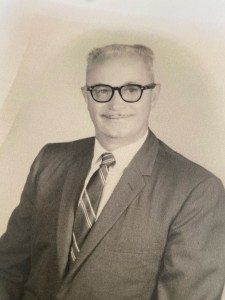
My Dad, my hero, Theodore Roosevelt Slutz, lived to be 94, dying a few months after his wife, our mother, passed away, having celebrated 72 years of the oneness of marriage by the grace of our good God.

By profession I am a soldier and take pride in that fact. But I am prouder—infinitely prouder—to be a father. A soldier destroys in order to build; the father only builds, never destroys. The one has the potentiality of death; the other embodies creation and life.” (General Douglas MacArthur, National Father of the Year, 1942.) My Dad enlisted to be a soldier but was asked to stay home in World War II. He was the kind of father MacArthur spoke of in this statement on “Fatherhood.”

Therefore shall a man leave his father and his mother, and shall cleave unto his wife: and they shall be one flesh.” (Gen. 2:24)

“Who can find a faithful husband, for his price is far above that of a Cadillac or even a Rolls Royce. The heart of his wife doth safely trust in him whether or not he is on a business trip, or comes home late from work. He learns to use the tools of his trade and isn’t afraid of a hard days work. He tries to do the best for his family as long as he lives.” (Note: I do not know who wrote these lines, which parallel the Proverbs 31 wife; if you would like a copy of the complete text, just contact me at trbcpastor@sbcglobal.net.)

Larry Young

(Yesterday, family and friends of Larry Young met in a local funeral home to pay our respects and bid Larry a final farewell. He seemed, at one time, a most improbable convert to Christ. So I share this eulogy, which I delivered in his memory, as a testimony that one should never give up on praying for an unsaved loved one or friend.)

For too, too many years when the Young family—Michele and children—attended church, it was always without the husband/father of the family, Larry. I don’t remember him being present for any of the important spiritual milestones in the lives of his children—baptisms, Awana Awards, Christmas Sunday School programs, graduations, or even the commissioning service of his beloved daughter, Michelle, for missionary service to Africa.

In fact, not only did Larry not attend the happy occasion of Michelle’s commissioning service, he opposed her going to a foreign mission field. Whereas most Dads would have been overjoyed that one of their children had the desire follow Christ’s command to go with the gospel to the world, Larry was anything but delighted at the prospect, and he endeavored with all his might to talk her out of going. But, she went anyway, because she had a Heavenly Father that she answered to first, and His evident call upon her life could not be denied.

I wish Larry had been present on the day, in Cleveland, that Baptist Mid-Missions accepted Michelle’s application to serve under the auspices of BMM as a missionary. The president of the board, Gary Anderson, after Michelle had been thoroughly interviewed by a group of pastors and other board members, announced that Michelle had passed the exam with flying colors. He went on to say, “In fact, if she weren’t a woman, we would have ordained her to the ministry!” I can imagine seeing that slow smile creep over Larry’s face, had he been there that day. But, he wasn’t; and Michelle followed her Lord’s leading all the way to Zambia, to serve as a single gal on the mission field.

In the course of time, though, God got ahold of Larry Young’s heart, as only He has a way of doing. And, there came a day when Larry yielded to the conviction of the Holy Spirit and to the invitation of Jesus—“Come unto me”—and he was gloriously saved and later baptized as a public profession of his faith in the Lord Jesus Christ. He then joined TRBC as a member. From that moment, Larry never again tried to dissuade his daughter from obeying her Savior’s command to “go into all the world, making disciples of all men….and, lo, I am with you always.” That was good enough for Larry—that Jesus was with the apple of his eye, and that he could fully trust her with Him.

When this began to take place, Larry accepted an invitation to engage in a program of one-on-one discipleship. He was at square one—as in, “There is an Old Testament, and there is a New Testament—both are part of what we call the Bible, God’s Word.” Larry was biblically and doctrinally illiterate, but he had one HUGE plus working in his favor: He was, from the moment he put his faith in Jesus Christ as his Savior, indwelt by the Holy Spirit of God. We met, then, each week for an hour or so: learning the books of the Bible, studying basic Bible doctrines, and eventually delving into the meanings of a list of two or three hundred Biblical and theological terms. Larry might have been Biblically illiterate, but this diesel mechanic was anything but stupid—and he had a desire to learn and a determination to grasp the teachings. He was a good student, and grew much.

He was, at the same time, doing something that some would have once believed would never happen: he began to attend church regularly with his wife. The church family soon became Larry’s family, too. He delighted in greeting people; and, though it was not easy for him to maneuver crowded aisles and spaces, he managed to get out of his comfort zone and shake hands with as many people as possible. His once-uncaring countenance turned into a joyful expression of God’s indwelling love in his heart, love for God, love for God’s people, and love for God’s Church. He had surely been born again, and it was evident to all that he was indeed a new creature in Christ Jesus. Larry lived to see his missionary daughter marry Harrison Banda—whom she met when she was serving in Zambia as a single missionary—and was thankful that the Bandas, with their family, were able to serve the Lord in Africa as ambassadors for Christ.

In time, his physical afflictions became more pronounced, and surgeries and disabilities eventually made it impossible for Larry to attend the church services that he so very much loved. But, Larry never lost his kindness, his sweet spirit, and his love for God and for God’s people.

He was lifted up by the most devoted help-meet a man could have asked for, his wife of 43 years, Michele—every day to the last day, Tuesday, August 19, 2025. Early, very early, on that morning, faith became sight for Larry Young, as his spirit took flight from a body wracked with pain. He took up his abode in the heaven of heavens, with the Lord Jesus and others of His body—the Church which, ahead of the much-anticipated Rapture of the Body and Bride of Christ, has already experienced what Paul meant when he said, “Absent from the Body, Present with the Lord.”

No soul sleep there; no special password needed to enter that city not made with hands. Jesus, who had once said to Larry, “Come unto Me,” on Tuesday the 19th said, “Come and dine.” And so he did. And so he is. And we can only rejoice, with those around the throne of God, that another one of His Lambs is safe forever in the Fold, safe in the arms of Jesus. To God be the glory, now and forever. Amen.

And I heard a voice from heaven saying unto me, Write, Blessed are the dead which die in the Lord from henceforth: Yea, saith the Spirit, that they may rest from their labors; and their works do follow them.” (Rev. 14:13)

Glorifying God Through Good Works

“Be ye strong therefore, and let not your hands be weak: for your work shall be rewarded.” (II Chr. 15:7) In this passage, the prophet of God told King Asa and Judah that they should be strong—and if they were, their work would be rewarded. God tells the Church that same thing: “Every man’s work shall be made manifest…the fire shall try every man’s work of what sort it is…if any man’s  work abide, he shall receive a reward.” (I Cor. 3:13)

“And if ye call on the Father who without respect of persons judgeth according to every man’s work.” (I Pet.1:17) To every one of the seven churches that received a special letter from Jesus, (Rev. 2,3) the same word was resounded: “I know thy works.” To the church at Thyatira Jesus said, “I will give unto every one of you according to your works.” (Rev. 2:23)

One of the last words in the Bible to God’s people is: “I come quickly and my reward is with me to give to every man according to his work.” (Rev. 22:12)

All of us probably know that we are not saved by works, but unto works. (Eph. 2:8-10) Though we are not saved by works, works are not in any way diminished in importance: “Even so faith, if it hath not works, is dead, being alone.” (James 2:17) Our works, Jesus taught, are seen by the world, and as such they glorify God: “Let your light so shine before men that they may see your good works and glorify your Father which is in heaven.” (Matt. 5:11)

We would all, if saved, agree to all that has been stated to this point. But one question not often dealt with is, “What is a good work?” Or, “What are good works?” Let me try to answer those questions here, in order that each of us might set ourselves to the task of working…for the night is coming!

The first and most important prerequisite is stated in John 6:28,29: When the Pharisees and others asked Jesus what they could do that “we might work the works of God,” He plainly said that “this is the work of God, that ye believe on Him whom He hath sent.” So, until you have believed on Jesus whom God sent—believe on Him as God’s Son, your Savior—there is no other “work” you can do that would please God. In other words, are you one of His through faith in Jesus Christ?

The second prerequisite is to study the Word of God and “shew thyself approved unto God, a workman that needed not to be ashamed, rightly dividing the word of truth.” (II Tim. 2:15) All scripture, Paul says, “is given by inspiration of God…that the man of God may be perfect, throughly furnished unto all good works.” (II Tim. 3:15,16) So here are some “good” works, or examples of good works, that one might do:

  1. Give God a sacrificial gift. Mark 14:3-6 tells us of a woman (Mary) who, while Jesus was eating in Bethany at the home of Simon the Leper, came with a box of very precious ointment and, breaking the box, poured the ointment on Jesus’ head. Some onlookers at once criticized the woman for having “wasted” this ointment—valued at 300 pence, equal to a year’s wages in that economy—rather than giving the money the ointment could have brought to the poor. Jesus, knowing the heart of the main grumbler, Judas Iscariot, looked him straight in the eye and said, “Let her alone; why trouble ye her? She hath wrought a good work on me.” (Mark 14:6) Christ commended the woman, stating that what she had done was tantamount to anointing His body for burying, and reminding all who were there that wherever the gospel would be preached through the whole world, this devoted woman had done that which would be spoken of as a memorial to her. It was a sacrificial gift; it was a good work.
  1. Feed or clothe a brother or sister who is naked or destitute of food or clothing. James 2:15-17: “If a brother or sister be naked, and destitute of daily food, And one of you say unto them, Depart in peace, be ye warmed and filled; notwithstanding ye give them not those things which are needful to the body, what doth it profit?” Today, there are rescue missions that not only feed and clothe men and women but also preach the life-saving gospel to them. Also, there are mission-ministries ministering to the needs of people in war-torn countries such as Ukraine or Myanmar—giving them food and clothing and other essentials, along with the love of Christ through gospel preaching. These are good works that demonstrate one’s faith.
  1. Do something for God that requires extraordinary faith. Gideon took on a massive Midianite army with a paltry 300 men armed with lamps and pitchers—and won. Rahab—once a harlot—demonstrated her faith by hiding the Israeli spies and helping them escape. James says, “Likewise also was not Rahab the harlot justified by works, when she had received the messengers, and had sent them out another way?” (James 2:25) Go preach on a busy street corner. Peacefully picket an abortion mill. Hand out a gospel tract to someone that you are fearful of (a boss?). Do something that requires, on your part, an extraordinary amount of faith. Do it for His sake—and relying on His power—and it just may be that men will see your good works and glorify your Father who is in Heaven.
  1. Exercise Christian hospitality. Paul spoke of caring for widows, I Tim. 5:10: If the church were to care for any particular widow, she had to have been one who was a widow indeed, and the first qualifier was listed as “well reported of for good works.” A list of those good works included the requirement that she had lodged strangers. Peter exhorts his readers to “use hospitality,” and in Hebrews 13:2 we are exhorted to “be not forgetful to entertain strangers: for thereby some have entertained angels unawares.” Hospitality is surely a “good work”—and one that Christians in America in this 21 century are not taking too seriously.
  1. Help supply necessities to the saints. Dorcas, a widow who died and was brought back to life, was known as a woman “full of good works” because of the coats and garments she made. She never preached a sermon from a pulpit; never went on a missionary trip; and never gave great sums of money to her local church. But from her heart and with her hands she clothed and covered needy saints in and around Joppa, and when she died people wept. You have some skill; some talent that you can give to God—something that you can do, and do well, that many others may not be able to do. Give it to God, small as it may seem. You, like Dorcas, can be “full of good works” to the glory of God.

Be ye strong therefore, and let not your hands be weak: for your work shall be rewarded.” (II Chr. 15:7)

A Brother In Need

This is a real-life, real-time story of the brother or sister who has a need (James 2:15)—and to whom someone who reads these blog posts might be able to lend a helping hand.

Marian Sebastian came to the United States in 1996 from his homeland in Sri Lanka, on the promise of finding work through which he would be able to earn money to send back to his family for their daily sustenance. As is so often the case, the promises were not authentic. They were made by unscrupulous people who planned to take advantage of him. In his own words, Marian says, “I came to America to earn money to buy a house for my family, my children’s education and their future; also to help my father, my brothers and sisters.” After a brief time in Florida, where he was supposed to get a job on a cruise ship, he ended up in Indiana, working in a restaurant for a calloused taskmaster—doing the work of two or three people, 13-15 hours a day, seven days a week.

Understandably, after months of this physical, emotional, and mental daily grind, Marian became very discouraged. “I lost hope. Day by day, my workload increased, and I became more and more depressed due to my feelings of loneliness. I told two other people about my situation, but they did not seem to care about me [and] there was also a language barrier. Finally, I concluded that I was unworthy to live any longer. I missed my wife, children, and country terribly. My body was at the point of exhaustion, and I was falling into deep depression. I resolved to end my life by drinking poison.” That was in September 1998.

Marian ended up in Methodist Hospital for 45 days. A social worker took him to Good News Mission on Indy’s east side, where he has resided ever since: “I lost my esophagus. I now need to be fed through a feeding tube. I still experience a great deal of pain and suffer frequent bouts of depression.”

At the Good News Mission, Marian began attending the evening chapel sessions, hearing the Word of God preached every night by different preachers. In a short time, he threw himself on the mercies of God and trusted in Jesus as his Lord and Savior, following Him in baptism shortly thereafter. He began reading God’s Word voraciously and enrolled in a local Bible college, which he attended for four years. Following his studies in college, Marian attended Indy Reads for several years, studying English. Now he is able to read, speak, and write English fluently. He feels that God has given him a second chance.

Marian has had multiple surgeries to repair his esophagus, but to no avail. He was taken to Mayo Clinic in 2021 for an examination but was unable to receive help there.

While at the mission, Marian has worked as a cook. He joined Thompson Road Baptist Church in 2012 and attends faithfully, participating in prayer meetings as he has opportunity. He prays earnestly, beseeching God’s throne of mercy. When one listens to Marian praying, one feels that he knows how to get in touch with his Heavenly father. His prayers are heartfelt and spiritually moving.

Again, in his words: “I have a confidence with Christ and His cross. The Lord said, ‘Take the cross and daily follow Me.’ (Luke 9:23,34) I have a powerful testimony in my life. The Lord Jesus Christ gave me a second chance of life. Many things the Lord has done for me and my family (for which) I praise the Lord. (Luke 19:10) He is the true and righteous God. The gospel message touched deeply in my heart. Today I am happy because of Christ. I believe one day the Lord Jesus will send me to my country to be united with my family. Amen.”

Marian has a wife and three children. He has received a Sri Lankan passport, is working on a T-Visa, has a legal ID card, and his desire is to have his wife come to the States to visit him. Because he cannot receive the medical help in Sri Lanka that is necessary for him to survive, he cannot visit his home country at this time (though he still holds out hope that he one day will be able to).

I was Marian’s pastor for several years and am still privileged to attend church with him at Thompson Road Baptist Church every Sunday and Wednesday. His love for Christ is genuine, and his testimony I can attest to. He has been accepted and loved and helped by our church family. The Good News Ministries of Indianapolis has been compassionate, generous, loving, and kind to Marian since the day he landed there from Methodist Hospital in 1998. They have provided comfortable housing, transportation, meals, clothing, and much medical assistance. As a pastor, close to Marian, I cannot say enough good about Dan Evans, Director of Good News Ministries, and the GNM staff for their loving kindness to our friend and brother in Christ, Marian Sebastian. They have been the Lord’s lifeline to this once destitute brother for more than a quarter of a century! Asking nothing in return.

How can you help Marian? Well, if there is an employer in greater Indianapolis that could provide a job for 15-20 hours a week, that is what he is praying for. He is limited physically in what he can do, but he still wants to earn some money to send home to his family in Sri Lanka. And, Marian covets your prayers for his family and for God’s continued guiding hand upon his life. If you can be of any help with employment for this brother, just reply to this blog. Or, if you would prefer, you can email Marian directly at sebastianmarian717@gmail.com.

And, pray for Good News Ministries in their amazing haven for the hopeless here in our city. Support it with your prayers and with your giving as God enables you to do so. They are an oasis of grace in this great metropolis.

Bear ye one another’s burdens, and so fulfill the law of Christ.” (Gal. 6:2)

Be Angry and Sin Not (Eph.4:26)

Anger unchecked boils over into acts that reveal the worst side of a person. The elder son of earth’s first marriage, Cain, was the first person in history eaten up with anger. (Gen. 4:5) He had disobeyed God and brought to His creator a sacrifice of his own concoction—rather than one that would answer to God’s commands. As a result, God did not accept Cain’s offering; whereas, righteous Abel obeyed God, brought the sacrifice that God had ordained, and it was accepted. Anger is an upheaval of the spirit that has slain many people since Cain, who in anger murdered his brother, becoming “wroth” with God not long after his parents were banished from the grand Garden of Eden due to their disobedience to God’s stated command. Anger is still one of mankind’s most active antagonists. It will be until time shall be no more.

Solomon wisely said that “He that is slow to anger is better than the mighty; and he that ruleth his spirit than he that taketh a city.” (Provs. 16:32) Alexander the Great, Greek general and world conqueror, learned this in a most agonizing way. The young Alexander was a gifted leader, “energetic, versatile and intelligent.” He was usually quite level-headed, but at times he let his anger control him, to his woeful remorse. One of Alexander’s closest friends, Cletus, on one occasion became drunk, and in his drunkenness began to make fun of the Emperor in front of his men. Blinded by anger, Alexander quickly grasped a spear from a soldier’s hand and hurled it at his drunken friend, with the intent of frightening the general; but, Alexander’s aim was deft, and the spear hit its mark with deadly force, killing the Emperor’s childhood friend. Alexander was never the same, sinking into deep remorse and even attempting to take his own life. For days he lay sick, crying out for Cletus, cursing, and calling himself a murderer. Alexander the Great conquered the world before he was 34 years of age but he never was able to conquer himself—another victim to the sin of anger.

  • The Sin of Anger: Anger is often birthed in rebellion. Man’s spirit stiffens itself against a person, a restriction, a perceived injustice, a jealous spirit, envy, revenge, and a multitude of other avenues that the fallen nature of man is quick to make available. The sin of anger is birthed in rebellion, ultimately, to the rule of God; it is also nurtured in pride and self-centeredness. Lucifer—son of the morning angel before being lifted up in pride and becoming the Devil—was angry that He was not on the throne of God, and in every deed the Devil has ever done there are the sister seeds of pride and anger.
  • The Signs of Anger: A fallen countenance (Gen. 4:5,6); irritableness; impatience, tense voice; glaring stare; hurtful epitaphs, words designed to hurt, explosive threats and actions, silence, clenched teeth, heavy breathing, violent behavior. Almost daily, in most major cities and even small cities, the awful end result of anger is reported on the news: murder.
  •  The Severe Consequences of Anger. Often, people overcome by anger become, as did Cain, fugitives. Cain lost his fellowship with God and, as a result, was made a fugitive and vagabond. (Gen. 4:14) In anguish, Cain remonstrated, “Behold, thou hast driven me out this day from the face of the earth; and from Thy face shall I be hid; and I shall be a fugitive and vagabond in the earth….” (Gen. 4:14) Not only was living as a fugitive one of the severe consequences of anger, but Cain also became a slave to fear: “Everyone that findeth me shall slay me.” Under the law, by God’s grace, people who were unintentional manslayers were able to take refuge in one of several “cities of refuge” provided at God’s instructions. Nothing is worse than living one’s life as a fugitive, immersed day and night in fear. Sin’s consequences are severe and unrelenting.
  • The Sad End of Anger: One person said well that “as long as anger lives, she continues to be the fruitful mother of many unhappy children.” A “resident” some years back in a wildlife park in the state of Victoria, in Australia, became something of a tourist attraction. It seems that a crocodile chewed the pipes in his tank and ate the filter, resulting in his normally green skin turning a bright orange. It is said that the change of color did nothing to improve his temper. His name was Snappy, and his keepers testified that the croc lived up to its name. That happens (with more tragic ends) with God’s creatures, who were created in his image—an image that was darkened by the fall of mankind into sin when our first parents disobeyed God’s command to not eat of the tree in the midst of the garden. So, Cain was overcome by anger: so was Saul, so were Esau and many others whose lives are a testament, in scripture, to the awful fruit of anger. Here is a short list of some other “fruits” of this sin: division, death, divorce, damnation, deceit, disfavor, destruction. That is why we read in the Proverbs: “Make no friendship with an angry man and with a furious man thou shalt not go; lest thou learn his ways.” (Provs. 22:24,25)
  • The Solution for Anger: (1) Do right; (2) Find acceptance (with God and man); (3) Obey God and receive His goodness. “And the Lord said unto Cain, Why art thou wroth? And why is thy countenance fallen? If thou doest well, shalt thou not be accepted? and if thou doest not well, sin lieth at the door.”  (Gen. 4:6,7)

    Be ye angry, and sin not: let not the son go down upon thy wrath.” (Eph. 4:26) “Be not hasty in thy spirit to be angry: for anger resteth in the bosom of fools.” (Eccl. 7:9)