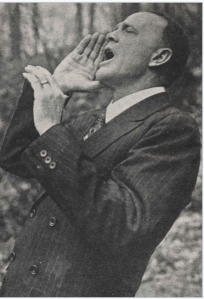
William T. Ellis, in his biography of Billy Sunday, relates the conversion story of the great former Chicago White Sox player. On a street corner in Chicago one Sunday afternoon, upon hearing a group of Christians from the Pacific Garden Mission singing and testifying, Sunday took his stand for Jesus Christ, announcing to his boozing, ball-playing buddies, “I am through: I am going to Jesus Christ. We’ve come to a parting of the ways, boys.” Some of his pals laughed, some mocked, one of them wished him well, and others just sat in silence.
Years later, Sunday related the sad stories of some famous teammates who sat with him that day when he decided to follow Jesus.
“Mike Kelley was sold to Boston for $10,000. Mike got half the purchase price. He came and showed me the check he got for $5,000. John Sullivan, the prize fighter, raised $12,000 to buy Mike a home and they gave him the deed to it. His salary for playing for Boston was $5,000 a year. When Mike died in Allentown, PA, he had spent all that he had made and that was given to him—and they had to take up an offering to get enough money to put him in the ground.”
Ed Williamson, another of Sunday’s buddies, was on a ship crossing the Pacific Ocean with the team when Spalding (a sports equipment company) took them on a playing tour around the world. While crossing the English Channel, a fierce storm arose and the Captain of the ship thought the vessel might be lost. Williamson dropped to his knees and prayed, asking God to bring the ship to harbor and assuring Him that he would sober up and become a Christian. The storm quieted, and the ship made it to safety. But when Williamson got back to the states he opened up a saloon on Dearborn Street in Chicago. Billy Sunday said that when he died, they put him on a table and took out his liver, which was the size of a candy bucket.
Then there was Frank Flint, a famed catcher for 19 years. He worked behind the plate before there were masks, chest protectors, or even gloves, catching bare-handed. There was not a bone in his hands that had not been broken, and his nose and cheeks, shoulders and ribs were all crushed in some fashion. Flint, a heavy drinker, was finally dismissed from the White Sox for his habit. He made his home in the Chicago saloons, and Sunday often said he found Frank sleeping on beer tables. His wife left him due to his drunkenness. One day, Frank staggered out of a saloon and was overcome with a coughing seizure. Blood was streaming down his nose and out of his mouth and eyes. A wealthy woman coming down the street took one look at him and cried out, “Frank, is that you? Oh, my dear!” It was his estranged wife. She came up and kissed the poor, ruined man on the cheek, hailed a cab, and called for the help of two nearby policemen. They hurried Frank to his wife’s house, and the best physicians were summoned. But they said the dying man had, at best, only a few hours to live. When his wife told him that the doctors could do nothing more for him, Frank said, “Send for Billy.” Listen to the pathetic account as Billy Sunday told it:
“They telephoned and I went. Frank said, ‘There is nothing in the life of years ago I care for now. I can hear the bleachers cheer when I make a hit that wins the game. But there is nothing that can help me now. And if the Umpire calls me out now, won’t you say a few words over me, Bill?’ He struggled, as he had a few years ago on the diamond when he tried to reach home, but the Great Umpire said, ‘You’re out!’ and waved him to the club house. He sat on the street corner with me, drunk, 27 years ago in Chicago when I said, ‘Good-bye, boys, I’m through!’ Did they win the game of life, or did Bill?”
Billy won the game of life; they lost because of sin. Some who read these lines may come to the end and the great Umpire will say, “You’re Out!” Beware the Course of sin, the Character of Sin, and the Curse of sin:
- The Course of sin, James 1:14: There is a look, then a lust; a touch, then a taste; a glance, then a gawk; a wish, then a will; a pause, then a pursuit; a handling, holding, and hugging—this is sin’s beginning, a drawing. But after the drawing there is a doing—usually against better judgment; against knowledge, good counsel, previous resolve, but never against one’s will. Then the end of sin, dying: “Wherefore as by one man sin entered into the world, and death by sin.” (Romans 5:12)
- The Character of sin, James 1:15a: Sin entices through the lust of the flesh, the lust of the eyes, and the pride of life. After it entices, it conceives, bearing fruit that multiplies. In every sin, there is seed of another sin: “Twas but a little drop of sin we saw this morning enter in; and, lo, at eventide a world is drowned.”
- The Curse of sin, James 1:15b: Death is the result of sin, both physical and spiritual. The first and final product of sin is death: “The wages of sin is death.” (Romans 6:23a) “In the day thou eatest thereof thou shalt surely die.” (Gen.2:17)
“Sin is a monster of such hideous mien, as to be hated is but to be seen; but seen too oft, familiar with her face, we first endure, then pity, then embrace.” (Hugo)
“But every man is tempted when he is drawn away of his own lust; and enticed. Then when lust hath conceived, it bringeth forth sin; and sin, when it is finished, bringeth forth death.” (James 1:14,15)
 YOU and GOD
As always, Brother Tony, excellent!
Thank you for sharing.
With the heart of a shepherd,
Travis D. Smith
Senior Pastor http://www.HeartofAShepherd.com https://youtube.com/c/HeartofAShepherdInc https://dailytestify.com/index.php/pages/59/
>
LikeLike
I forgot to ask, but would you grant me permission to share your article on my Social media sites?
I can copy the link, and people will be directed to your article.
With the heart of a shepherd,
Travis D. Smith
Senior Pastor http://www.HeartofAShepherd.com https://youtube.com/c/HeartofAShepherdInc https://dailytestify.com/index.php/pages/59/
>
LikeLike