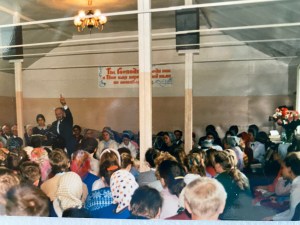
In 1989, through the political engineering of two heads of state, U.S. President Ronald Reagan and the Soviet Union’s Premier, Mikhail Gorbachev, the impenetrable “Iron Curtain” began to crack. The opening made it possible in June of that year for Evangelist Ed Nelson and myself, with Natasha Vins and a few other believers, to take a blitz trip to several Soviet cities—including Moscow, Kiev, Kharkov, Rostov on Don, and St. Petersburg (Leningrad). We visited churches that Natasha had contacted ahead of time.
Natasha Vins’ father, Georgi, along with many other believers in Russia, had been imprisoned for believing in and preaching the gospel. Most of them had been in Siberian prison camps— suffering separation from their families and torture—for their refusal to deny Christ. I had heard of their plight through ministries like Dr. Carl McIntire’s 20th Century Reformation Hour which, in the 1960s, was broadcast on more than 600 U.S. radio stations daily. McIntire, through his radio broadcast and publications, alerted his audiences to the persecution of thousands of believers in Russia, asking that his listeners pray for these brethren. He and other ministries published pictures and brief biographies of those, such as Pastor Vins, who were imprisoned for their faith.
Pastor Vins was deported from Russia in 1978 as part of a prisoner exchange between the Soviet Union and the U.S. State department. He was flown from his cell in Siberia to an interrogation room in Moscow and informed that if he did not renounce Christ he would be deported, never to see his family again. He refused to renounce his Savior, of course, and thus was promptly deported, along with four other “dissidents,” in exchange for five Soviet spies that had been arrested in the United States. Credit can be given to the then President of the U.S., Jimmy Carter, for helping execute this exchange. Eventually, Vins’ family was able to join him in America—including Natasha, who accompanied Pastor Nelson, myself and a few others on our 1989 excursion.
Since I had heard and read of their plight for several years, this was the trip of a lifetime for me, and I am sure for Pastor Nelson, too.* Having Natasha as our guide and trip coordinator was an extraordinary blessing. She knew the churches, pastors, and people, as the underground church in the Soviet Union had been very active and organized in translating, undercover, copies of the Bible and distributing them as widely as possible.
When our plane landed in Moscow on that beautiful June day, we made our way through customs—facing the dubious glares of officials—and were met by someone who directed us to waiting cars, which would take us to our hotel, 30 minutes away. It was incredible that, on the way (the driver drove like Jehu!), we saw a huge billboard not far from the airport that read: “In God We Trust.” It might have been a ploy by the Soviets, but it did give me some relief that in a nation whose official religion was atheism, there was a testimony that God was not dead there, at least for some.
Our first meeting with believers was in a crowded apartment room somewhere in Moscow, where 30 or 40 people—children and adults—packed into the small living room. I do not remember who spoke, but the service began at 7 p.m. and concluded at 10 p.m. The next afternoon, we met with 20 or 30 believers and talked about soul-winning and the Spirit-filled life. We enjoyed a meal of sausage, cheese, salad, and some Russian candy.
The next day, it was off to Kiev—a city that, along with Kharkov and some others that we visited, was not in Ukraine then but in the Soviet Union. We had a well-attended Friday night service in the backyard of a believer’s home, about 20 minutes outside of Kiev, with 100 or so people sitting on the 2×6 benches. Children sat in the front. Songs were generally sung in a minor key, but there were a few that we could sing along with, including “What a Friend We Have in Jesus,” “The Old Rugged Cross,” and “How Great Thou Art.” Saturday morning, we met with about 10 “preacher boys,” and Dr. Nelson spoke on “The Word of God.” He emphasized sermon preparation, and his talk was followed by a question-and-answer time.
Sunday, June 4, we had a service with upwards of 200 present, including some town authorities. A lady—a cousin of Georgi Vins—professed Christ as Savior. At the close of the four-hour service, the Lord’s Table was served. I am not sure what the common cup from which we all drank contained, but I noted that it “burned all the way down.” That evening, we met in a forest clearing and sat on logs for benches. Dr. Nelson preached, followed by a question-and-answer session. The local pastor read I Thess. 3:7-10: “Therefore, brethren, we were comforted over you in all our affliction and distress by your faith: for now we live, if ye stand fast in the Lord. For what thanks can we render to God again for you, for all the joy wherewith we joy for your sakes before our God. Night and day praying exceedingly that we might see your face, and might perfect that which is lacking in your faith.” In every church we visited, there were pastors and lay people who had suffered in Soviet prisons for their faith in Jesus Christ.
At train stations when we departed from Kiev and Kharkov, scores of believers showed up to express gratitude to us for coming to visit. They asked us to bear greetings to churches in America, thanking them for not forgetting their plight and for our prayers for them. That was more than 30 years ago. The world has changed so much since then. Believers we worshipped with in Russia then expressed their belief that the then-open window would not remain open long. And, as we now know, it has pretty much closed in the former Soviet Union. But there are still masses of believers in many places who are now suffering for their faith. It behooves us, with our freedoms, to keep these saints in our prayers, and to not forget the admonition of Hebrews 13:3:
“Remember them that are in bonds, as bound with them; and them which suffer adversity, as being yourselves also in body.”
*Upon returning from our trip, Dr. Nelson arranged and campaigned for the printing and sending of Bible Concordances to Russian pastors.
 YOU and GOD