Add to Your Faith Godliness (6th in Series)

Perhaps you have spent time in the presence of a believer, after which you have said to yourself, “That is the godliest person I believe I have ever been around.” Maybe a mentor, a pastor, a shut-in, a missionary, a mother or father, or someone you met through reading about in a book. Can you remember someone who has left you with the feeling that they possess a godliness that you would like to emulate in your own walk with Christ?

Peter lists godliness as the fifth quality that we ought to add to the building block of faith. (2 Peter 1:6) These are sometimes called the fruits of faith. In Galatians, Paul lists nine “fruit of the Spirit” that are manifest in lives of believers who are yielded to the Holy Spirit and “walking in the Spirit.” (Gal. 5:16,22,23) In that passage, Paul establishes that one who is not walking in the Spirit as a believer is walking in the flesh and is carnal. In 2 Peter 1, Peter concludes that the believer who has not added to his faith these building blocks is barren, blind, and forgetful. (2 Peter 1:8,9) It is imperative, therefore, that we are diligent in adding to our faith each of these Christian distinctives.

Let us consider, then, the quality of godliness: what godliness is not, what it is, where it comes from, and how it manifests itself in a believer’s life.

  1. What godliness is not

a. It is not prosperity: “Perverse disputings of men of corrupt minds, and destitute of the truth, supposing that gain is godliness; from such withdraw thyself.” (I Tim. 6:5) Pharisees in Christ’s time advocated that those who were prosperous, like Abraham and other Old Testament patriarchs, were godly as evidenced in how God had blessed them materially. Job’s friends were operating under this delusion. (Job 15:20,23,29)

b. It is not outward show: “Having a form of godliness, but denying the power thereof.” (2 Tim.3:5) Praying, giving, fasting and other visible acts can at times mimic true worship, so that these acts in and of themselves are not necessarily evidences of godliness. (Matt.6:2; Mark 12:41-44; Luke 18:10 ff.)

c. It is not activity done under the guise of religion. “But refuse profane and old wives’ fables, and exercise thyself rather unto godliness. For bodily exercise profiteth little, but godliness is profitable unto all things.” (I Tim. 4:7,8)

So, the gain, the garish, and the goings of those who mask their motives under the label of religion are not to be confused with what God calls godliness.

  1. What true godliness is

a. Internally, it is a holy disposition of the soul toward God, worship.
b. Externally, it is an expression of the internal disposition; worship translated and transferred into daily action. David’s soul thirsted and panted after the living God, (Ps. 42:1,2) waited upon God, (Ps.62:1) and then exclaimed: “I will praise the Lord with my heart, in the assembly of the upright, and in the congregation.” (Ps.111:1)

  1. Where does godliness come from?

a. It comes as a gift to those who have received eternal life: “According as His divine power hath given unto us all things that pertain unto life and godliness.” (2 Pet.1:3) It is not manifest in the life of a carnal Christian. (Romans 8:5)

b. It comes from knowing God: “Without controversy, great is the mystery of godliness.” (I Tim.3:16) The mystery of godliness, His manifestation in flesh, justification in the Spirit, being “seen of angels, preached unto the Gentiles, believed on in the world, received up into glory,” can be known only by the Spirit of God’s opening the understanding of the believer’s mind and heart unto these precious truths concerning our Savior’s life, death, and resurrection. An intimate knowledge of God will manifest itself in one’s life as true godliness. It is sound doctrine accompanied by sound living: “If any man teach otherwise and consent not to wholesome words, even the words of our Lord Jesus Christ, and to the doctrine which is according to godliness; He is proud.” (I Tim. 6:3,4a)

  1. How Is godliness manifest in a believer’s life?

a. It shows itself in one’s life in such a way that we “may lead a quiet and peaceable life in all godliness and honesty.” (I Tim. 2:2)
b. It causes us to engage in holy pursuits: “Exercise thyself rather unto godliness.” (I Tim. 4:7)
c. It manifests itself in our embracing a proper perspective of life, i.e. that “godliness with contentment is great gain.” (I Tim. 6:6)

We have a mandate for godliness, (I Tim.4:7); a model of godliness in Jesus Christ, “who before Pontius Pilate witnessed a good profession” (I Tim.6:11:13); and a motive for godliness: “Seeing then that all these things shall be dissolved, what manner of persons ought ye to be in all holy conversation and godliness.” (2 Pet. 3:11)

“Teaching us that, denying ungodliness and worldly lusts, we should live soberly, righteously and godly, in this present world.” (Titus 2:12)

 About Lent

Most of us are aware that on what is called “Ash Wednesday,” some of our friends may show up at work with “ashes” on their foreheads, sometimes appearing in the form of a cross. We probably realize that they have been to a service in their church, where their priest dipped his thumb into a vessel of some sort containing ashes, then swiped their forehead with that thumb—making a cross that they wore the rest of the day. Those of us who attend evangelical churches do not practice this custom and probably are not too familiar with it. When we hear of the approach of “Ash Wednesday,” we might well think of “Fat Tuesday,” the day before Ash Wednesday when, at notoriously famous places like New Orleans, there are what appear to be “orgies” of self-indulgence as people supposedly prepare to give up fatty foods and other “luxuries” for the 40 days of Lent—to identify with Jesus, who became poor so that we might become rich. (2 Cor. 8:9)

The word for Lent comes from an old English word “lencten,” which means spring season. Lent is usually observed at that time of the year when the days begin to lengthen, about the 7th Wednesday before Easter, and it lasts until Good Friday. This year, it began February 14 and will end March 28.

The original idea was to set aside a period of a time of personal reflection concerning the events that led up to the crucifixion of Christ. “By observing 40 days of Lent, Christians replicate Jesus Christ’s sacrifice and withdrawal into the desert for 40 days; a season of reflection and preparation before the celebrations of Easter; a time of prayer and penance.” (Wikipedia)

During the time known as Lent, observers give up the enjoyment of something they cherish. It may be sweets, TV, meat, coffee, or some other valued food or habit. They typically “fast” on Ash Wednesday and Good Friday, meaning they only eat one meal on those days.  The sacrifice they make by giving up something that they like very much normally lasts for the duration of the Lenten season.

The “faithful” will begin this season by attending a service where they confess their sins and receive “absolution” from the same by their priest. This is known as the Sacrament of Penance, whereby one is released from the guilt and pain brought on by the commission of sins. They may be required to do certain indulgences, not in order to receive forgiveness but to restore wrongs done to persons who were hurt by their sins.

So, as noted, evangelical churches for the most part do not engage in any Lenten activities. The somber reflection on what Jesus suffered in providing our salvation on Calvary ought to be a daily occurrence of His followers. We do so by reading the wonderful words of His life and death in Scripture; by singing with His Body, the Church, great Hymns of the faith which tell the story of Jesus; by meditation and personal devotion in and through His Word; and by giving our ears and hearts to messages week after week that set forth our Savior in all of His perfections as the “Lamb of God” which taketh away the sins of the world.

All the trappings associated with Lent have been gathered together over the centuries by traditions, and they are not only confusing but unscriptural; in fact, they are anti-scriptural. Nothing in the Bible warrants our confession of sins to anyone but our High Priest, Jesus Christ, alone. Nothing in God’s Word indicates that a “cross” of ashes on our foreheads is in any way a spiritual exercise with biblical precedent; there is nothing Biblical about doing penance, or receiving from a man “absolution” from our sins, or doing “indulgences” as a means of making right any wrongs we have committed.

The above paragraph is an honest attempt to evaluate what our friends who embrace and practice Lenten traditions have been erroneously taught as truth concerning a right approach to the commemoration and celebration of Easter. “Fat Tuesday” is commonly recognized as a day to indulge the “flesh” in an ungodly manner. And giving up certain foods, or “luxuries,” for 40 days to identify with Christ’s fasting for 40 days and nights in the wilderness has nothing to do with Easter. In no way could giving up meat (or anything) for a day or two, or even for 40 days, identify us with what Christ suffered either in the wilderness or on the cross at Calvary.

Because Lent is a fairly common practice today, and because those of us who do not practice the keeping of Lent often do not understand the whys and wherefores of its traditions, I have chosen to write this post. Again, for those of you who do keep Lent who may read this, I have not attempted to offend you in any way. I hope I have fairly represented what you believe to be the reasons for your keeping of this season, and I trust I have challenged you to search the scriptures to compare what you believe about Lent—and how you keep it—with what God’s Word actually says about it. I am surely open to hearing your viewpoint and welcome your response and dialog.

All scripture is given by inspiration of God, and is profitable for doctrine, for reproof, for correction, for instruction in righteousness: that the man of God may be perfect, throughly furnished unto all good works.” (2 Tim. 3:16,17)

Add To Your Faith Patience (5th in series)

Add to your faith virtue; and to virtue knowledge; and to knowledge temperance; and to temperance patience. (II Pet. 1:5,6)

What is more needed in our daily walk with Christ than patience? (Ellen will be glad when she sees that I have come to grips again with patience in this passage; more than anyone, she knows I need a good dose of it!)

In this age of the “instant,” we want things pronto: instant cereal, instant information, instant potatoes, and even instant cash!

But, in spiritual matters, things do not usually come instantly! Certainly, salvation comes instantly upon one’s confession of faith in Christ and repentance toward God, but after that comes a process of spiritual growth and nurturing. Peter urges us in I Peter 1:2 to “desire the sincere milk of the Word,” as a newborn infant, that we may grow thereby; and his last written word to his readers was “grow in grace and in the knowledge of our Lord and Savior Jesus Christ.” (II Pet. 3:18)

No one knew better than the Apostle Peter that patience did not come overnight. He was the one who drew his sword in the garden and cut off the ear of the High Priest’s servant’s son. He was the one who jumped out of the boat naked to run toward his Lord on the sea; He was the one who swore when asked the third time if he were not a follower of Jesus. Peter knew that patience was needful; and so do we. “In patience, possess your souls.” (Luke 21:19); “Be patient to all men.” (I Th. 5:14) “For ye have need of patience, that, after ye have done the will of God, ye might receive the promise.” (Hebs. 10:36) “Let us run with patience the race…before us.” (Hebs. 12:2) “Rejoicing in hope, patient in tribulation.” (Rom. 12:12)

  1. We will need patience in prayer. “And shall not God avenge His own elect who cry day and night unto Him, though He bear long with them?” (Luke 18:7) George Muller, operator of an orphanage in England, once said that he prayed 18 years for something, but he never prayed for anything that God did not answer.

My wife recently listened as a long-time friend of ours shared with her that a son-in-law had recently accepted Christ as his Savior. She had been praying for his salvation for 36 years! God answers prayer. It may be soon, it may be late, but He has promised to hear and answer our prayers.

As I finished typing the previous paragraph, a text notice appeared on my phone. It read, in part: “We have a living God who hears and answers prayers.” This from a person who underwent surgery last week and is recovering without complications. Yes, He does!

  1. We will need patience for progress. “To them who by patient continuance in well doing seek for glory and honor and immortality, eternal life.” (Rom. 2:7) “Be patient therefore, brethren, unto the coming of the Lord. Behold the husbandman waiteth for the precious fruit of the earth, and hath long patience for it, until he receive the early and latter rain. Be ye also patient; stablish your hearts.” (James 5:7-8) Thomas Edison tried 18,000 times and failed until success finally came on try 18,001! Hudson Taylor, missionary statesman and founder of the China Inland Mission, said there were three absolute requirements for a missionary: (1) Patience, (2) Patience, and (3) Patience.
  2. We will need patience in tribulations: “The testing of your faith worketh patience.” (James 1:3) “Tribulation worketh patience.” (Romans 5:3) “Blessed is the man that endureth temptations, for when he is tried he shall receive the crown of life.” (James 1:12)

“Ye have heard of the patience of Job and have seen the end of the Lord that the Lord is very pitiful and of tender mercy.” (James 5:11)

We will not be tested as Job was; but we will be tested, and through every trial we can trust God that He is “growing” us into a patient, productive, fruit-bearing branch in Him who is the vine.

Back when ice-cream sundaes at the old soda fountain were much cheaper, a lad asked the waitress how much a sundae would cost. “50 cents,” she replied, a bit impatiently. The boy reached deeply into his pockets, pulling out a number of coins and carefully counting them, then asked, “How much is a bowl of plain ice-cream?” The waitress, noticing that there were other customers waiting, angrily said, “35 cents.” The lad again carefully counted his coins to the last penny. “I’ll have the plain ice-cream,” he said. The waitress brought the ice-cream and walked away. When the lad finished his ice-cream, he paid the cashier and left. As the waitress came back to pick up the empty bowl, she had to swallow a bit hard when she noticed, carefully placed beside the folded napkin, two nickels and five pennies—her tip!

Yes, let us add to our faith patience!

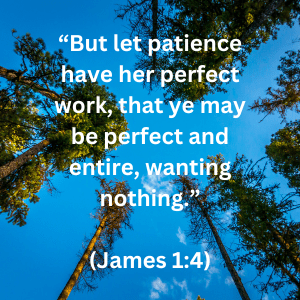
“But let patience have her perfect work, that ye may be perfect and entire, wanting nothing.” (James 1:4)

The Lord’s Supper

Paul mentions in writing to the church at Corinth “the ordinances” that he had delivered to the church. (I Cor. 11:2) The context that follows his praise for the church in keeping the ordinances clearly indicates that one of them is what he calls “the Lord’s supper.” (I Cor. 11: 20) It is sometimes called “the Last supper,” or more often “Communion” or “the Lord’s Table.” The other “ordinance” that Christ commanded is what He instructed His disciples to do after they had made “disciples,” and that was “baptizing them in the name of the Father, and of the Son, and of the Holy Ghost.” (Matt. 28:19,20). So, in most evangelical churches, those two commands of Christ are regularly kept—baptism and the Lord’s supper—as the “ordinances.”

That the Lord’s supper was commanded can be seen in the Upper Room as Christ celebrated the Passover with His disciples on the way to the Garden of Gethsemane and then Calvary. “This do,” He said, as He broke the bread and then passed the cup. Paul would instruct the Corinthian church with “as often as ye eat this bread and drink this cup”; and he would also quote Christ’s Last supper words to the disciples, “this do in remembrance of me,” and “this do ye…in remembrance of me.” (I Cor. 11:24,25). So, clearly, the keeping of this ordinance is not an option, but rather a command originally uttered to His apostles, who would become the foundation of the Church He would build, and then reiterated by the Apostle Paul in instructing local churches. It is a mandate to local New Testament assemblies in all places and for all ages.

But what, then, is the meaning of it? It should be noted that in the Upper Room, Jesus said that the cup that He was passing was the “new testament in my blood which is shed for you.” (Luke 22) This “new testament” (or covenant) contrasts with the old covenant, which was by the blood of bulls and goats. The writer of Hebrews calls this “new covenant” a better covenant, unlike the old covenant which was “faulty,” (Hebs. 8:6ff.) administered by priests daily as a “shadow,” or figure, of the new covenant administered by Christ, our High Priest, “once for all” when He entered the holy place offering “one sacrifice for sins forever”—after which “He sat down at the right hand of God.” (Hebs. 10:10ff.). The bread and the cup, as served by Christ to His disciples at the Last supper, were symbolic of his body and blood, which would be the “once for all sacrifice,” sealing the establishment of a new and better covenant with better promises. The elements of the bread and cup were no more literal than was the door when Jesus said, “I am the door,” or the vine when He said, “I am the vine.” (John 10:7; 15:5).

What are some misunderstandings of the Last supper? Catholic theology and practice approach the “Eucharist” as a sacerdotal sacrament in which the participants—when eating the wafer (bread) and drinking the cup—are literally receiving the physical body and blood of Jesus. This is called “consubstantiation,” and there is no biblical basis for such a doctrine. Reformed groups, primarily Lutherans, hold to what is called “transubstantiation,” which states that the elements of the table, the bread and juice, do not literally become Christ’s body and blood, but that there is some mystical happening that in some way imparts grace to the participant. There is no biblical basis for this doctrine either. In receiving the elements of the table, no physical or non-physical change takes place to the elements or within the participants whereby grace is imparted. To teach that is adding, unjustifiably, to the Word of God through a faulty, false interpretation of the texts.

So, the Communion service, or Lord’s table, as Paul sets forth in I Cor. 11, is a somber, meaningful worship service in which each person is admonished to examine his or her own heart, remembering that Christ offered his body and blood on Calvary for the remission of our sins. To allow sin to govern our lives or dwell in our hearts—knowing that Christ shed His precious blood to provide forgiveness, cleansing, and victory over sin—is a serious matter. Each believer, remembering Calvary at Communion, and examining their heart and confessing any known sin, must approach the table in humility, repentance, thankfulness, and transparency, giving glory to God for the promises of the New Covenant sealed by the blood of Jesus on an old rugged cross.


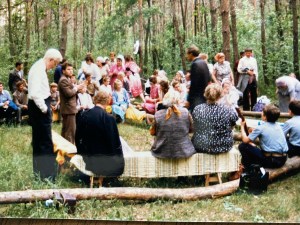
In June of 1989, it was my privilege to visit the Soviet Union with Evangelist Ed Nelson and Natasha Vins, daughter of former imprisoned Russian Baptist pastor, Georgi Vins. At that time, the Soviet Union had not fragmented, and Ukraine was still in what was known as Russia. We visited believers and worshipped in churches in Moscow, Kiev, Kharkov, Leningrad, and other cities. On Sunday, June 4, we met with a church in Kiev where 150 believers were present. The service began at 11 a.m. and concluded with the Lord’s table at 3:30 p.m. I mentioned in my notes that afternoon, concerning the “fruit of the vine,” which every person drank as the common cup was passed from person to person, that it “burned all the way down.” That evening we met in a forest clearing on the outskirts of town with another group of believers. Fallen tree limbs served as benches (pews) while Pastor Nelson preached a message on “The Ascension of Christ.” We stood and joined hands to close the service by singing “God Be With You Till We Meet Again.” Many Russian believers in those services, and in all the meetings we participated in on that trip, either had been in prison for their faith in Christ or had loved ones or pastors who had been. Communion on Sunday morning, June 4, 1989, in Kiev was as precious as communion this side of heaven could be.

For as often as ye eat this bread, and drink this cup, ye do shew the Lord’s death till he come.” (I Cor.11:26)

Add To Your Faith Temperance (# 4 in Series)

Add to your faith temperance. This is the third of seven building blocks that Christians are to add to the foundation of the Christian life. The foundation is faith, without which it is impossible to please God.

It is interesting to note that in the list of the fruit of the Spirit given in Galatians 5, temperance is mentioned there, and it is the only fruit of the Spirit that is also mentioned in Peter’s list of add-ons in II Peter 1. The fruit of the Spirit—such as love, joy and peace—are manifest in the believer’s life when he is yielded to the Holy Spirit. You cannot produce these things; they are solely the result of what the Holy Spirit produces in the life of a yielded child of God.

On the other hand, the seven building blocks listed by Peter are things that are added on to one’s faith, and we can and should be involved in that process. We cannot add love, joy, or peace; they come wholly from the Holy Spirit’s work in our lives. But we can, with diligent and devoted effort, add virtue, knowledge, and patience. The one exception to this list is temperance; it is a fruit of the Spirit, and we can add temperance to our life only as we are yielded to the Holy Spirit of God. But what is it, why do we need it, and how do we get it?

  1. What is temperance?

It is self-control, self-discipline, moderation: “And every man that striveth for the mastery is temperate in all things…I therefore run, not as uncertainly: so fight I, not as one that beateth the air: but I keep under my body, and bring it into subjection: lest that by any means, when I have preached to others, I myself should be a castaway.” (I Cor. 9:25-27)

  1. Why do we need temperance?

(a) For sexual purity so that we will avoid adultery, fornication, uncleanness, lasciviousness, because “marriage is honorable in all and the bed undefiled, but whoremongers and adulterers God will judge.” (Hebs. 13:4) “But fornication, and all uncleanness or covetousness, let it not be once named among you as becometh saints.” (Eph. 5:3) “The truth is, whenever man lies with a woman, whether they like it or not, there is set up between the two, a transcendental relation which must be eternally enjoyed or eternally endured.” (C.S. Lewis)

(b) In what we eat or drink: “For the drunkard or glutton shall come to poverty.” (Prov. 23:21)

(c) In matters mental: to avoid excesses such as anorexia, bulimia, depression, hypochondria, all sorts of phobias: “And the very God of peace sanctify you wholly; and I pray God your whole spirit and soul and body be preserved blameless unto the coming of our Lord Jesus Christ.” (I Thess. 5:23)

Interestingly, when Paul had the opportunity to witness at length of the resurrection of Christ to the Roman Governor, Felix, in Caesarea, he “reasoned of righteousness, temperance, and judgment to come….” (Acts 24:25). Paul would not reason with an unbeliever of that which he could not obtain through self-effort, i.e. love (agape), joy, peace. But, one wonders whether Paul knew from common knowledge that Felix had a problem with self-control in some area such as anger or alcohol or adultery, and thus reasoned with him that there was a path to freedom from this torturing sin—that being through the righteousness and temperance that comes through knowing Christ and being indwelt by the Holy Spirit of God.

  1. How do we get it?

“And grieve not the Holy Spirit of God, whereby ye are sealed unto the day of redemption: let all bitterness, wrath, anger, and clamor and evil speaking, be put away from you with all malice.” (Eph. 4:30,31)

“O that a man would arise in me that the man I am would cease to be!” (Augustine)
“Be ye kind one to another, tenderhearted, forgiving one another even as God for Christ’s sake hath forgiven you.” (Eph. 4:32) Temperance is a fruit of the Spirit which every believer can enjoy as he or she is yielded to the God’s Holy Spirit.

It was the wisest of the wise who said, “He that is slow to anger (temperate) is better than the mighty; and he that ruleth his spirit than he that taketh a city.” (Provs. 16:32) Strive diligently, therefore, to add to your faith temperance through moment by moment yielding to God’s Holy Spirit, who dwells within you as a believer. “Few,” one has opined, “are fit to be entrusted to themselves.” That is true even of believers! But entrusted into the guidance of God, through the work of His Holy Spirit, we can be governed in our spirit, soul, body and mind.

Believers are taught in the Holy Scriptures, by His spirit, to be governed in mind, body and spirit so that our lives will not be a reproach but a rebuke in a godless age that has removed almost every ancient landmark.

“Be not overcome of evil, but overcome evil with good.” (Romans 19:21)

Handling Criticism

John Smith went to church one Sunday morning. He heard the organist miss a note during the prelude, and he winced. He saw a teenager talking when everybody was supposed to be bowed in silent prayer. He felt like an usher was watching to see what he put into the offering plate, and it made him boil. He caught five grammatical errors in the sermon. As he slipped out through the side door during the closing hymn, he muttered to himself, “Never again! What a bunch of clods and hypocrites!”

Jack Jones went to church one Sunday morning. He heard the organist play an arrangement of “A Might Fortress,” and he thrilled at the majesty of it. He heard a young girl take a moment in the service to speak of the difference her faith makes in her life. He was glad to see that his church was sharing in a special offering for the hungry children of Nigeria. He especially appreciated the sermon that Sunday—it answered a question that had bothered him for a long time. He thought, as he walked through the doors of the church, “How can a man enter this place and not feel the presence of God?”

Both men went to the same church on the same Sunday morning. Each found what he was looking for. What will you find next Sunday? (Copied)

None of us like criticism directed to us or our efforts; but most of us understand what was meant by the motto: “If you can’t say anything good about a person, let’s hear it.” We too often don’t mind criticizing others, nor do we mind hearing others criticize others.

Abraham Lincoln said, “If I tried to read much less answer all the criticisms made of me, and all the attacks leveled against me, this office would have to be closed for all other business. I do the best I can. And I mean to keep on doing this, down to the very end. If the end brings me out wrong, then ten angels swearing I had been right would make no difference. If the end brings me out all right, then what is said against me now will not amount to anything.”

“My dear boy,” said a father, “take a word of advice from an old man who loves peace. An insult is like mud; it will brush off much better when it is dry. Wait a little, till he and you are both cool, and the thing will be easily mended. If you go now, it will only be to quarrel.” Good advice for all when our patience is put to the test.

The eighteenth-century English evangelist John Wesley became concerned about wasting good time over less than wholesome talk, so he and eleven of his fellow preachers entered into the following covenant, which they each signed: “It is agreed by those whose names are underwritten that (1) We will not listen, or willingly inquire after any ill concerning each other; (2) If we do hear any ill of each other, we will not be forward to believe it; (3) As soon as possible, we will communicate what we heard by speaking or writing to the person concerned; (4) Until we have done this, we will not write or speak a syllable of it to any other person whatever; (5) Neither will we mention it after we have done this to any other person; (6) We will not make any exception to any of these rules, unless we think ourselves absolutely obliged in conscience to do so.” (Quoted by Leslie Parrott in The Power of Your Attitudes.)

One of America’s beloved poets aptly wrote: “I watched them tearing a building down, a gang of men in a busy town. With a ho-heave-ho and a lusty yell, they swung a beam and a side wall fell.

I asked the foreman, ‘Are these men skilled? And the men you’d hire if you had to build?’

He gave a laugh and said ‘No indeed! Just common labor is all I need. I can easily wreck in a day or two what builders have taken a year to do.’

And I thought to myself as I went my way, which of these roles have I tried to play?

Am I a builder who works with care, measuring life by the rule and square?

Am I shaping my deeds to a well-made plan, patiently doing the best I can?

Or am I a wrecker, who walks to town, content with the labor of tearing down?” (Edgar Guest)

The building of the Panama Canal brought many challenges to George Washington Goethals as he was in midst of the toilsome task. He had more than enough critics scrutinizing his work, picking it apart, criticizing his progress, and prophesying that the canal would never come to completion. Someone once asked the builder if he were not going to answer his critics, to which Goethals replied, “In time.” “How?” The master builder replied simply, “With the canal.” (Stephen Olford, “God’s Refining Cleansing Fire,” Charisma, April 1984)

For with the same judgment ye judge, ye shall be judged; and with what measure ye mete, it shall be measured to you again.” (Matthew 7:2)

Add to Your Faith Knowledge (#3 in series)

It’s not what we eat but what we digest that makes us strong; not what we gain but what we give that makes us rich; not what we read but what we remember that makes us learned; not what we profess but what we possess that makes us a Christian.

And, only if you possess saving faith in Jesus Christ are you a Christian. But faith is only the beginning. Faith results in the new birth, and the new birth issues into a new life. To this saving faith, Peter instructs us to add seven essential building blocks to our life in Christ. We have seen that the first of these is virtue. Virtue is strength of mind, spirit and soul. It manifests itself in the Christian life in spiritual power and spiritual praise.

Next on the list in 2 Peter 1:5 is the basic building block of knowledge. Without faith, one cannot possess virtue; without virtue, one will never realize true knowledge. We are not talking about human knowledge or understanding. Of this kind of knowledge, Solomon said that he who has it increases in sorrow. Paul warned that human knowledge “puffed” up and said that it would eventually “vanish away.” (I Cor. 13:8)

 Consider the NATURE of the knowledge that we should add to our faith:

  1.  It is personal: “That I might know Him, and the power of His resurrection.” (Phil.3:10). Jesus: “This is life eternal that they might know thee the only true God and Jesus Christ Whom Thou has sent.” (John 17:3) Christianity is not a matter of academics—not just ascribing to a creed or confession—but a personal relationship with the Lord Jesus Christ.
  • It is priceless: “But what things were gain to me, those things I counted loss for Christ; yea, doubtless and I count all things but loss for the excellency of the knowledge of Christ Jesus my Lord.” (Phil. 3:7,8) House, degree, job, earnings: nothing in this life, even family, can compare to knowing Christ To know Him aright is life eternal.
  • It is progressive: “But grow in grace and in the knowledge of our Lord and Savior Jesus Christ.” (2 Pet. 3:18) “As new-born babes desire the sincere milk of the Word that ye may grow thereby.” (I Pet.2:2) It takes time. Relationship building is always a process.
  • It is perfecting: “For the perfecting of the saints…till we all come in the unity of the faith and of the knowledge of the Son of God unto a perfect (mature) man.” (Eph. 4:12) A growing knowledge of Jesus Christ will deepen your spiritual life, just as getting to more fully know some people will make you a better person.

Now consider the NECESSITY of the knowledge that we are to add to our faith:

  1.  It is necessary for effectual work: “Who is a wise man and endued with knowledge among you? Let him shew out of a good conversation his works with meekness of wisdom.” (James 3:13)
  • It is necessary for an effectual witness: “My people are destroyed for lack of knowledge.” (Hosea 4:6)
  • It is necessary for an effectual walk: “For this cause we also, since the day we heard it, do not cease to pray for you, and desire that ye might be filled with the knowledge of His will in all wisdom and spiritual understanding; that you might walk worthy of the Lord unto all pleasing.” (Col. 1:19,20)
  • It is necessary for an effectual word: “And I myself also am persuaded of you, my brethren, that ye also are full of goodness; filled with all knowledge, also able to admonish one another.” (Rom. 15:14)
  • It is necessary for an effectual worship: “But I desired mercy and not sacrifice: and the knowledge of God more than burnt offerings.” (Hosea 6:6)

The writer of the book of Hebrews was distressed that many to whom he wrote his epistle had been saved long enough to have been able to teach others; but they were, for the most part, still in need of being taught. (Heb. 5:11-14) Jesus expressed a similar concern when, to Phillip, He said, “Have I been so long time with you and yet thou hast not known me?” (John 14:9)

How long have you been a believer? Are you daily growing in your knowledge of Him? It cannot be done by osmosis. It requires a consistent time with Him and in His Word. Add to your faith virtue, and to virtue knowledge.

That I might know Him, and the power of His resurrection, and the fellowship of His sufferings, being made conformable unto His death.” (Phil.3:10)

Blessed Fleas!

Corrie Ten Boom was imprisoned, with her sister Betsie, in a Nazi concentration camp. It was a filthy, flea-infested place; yet Corrie’s sister insisted that God still wanted them to “in everything give thanks,” for even this was God’s will for them. (I Thess. 5:18) Corrie had a difficult time accepting that until she learned one day why the guards never visited their barracks to insist that they stop praying, singing, and reading the Bible: They wanted to stay clear of the fleas! So, as the sisters learned, even the pesky, totally bothersome fleas were agents of God’s grace and mercies, and were His answers to their prayers.

James, in his New Testament epistle, begins his letter to the persecuted and scattered first-century saints by encouraging them to “count it all joy” when they were beset with trials, tribulations, and adversities. (James 1:1,2)

The Apostle Paul enumerated some of the physical adversities that he had encountered in ministry, and few followers of our Lord have suffered more severe hardships. Yet he wrote to believers in Rome that they should glory in tribulations because they would produce patience in their lives; patience would no doubt bring experience; and, finally, experience would usher in hope. (Romans 5:3,4)

Who has not been visited by trials, tribulations, and adversities? But, consider a lesson from our natural world. Every beautiful snowflake differs from every other snowflake; none is exactly like another. Who has not marveled at their six-point symmetry, grace, and pure white loveliness when they’re gently falling? Truth: at the very core of each of these beauties is a grain of dirt or foreign matter. This minute particle is sometimes as small as one one-hundred-thousandth of a millimeter in size, but those floating particles collect condensation as they tumble through the atmosphere to their final resting place, usually on our streets, walks, driveways, lawns. And, how beautiful they are when fresh fallen! Yet it all began with a foreign, unattractive, maybe even ugly speck out there in space.

We often go through a similar metamorphosis. An unwanted, ugly, foreign matter intrudes into our daily sphere of existence, attaches itself to our life, and hangs on for dear life so to speak. What may have been uninvited, unappealing, and unwanted at the beginning may, when it is all said and done, turn out to be a beautiful blessing in disguise. The heartbreak, illness, and confusion attaching itself to our orb in life clings on through the journey—until maybe, just maybe, it becomes an amazing, surprising source of beauty and blessing.

Former President Richard Nixon, receiving a landslide mandate in 1972 to serve a second term as president before he was forced to leave that office in disgrace in 1974, as a young man had visited the Grand Canyon. He was overcome with the majestic beauty of this giant wonder as he viewed it from the South Rim, looking down at the magnificent, breathtaking, panoramic view. But then, the young future president hiked seven miles down to the floor of the canyon and looked from its depth up to the heights, hearing and seeing the rushing waters of the Colorado River. Nixon would later muse of the experience, “Only then did I fully appreciate the majesty of one of the seven natural wonders of the world. Only when you have been to the depth can you truly appreciate the heights.” (Norman Bales)

Most of us, at one time or another, will find ourselves staring at life from the depths. We will learn how beautiful the heights are when we are at the very bottom. By God’s grace, He will not leave us at the bottom, but with cords of love will pull us to Himself, even as He did His children of Israel who had hit the bottom after 400 years in Egypt. That is why Paul said we could “glory in tribulations,” and James said we could “count it all joy.”

Yes, even the fleas may be agents of His never failing grace.

A pastor was visiting one of his shut-in members when she exclaimed, “How I enjoy the songs of the birds! But there is one that I would rather hear than all the rest—the robin!” “Does he sing more beautifully than the rest,” the pastor asked. The sick lady said, “No, not more beautiful; but the robin is the only one that sings in the storm. When the storms come and the clouds get black and the winds blow, the robin stays out there in the storm and sings its little song.” (copied)

We, too, can thank God for a song that all the storms of life cannot quench! The song of salvation; songs that will buoy us up even in the worst of life’s adversities—so that we can surely “glory” in them all, counting them all joy!

And not only so, but we glory in tribulations also: knowing that tribulation worketh patience; and patience, experience; and experience, hope: and hope maketh not ashamed; because the love of God is shed abroad in our hearts by the Holy Ghost which is given to us.” (Romans 5:3-5)

Add to Your Faith Virtue (# 2 in Series)

Peter, writing a general epistle primarily to persecuted saints who had been scattered throughout their world, (I Pet. 1:1) establishes in the first few verses of his second letter to them that the foundation of any life is, first and foremost, faith. But our experience does not end there. Peter quickly adds that there are several crucial characteristics that followers of Christ must cultivate in our walk with Him. The first of these is virtue.

Virtue is demanded by our calling: “According as His divine power hath given unto us all things that pertain unto life and godliness, through the knowledge of Him that hath called us to glory and virtue.” (II Peter 1:3) A common definition of virtue is “moral excellence.” “Who can find a virtuous woman?” Solomon queries in Proverbs 31:10, and then proceeds to tell us what she looks like. She is a woman of impeccable principle, self-discipline, unabated love for and protection of her family, and conscientious service to the community in which she lives.  

Perhaps one would hesitate to quote John F. Kennedy on the subject of virtue, but what he once said about a person of virtue remains true: “Of those to whom much is given, much is required. And, when at some future date the high court of history sits in judgment on each of us, recording whether in our brief span of service we fulfilled our responsibilities, our success or failure, we will be measured by the answers to the following four questions: Were we truly men of courage; were we truly men of judgment; were we truly men of integrity; were we truly men of dedication?” (Speech before the Massachusetts State Legislature, Jan. 9, 1961. Papers of John F. Kennedy) Our high calling of God in Christ Jesus demands nothing less than to embrace those things in which there is “any virtue.” (Phil. 4:8)

Virtue is also detailed by our character. We ever strive for excellence along with effectiveness. Not “how much” or “how fast” is the key to reaching that goal—but simply “how?” Did we play by the rules? Were we considerate of others? Was our goal to succeed to fulfill a selfish ambition, or to please our God? Edwin Markham, the poet laureate of Oregon (1923-1931), offers some food for thought here: “We are blind until we see nothing is worth the making if it does not make the man. Why build these cities glorious if man unbuilded goes? In vain we build the world, unless the builder grows.” Virtue, detailed by our character, will keep us on track and on target in the building of our life and legacy.

Virtue is deciphered by our composite. Who is the composite you? A beautiful composite portrait of a woman of virtue is, again, painted in Proverbs 31. Gene Getz, in his best-selling book The Measure of a Man, draws from Paul’s composite depiction of the bishop, who must be “blameless…vigilant, sober, of good behavior, given to hospitality…not given to wine, no striker, not greedy of filthy lucre; but patient, not a brawler, not covetous.” (I Tim. 3:2,3) That would be a composite portrayal of a man of virtue. George Washington desired that his life would reflect virtuous qualities: “I hope I shall always possess firmness and virtue enough to maintain what I consider the most enviable of all titles, the character of an ‘honest man.’” If we aspire to the same noble end, it will be because of a personal decision, and through a personal diligence: “I press toward the mark for the prize of the high calling of God in Christ Jesus.” (Phil. 3:14). There was a personal decision and a persistent diligence to allow the Holy Spirit to produce a man who could be deciphered by a composite: virtue.

Finally, virtue is delivered by our contemplation. Paul said, “If there be any virtue…any praise, think on these things.” (Phil. 4:8) “And beside this, giving all diligence,” Peter admonishes. (I Pet.1:5) We must and will find time, in the busyness of the hurry-scurry world in which we live, to join the band of those who have finished their course before us to contemplate His life in us and our life in Him. If indeed, as Peter affirms, He has given unto us “all things that pertain unto life and godliness,” there is no limit as to the contemplative life of the follower of Christ. This of course will not mean that we will be so heavenly minded that we will be of no earthly good; but it will mean that we will be so heavenly minded that we will be of great earthly good.

Add to your faith, then, virtue. It is demanded by our calling, detailed by our character, deciphered by our composite, and delivered by our contemplation.

Finally, brethren, whatsoever things are true, whatsoever things are honest, whatsoever things are just, whatsoever things are pure, whatsoever things are lovely, whatsoever things are of good report; if there be any virtue, and if there be any praise, think on these things.” (Phil.4:8)

“Two Lovers”

I have a poem that I am going to share with you in this column since tomorrow is Valentine’s Day, and our thoughts naturally turn to romance, love, and sweethearts. Isn’t it nice that in the middle of winter we have such a special day that always warms one’s heart as thoughts of “first love,” and life-long love, flood one’s mind? It was 59 years ago this summer that Ellen and I sealed our love with sacred vows, and at a holy altar promised ourselves each to the other. The memory of that night in North Carolina, in that little white-steepled church where we joined hands and hearts in a lifetime journey, is etched into the deepest recesses of my mind and heart. It will be with me as long as I am able to have conscious thoughts.

So I cherish every opportunity to reflect upon that day and all the days that have ensued since—with births, marriages, birthdays, Christmases and, yes, sadly so, even some funerals: all part and parcel of a life adventure that started with young love and longings and matured into a full-bloomed, nurturing love one for the other. It is now, more than half a century later, a love that is still with pleasure yet not without pain, drawing our souls, minds, and hearts ever-more tightly together into that perfect bond of “oneness.”

The poem that follows, “Two Lovers,” speaks to this maturing bonding of a perfect love:

Two lovers by a moss-grown spring:
They leaned soft cheeks together there,
Mingled the dark and sunny hair,
And heard the wooing thrushes sing.
O budding time!
O love's blest prime!

Two wedded from the portal stept:
The bells made happy carolings,
The air was soft as fanning wings,
White petals on the pathway slept.
O pure-eyed bride!
O tender pride!

Two faces o'er a cradle bent:
Two hands above the head were locked:
These pressed each other while they rocked,
Those watched a life that love had sent.
O solemn hour!
O hidden power!

Two parents by the evening fire:
The red light fell about their knees
On heads that rose by slow degrees
Like buds upon the lily spire.
O patient life!
O tender strife!

The two still sat together there,
The red light shone about their knees;
But all the heads by slow degrees
Had gone and left that lonely pair.
O voyage fast!
O vanished past!

The red light shone upon the floor
And made the space between them wide;
They drew their chairs up side by side,
Their pale cheeks joined, and said, "Once more!"
O memories!
O past that is!
O memories! O past that is!

(The author of this poem, “Two Lovers,” was a woman named Mary Ann Evans (1819-1880), who used the pen name “George Eliot” so that her poetry would be more widely read and accepted in 19th century England.)

Ellen and I wish you all a happy, love-filled Valentine’s Day! (O memories! O past that is!)

To every thing there is a season, and a time to every purpose under the heaven…He hath made every thing beautiful in His time.”  (Eccl. 3:1,11)